



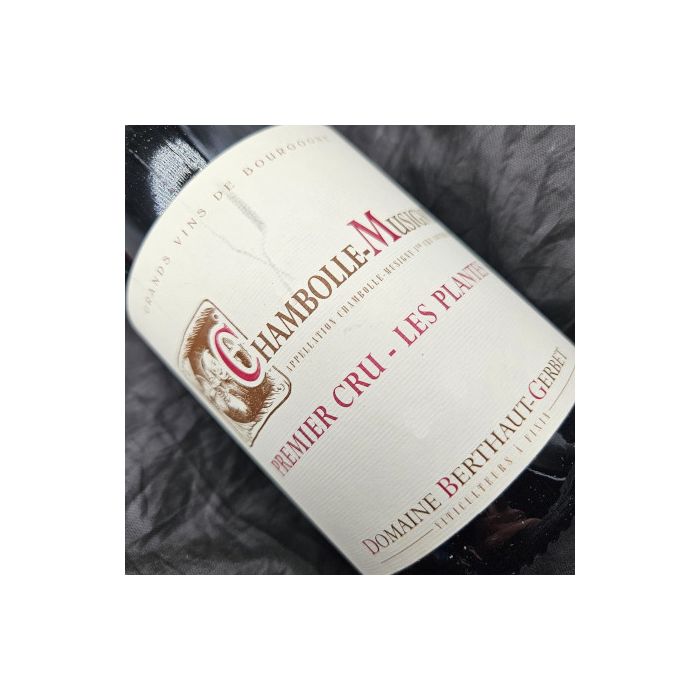
Domain Berthaut-Gernet Berthaut Gerbet Chambolle Musigny Les Plantes 2019 Bottle (75cl)
The 2019 Domaine Berthaut-Gerbet Chambolle-Musigny Les Plantes is a red Burgundy wine from the Chambolle-Musigny appellation. Classified as a Village wine, it is made exclusively from Pinot Noir and originates from the Les Plantes parcel. The estate farms 0.25 hectares of vines planted there between 1950 and 1987 on clay-silt-sandy limestone soils resting on crinoidal limestone. The cuvée is vinified with 30 to 40% whole cluster and aged for 15 months in barrels, 20% of which are new.
The bottle offered
- Size
- Bottle (75cl)
- Packaging
- Loose
- Label Condition
- Perfect
- Fill Level
- Perfect
- Capsule Condition
- Perfect
Wine details
- Couleur
- Red
- Pays
- France
- Région
- Bourgogne
- Appellation
- Chambolle Musigny
- Producteur / Domaine
- Domaine Berthaut-Gerbet
- Parcelle / Cru
- Les Plantes
- Millésime
- 2019
Domaine Berthaut-Gerbet
Based in Fixin, Domaine Berthaut-Gerbet farms 18 hectares spread mainly across Fixin, Gevrey-Chambertin, Vosne-Romanée, and Flagey-Échezeaux. Amélie Berthaut-Gerbet has managed winemaking there since 2013, while her husband Nicolas Faure has been in charge of viticulture since 2017. The estate produces exclusively appellation wines, approximately 90% of which are red, with minimal intervention claimed in both vinification and aging.
- Owner
- Berthaut Gerbet
- Maître de chais
- Amélie Berthaut-Gerbet
- Surface (ha)
- 0,48 ha
Histoire du domaine
The family history begins in Fixin at the end of the 18th century, when the father of François Berthaut farmed a few hectares of vines at 9 rue Noisot. Firmin Berthaut (1845-1920), followed by Bernard Berthaut (1879-1913), succeeded him. After Bernard's untimely death, his widow Jeanne ran the estate until their son Guy came of age. Guy Berthaut took over the estate in 1930; following the Second World War, he developed estate bottling, purchased a house at 18 rue Noisot, and took on sharecropping plots in Gevrey-Chambertin. In the 1960s, he notably opened an export market to the United States. His sons Vincent and Denis, both trained in oenology, succeeded him in 1974 and expanded the vineyard by purchasing vines in Fixin village and premier cru. A new aging cellar was built on the Route des Grands Crus in 2005. The daughter of Denis Berthaut and Marie-Andrée Gerbet, from Domaine François Gerbet in Vosne-Romanée, Amélie joined the estate in 2013 after training as an agricultural engineer and oenologist in Bordeaux. Her father then entrusted her with the responsibility of winemaking. The pooling of all the vineyards from Domaine Berthaut and part of those from Domaine Gerbet gave birth to Domaine Berthaut-Gerbet; this name has been used exclusively on labels starting from the 2015 vintage. Nicolas Faure, Amélie's husband, joined the team in 2017 as vineyard manager.
Les Plantes
Les Plantes is an officially recognized climat for the Chambolle-Musigny Premier Cru denomination, exclusively for red wine. It is located in the central sector of the vineyard, immediately east of the Premier Cru Les Charmes and just below the village. Institutional sources generally describe the Premiers Crus of Chambolle as being on the mid-slope, on clay-limestone soils, but no sufficiently precise pedological or geological characterization of this specific climat alone has been found.
- Vineyard commune
- Chambolle-Musigny
- Origin of the vineyard name
- The BIVB links "Les Plantes" to young vine plantations, traditionally called "plantes" in Burgundy.
Le domaine dans cette parcelle
- Estate holding in the vineyard (ha)
- 0.250000 ha
- Indicative vine age
- Plantings indicated in 1950 and 1987.
Histoire de la parcelle
The AOC Chambolle-Musigny was recognized in 1936, and the list of climats eligible for the Premier Cru designation was established in 1943. Les Plantes appears in the current official list of authorized climats with this designation. The product specifications place this recognition within a medieval plot organization and the historical hierarchization of Chambolle terroirs in the 18th and 19th centuries, without providing a specific chronology for Les Plantes.