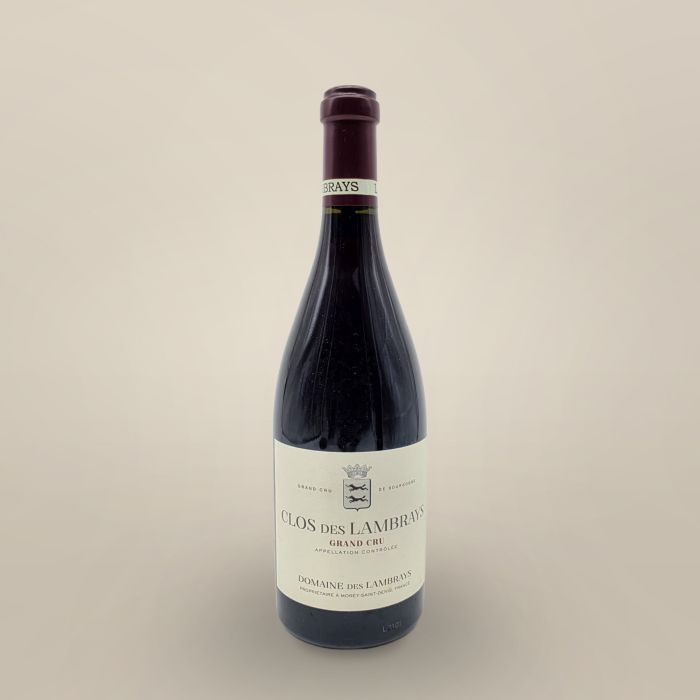
Le Clos des Lambrays is a physically defined climat entirely enclosed by walls, formed by the cadastral lieux-dits Les Bouchots, Les Meix Rentiers, and Les Larrets. Located in the heart of the Morey-Saint-Denis hillside between 260 and 350 meters, it features a gently sloping lower section and a steeper upper section, oriented towards the rising sun. The soils are shallow, clayey, carbonated, and well-draining, beneath a layer of colluvium mixing clays, red silts, gravel, and limestone pebbles. The substratum combines Bajocian crinoidal limestones, marls, and Bathonian limestones in the highest sectors.
- Vineyard commune
- Morey-Saint-Denis
- Exposure
- rising sun, east to slightly south-east
- Altitude
- 260–350 m
- Slope
- gently sloping at the bottom, steeper in the upper section
- Soil
- Shallow, carbonated soils, rich in clay and well-draining, beneath a few decimeters of clayey colluvium with gravel and limestone pebbles.
- Subsoil and geology
- Bajocian crinoidal limestones in the lower section, a marly layer on the slope, and hard, frost-sensitive Bathonian limestone in the upper section.
Le domaine dans cette parcelle
- Estate holding in the vineyard (ha)
- 8.662000 ha
- Vineyard holding status
- Owner of 202 ouvrées; quasi-monopolist of the Clos
- Indicative vine age
- 70% of the vines planted between 1898 and 1935, 28% in 1980, and 2% in 2000.
Histoire de la parcelle
The clos is attested in February 1365 under the name "Cloux des Lambrey" in a property title of the Cîteaux Abbey. Fragmented after the Revolution, it had 74 owners before a long consolidation process initiated in the 19th century. 19th-century wine classifications placed its parcels in first or second class, but the AOC Clos des Lambrays was only officially recognized by the decree of April 27, 1981. The restorations and replantings undertaken in the last third of the 20th century contributed to the restoration of its unity and renown.