



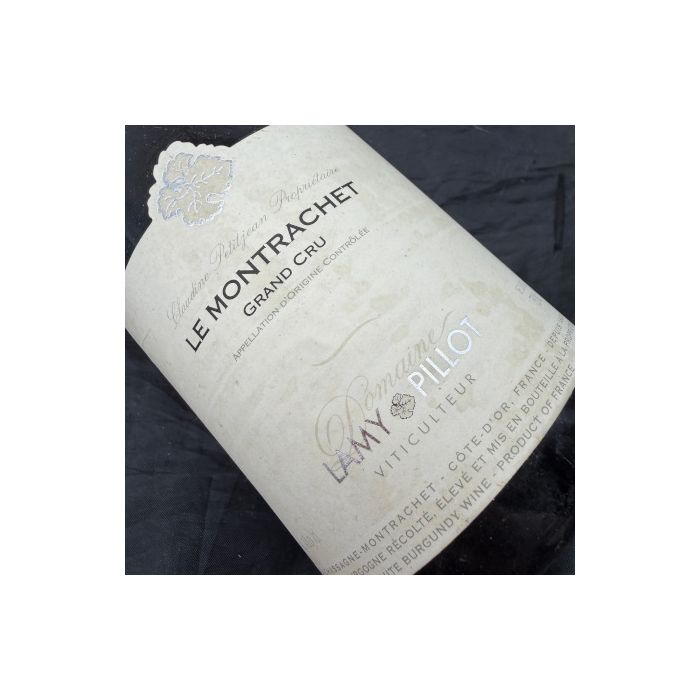
Domaine Lamy-Pillot Montrachet 2000 Bouteille (75cl)
Domaine Lamy-Pillot Montrachet 2000 is a white Burgundy wine, referenced under the Beaune appellation and classified as a Burgundy Premier Cru. Coming from the Montrachet parcel, it is crafted exclusively from Chardonnay. Domaine Lamy-Pillot, established in Chassagne-Montrachet since 1973, anchors this cuvée within the Côte de Beaune vineyards.
The bottle offered
- Size
- Bottle (75cl)
- Packaging
- Loose
- Label Condition
- Perfect
- Fill Level
- Perfect
- Capsule Condition
- Perfect
Wine details
- Couleur
- White
- Pays
- France
- Région
- Bourgogne
- Appellation
- Beaune
- Producteur / Domaine
- Domaine Lamy-Pillot
- Parcelle / Cru
- Montrachet
- Millésime
- 2000
Domaine Lamy-Pillot
The Lamy-Pillot estate is a family-run business based in Chassagne-Montrachet, in the Côte de Beaune, since 1973. It now comprises 12 hectares of vineyards and produces wines from Chassagne-Montrachet, Saint-Aubin, Blagny and Montrachet. The estate is run by Florence Lamy-Caillat and Sébastien Caillat, with the latter overseeing the winemaking process.
- Owner
- Florence Lamy-Caillat et Sébastien Caillat
- Maître de chais
- Sébastien Caillat
- Surface (ha)
- 12.00 ha
Histoire du domaine
The Lamy-Pillot estate was founded in 1973 in Chassagne-Montrachet by René Lamy and Marie-Thérèse Pillot, both from families of winegrowers. The founders settled in the hamlet of Morgeot, where they established their estate and initially worked a few plots, handling the winemaking and marketing of their harvest themselves. Over the years, the estate has expanded its vineyards in the Côte de Beaune. The next generation of the family gradually took over from 1998 onwards. Florence Lamy and her husband Sébastien Caillat are now listed as partners in the National Register of Companies; Florence Lamy-Caillat is the managing director. The estate currently comprises 12 hectares of vineyards. Its plots are situated notably in Chassagne-Montrachet and Saint-Aubin, with wines also produced from Blagny and the Montrachet appellation. The estate produces both white and red wines, with reds accounting for the majority of its production, according to the estate’s website. Sébastien Caillat is listed as the winemaker.
Montrachet
Montrachet is a physically delimited climat and Grand Cru appellation shared between Puligny-Montrachet and Chassagne-Montrachet. Its vines occupy a narrow, elongated strip, perpendicular to the slope, in a slight concavity in the lower part of the east- and southeast-facing hillside. The terroir combines red, clayey, calcareous, and very stony soils with Jurassic substrates differentiated by a fault. Its rapid drainage and nocturnal air drainage limit humidity and frost risks.
- Vineyard commune
- Puligny-Montrachet et Chassagne-Montrachet
- Origin of the vineyard name
- The name comes from "Mont Rachet," understood as "bald mountain" or "barren mountain," probably referring to the sparsely vegetated promontory overlooking the site; "râche" is a regional term designating ringworm or scurf.
- Exposure
- East to southeast
- Altitude
- 250–270 m
- Slope
- Lower part of the hillside; strip perpendicular to the slope
- Soil
- Red, clayey, calcareous, very stony, and well-structured soils; locally lean and very stoney soils.
- Subsoil and geology
- Fault separating two sectors; Oxfordian marls rich in iron oxides over Bajocian/Callovian flaggy limestones, with locally highly fragmented Bathonian limestones.
Le domaine dans cette parcelle
- Estate holding in the vineyard (ha)
- 0.054000 ha
- Vineyard holding status
- Sharecropping; plot belonging to Claudine Petitjean
Histoire de la parcelle
The cru is attested as early as the 13th century in the form "Mont Rachaz." It truly took off in the 18th century under the impetus of the Clermont-Montoison family, lords of Chagny, and Thomas Jefferson placed it on par with Chambertin in 1787. Puligny and Chassagne appended the name Montrachet to their village names in 1878. A Beaune court ruling defined the appellation of origin in 1921, and the Montrachet AOC was subsequently recognized on July 31, 1937.