

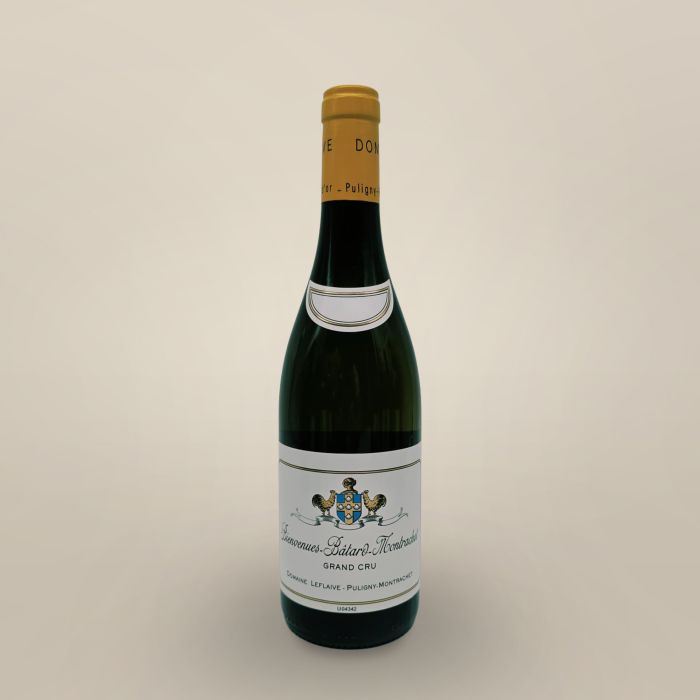
Domain Leflaive Bienvenues Batard Montrachet 2012


The 2012 Domaine Leflaive Bienvenues-Bâtard-Montrachet is a white Burgundy Grand Cru from the Puligny-Montrachet appellation. Made from 100% Chardonnay from the Bienvenues-Bâtard-Montrachet parcel, it was awarded 94-96/100 by The Wine Advocate and 90/100 by James Suckling. The Wine Advocate highlights a complex bouquet, a pronounced mineral structure, and a taut, persistent finish, while James Suckling recommends drinking it now.
Out of stock
€1,056.00 €880.00
Rupture de stock
Une question ? Notre équipe vous conseille sur WhatsApp +33 1 39 70 60 70

La bouteille proposée

Size
Bottle (75cl)
Packaging
Loose
Label Condition
Perfect
Fill Level
Perfect
Capsule Condition
Perfect

Identité du vin

Couleur
White
Pays
France
Région
Bourgogne
Appellation
Puligny Montrachet
Producteur / Domaine
Domaine Leflaive
Parcelle / Cru
Bienvenues-Bâtard-Montrachet
Millésime
2012

Cépage et assemblage

Grape Variety
100% Chardonnay
Domaine

Domaine Leflaive

Domaine Leflaive is a family-run estate based in Puligny-Montrachet, in the heart of the Côte de Beaune. It cultivates 24 hectares of Chardonnay, spread across the appellations of Puligny-Montrachet, Meursault, Chassagne-Montrachet and several grands crus. The estate is run by Brice de La Morandière, representing the fourth generation linked to the Leflaive family.

Owner
Famille Leflaive
Maître de chais
Amandine Brillanceau
Surface (ha)
24.00 ha
Production (average bottles per vintage)
120 000 bouteilles/an

Histoire du domaine

The Leflaive family has been based in Puligny-Montrachet since 1717 and at that time owned a few vineyards, the grapes from which were sold. The estate in its modern form was established by Joseph Leflaive (1870–1953), an engineer by training, who returned to manage the family estate following the phylloxera crisis. From 1920 onwards, he embarked on a programme of replanting, acquiring and developing the vineyards, with the support of his estate manager, François Virot. He gradually began marketing the wines under his own label, whilst the first bottles were exported to the United States between 1932 and 1939. Following his death in 1953, his children Jo, Jeanne, Anne and Vincent kept the estate together and established a civil partnership in 1973. Jo took charge of administration and finances, whilst Vincent oversaw the vineyard, the wines and their marketing. Olivier Leflaive became co-manager alongside Vincent in 1986, then Anne-Claude Leflaive joined the management team in 1990 before being appointed manager in 1994. Under her leadership, the estate gradually adopted biodynamic farming during the 1990s. Following her death in April 2015, her nephew Brice de La Morandière, the great-grandson of Joseph Leflaive, became managing partner. Since January 2025, Amandine Brillanceau has held the post of technical director; Louis Brière is cellar master at Puligny-Montrachet.

Parcelle & terroir

Bienvenues-Bâtard-Montrachet

Bienvenues-Bâtard-Montrachet is a physically delimited climat of Puligny-Montrachet, also constituting a Grand Cru Appellation d’Origine Contrôlée reserved for white wines. It occupies the lower part of the slope, with an east and south-east exposure, at an altitude of approximately 250 meters. Clayey colluvium, relatively poor in limestone pebbles, covers a Callovian subsoil of slab limestones, which favors drainage.

Vineyard commune
Puligny-Montrachet
Exposure
East to south-east
Slope
Lower part of the slope
Soil
Irregular clayey colluvium, fairly poor in limestone pebbles
Subsoil and geology
Middle Jurassic slab limestones, Callovian stage

Le domaine dans cette parcelle

Estate holding in the vineyard (ha)
1.150000 ha
Vineyard holding status
Owner of a single plot
Indicative vine age
Plot planted in 1958 and 1959.

Histoire de la parcelle

In the 18th century, the wines from the "Bienvenues" climat still appear to have been grouped with those of Montrachet or Bâtard. A court ruling in 1921 established the hierarchy of the grand crus of Puligny-Montrachet, and then the plot area of Bienvenues-Bâtard-Montrachet was individualized and recognized under the "grand cru" designation in 1939.

Critiques professionnelles

Notes & cotations

The Wine Advocate 94-96/100
Reviewed by
Neal Martin
Published

The 2012 Bienvenue-Batard-Montrachet Grand Cru possesses a wonderful, complex bouquet with orange zest, apricot blossom, minerals and white peach that wafts enticingly from the glass, gathering momentum with aeration. The palate is medium-bodied with a crisp, effervescent entry. The mineral-core is more pronounced here than the premier crus, with a taut piercing finish that feels very persistency in the mouth. Superb. Anne-Claude Leflaive made a brief appearance during my tasting at the domaine since she was hastening off to Italy. I have been visiting here for as long as I can remember, first meeting former winemaker Pierre Morey in the 1990s. Back in those days, the tenets of biodynamism were evident, although back then I did not really understand them. Today, there is almost evangelism towards Steiner’s philosophy, not in a monomaniacal sense, rather a strong belief that Anne-Claude’s wines would be pale shadows without them. Parking outside their gates, it was good to be back after a three-year absence. Nothing much had changed. On this occasion it was Antoine Repetit de la Bigne who escorted me down to the stainless-steel vats where the final blends were resting prior to bottling, which is where I always taste. I wondered whether finally I would hear “Oui” when I ask whether I could taste their single barrel of Montrachet? I decided not to ask. That would be rude. Antoine told me that the harvest began on September 14 and everything was picked by September 21. Of course, I had to bring up the topic of hail damage. Antoine explained that here it was de facto the second hail storm on August 1 that inflicted the most damage, particularly on their parcels of village cru. In the end, Leflaive ended up losing approximately half their crop depending up the vineyard. “Fortunately it was just before veraison so the berries did not have a lot of juice in them,” Antoine informed me, clambering up the ladder to dip his pipette into another vat. “Curiously, even the big berries had little juice. It was important to apply the treatments quickly so that the vines do not become stressed and retard the vegetative cycle. We used nettle and velarian (a source of phosphorous) that were both very effective. Then when it came to sorting, the vibrating table de trie was crucial.” Many of the treatments had to be done on foot, much to the chagrin of the team plodding through the vines in their heavy muddy boots. Usually for the last three years it has been horses hooves in the vineyard. However, in 2012 it was found that two human legs were better than four equine ones. It is always an intellectual as well as satisfying sensory exercise tasting through Anne-Claude Leflaive’s wines. It always serves as a lesson in terroir expression: same grape, same approach. As so often I find, those not wishing to spend too much money ought to head directly from their village cru, their Puligny-Montrachet one of the finest you will find in Cote de Beaune. Beyond that, well each year springs up a different premier cru that catches you off guard. Myself, I was taken with stunning Les Pucelles due to its precocity and intensity that lifted it equal to the grand crus. Others might prefer something subtler. I do not think Anne-Claude wines are beyond criticism. Sometimes the aura that veils the estate and Anne-Claude herself, creates a shield so that they are impermeable to dissenting comments. Biodynamics itself has never precluded an intrinsically superior wine to one where a load of chemical was dumped onto the vineyard. The question is more: if given the choice, which would you prefer to put in your mouth? Antoine hands me a copy of his paperback entitled “What’s so Special About Biodynamic Wine.” I read the chapter on wine critics on the way home. I agree with him that we should strive to taste as much as possible at the domaine, but at the end of the day, a biodynamic wine should not be critiqued with preferential treatment. Whether Anne-Claude Leflaive’s Chevalier-Montrachet is biodynamic or not is irrelevant. I am more interested in its intrinsic qualities vis-a-vis their Les Pucelles or Bienvenue, vis-a-vis the Chevalier-Montrachet from Alain Chavy, Jean Chartron, Etienne Sauzet or Michel Niellon. And the Chevalier-Montrachet here is a sublime expression of the vineyard no doubt destined to age with grace and style. That is what matters. You may have noticed there is no Montrachet note here. The reason is not personal. Just that there is so little that it is being matured in a specially made small barrel, which renders the elevage extremely sensitive and fragile (see Frederic Barnier’s comments about his Criots-Batard-Montrachet.) I would not want to ruin what little there is for the sake of vanity. Importer: Wilson-Daniels, St. Helena, CA; tel. (707) 963-9661

James Suckling 90/100
Published

Fully developed nose with plenty of bitter orange and bergamot, plus some summer-meadow character. Very mature, full-bodied palate with an intense, bready character. The firm tannins hold all this together, but will not suit everyone’s palate. Just enough acidity. From biodynamically grown grapes. Drink now.

Votre avis sur Domain Leflaive Bienvenues Batard Montrachet 2012
How Do You Rate This Product?
Sell Your Wine Cellar
Vous possédez des bouteilles de Domain Leflaive Bienvenues Batard Montrachet 2012
Vendez vos bouteilles au meilleur prix
Offre complète
Notre offre complète au format PDF
Consulter l’offre complète PDF
Livraison & règlement
Livraison et règlement
Voir les modalités
WhatsApp Chat WhatsApp Chat