




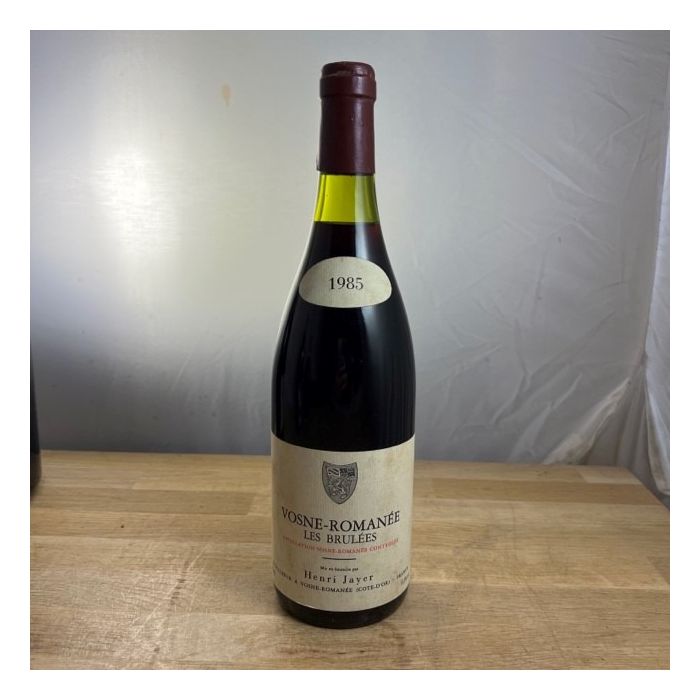
Domain Henri Jayer Vosne Romanee Les Brulees 1985
Domaine Henri Jayer Vosne-Romanée 1er Cru Les Brulées 1985 is a red Burgundy wine from the Aux Brulées parcel in the Vosne-Romanée appellation. Crafted from 100% Pinot Noir, it comes from 55-year-old vines. The Wine Advocate awards it 91/100 and describes a supple, smoky, highly concentrated wine driven by intense and precise Pinot Noir fruit. The publication indicated favorable evolution at least until between 1997 and 2003.
La bouteille proposée
- Size
- Bottle (75cl)
- Packaging
- Loose
- Label Condition
- Perfect
- Fill Level
- Perfect
- Capsule Condition
- Perfect
Identité du vin
- Couleur
- Red
- Pays
- France
- Région
- Bourgogne
- Appellation
- Vosne Romanée
- Producteur / Domaine
- Domaine Henri Jayer
- Parcelle / Cru
- Aux Brulées
- Millésime
- 1985
Cépage et assemblage
- Grape Variety
- 100% Pinot Noir
Domaine Henri Jayer
Henri Jayer refers to the Vosne-Romanée winemaker Henri Jayer (1922–2006) and the wines he produced in Burgundy. His estate no longer exists as an independent wine-producing estate: the vineyards were gradually handed over to his nephew Emmanuel Rouget, whilst Cros-Parantoux is now run by Emmanuel Rouget and, in part, by the Méo-Camuzet estate.
Histoire du domaine
Born in Vosne-Romanée in 1922, Henri Jayer took over the family estate in 1939, at the age of 16, when his brothers were called up for military service. He then went on to study oenology in Dijon. His estate initially covered 3.5 hectares spread across Vosne-Romanée, Nuits-Saint-Georges and Échézeaux. After the war, he also worked as a sharecropper on vineyards that did not belong to him. In 1950, he entered into a sharecropping agreement with Maria Noirot-Camuzet for Cros-Parantoux, a plot of land in Vosne-Romanée that was then lying fallow, almost all of which he subsequently acquired. He began bottling some of his wines under his own name in 1959. Having initially blended Cros-Parantoux into his Vosne-Romanée village wine, he began vinifying it separately from 1978 onwards. His winemaking practices were based in particular on careful soil management, moderate yields, the complete destemming of the harvest and the use of new oak barrels. Emmanuel Rouget, his nephew, began working with him in 1976 and gradually took over the estate; by 2001, all of Henri Jayer’s vineyards were under his control. Henri Jayer died in Dijon on 20 September 2006. Two-thirds of Cros-Parantoux now belong to Henri Jayer’s two daughters and are managed by Emmanuel Rouget; the remainder is managed by the Méo-Camuzet estate.
Aux Brulées
Aux Brulées is an officially recognized climat for the Vosne-Romanée Premier Cru appellation, located on the slope northwest of the Richebourg grand cru, near Cros Parantoux and Les Beaux Monts. Viticultural mapping also links part of the La Combe Brulée cadastral lieu-dit to this appellation. Institutional sources generally describe the terroirs of Vosne-Romanée as east-facing, on carbonate soils mixing limestone elements, clayey marls, scree, and fine particles, but they do not provide a distinct and complete pedological characterization for Aux Brulées alone.
- Vineyard commune
- Vosne-Romanée
- Origin of the vineyard name
- The name refers to the ancient practice of paring and burning, which means clearing or cultivating land by burning.
Le domaine dans cette parcelle
- Vineyard holding status
- Sharecropping agreement with the Noirot-Camuzet and then Méo families, ending after the 1987 vintage
- Indicative vine age
- Original planting dating mostly from the 1930s for the Méo-Camuzet parcels farmed by Jayer.
Histoire de la parcelle
The toponymy of Aux Brulées preserves the memory of land clearance by paring and burning carried out to establish certain vineyards. The AOC Vosne-Romanée was recognized by decree on September 11, 1936. In 1943, Aux Brulées was integrated into the recognized list of climats eligible for the Premier Cru designation, a list based on the classification of Côte crus established in the 19th century; the current product specification confirms this designation and also partially includes La Combe Brulée in its cadastral correspondence.


