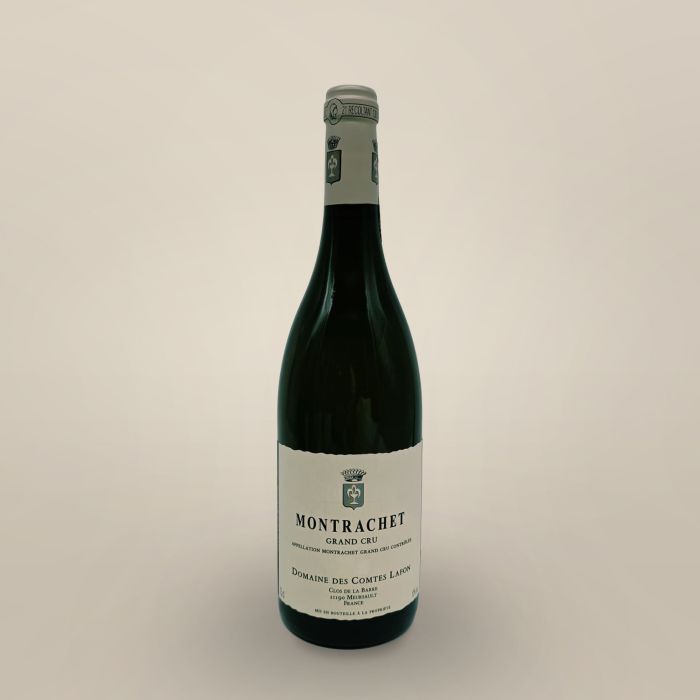
Domain Comtes Lafon Montrachet 1999


The 1999 Domaine des Comtes Lafon Montrachet is a white Burgundy wine from the Montrachet Grand Cru. Produced by Domaine des Comtes Lafon from 100% chardonnay, it combines richness, amplitude, and precision. The Wine Advocate awards it 93-95/100, describing it as harmonious and refined, driven by notes of flowers, white-fleshed fruit, minerality, toast, and spices, with a satin texture. Jancis Robinson rates it 17.5+/20, highlighting its savory intensity, depth, and distinct evolution in the glass. Published tasting windows: 2004-2012 and 2008-2024.
stock: 1
Special Price €2,760.00 €2,300.00 Regular Price €3,000.00 €2,500.00
En stock 1 bouteille disponible
DHL Express delivery: approx. 2 business days
Estimated transit time after handover to DHL. Varies by destination.
Une question ? Notre équipe vous conseille sur WhatsApp +33 1 39 70 60 70

The bottle offered

Size
Bottle (75cl)
Packaging
Loose
Label Condition
Perfect
Fill Level
Perfect
Capsule Condition
Perfect

Wine details

Couleur
White
Pays
France
Région
Bourgogne
Appellation
Puligny Montrachet
Producteur / Domaine
Domaine des Comtes Lafon
Parcelle / Cru
Montrachet
Millésime
1999

Cépage et assemblage

Grape Variety
100% Chardonnay
Domaine

Domaine des Comtes Lafon

The Domaine des Comtes Lafon is a family-run estate based in Meursault, in the heart of the Côte de Beaune. Its vineyards are spread across Meursault, Volnay, Monthélie and Chassagne-Montrachet, notably including plots in Meursault’s Premier Cru vineyards and Montrachet’s Grand Cru vineyard. The estate is currently run by Léa and Pierre Lafon, whilst Jérôme Delassus is listed as cellar master.

Owner
GFA du Domaine des Comtes Lafon (famille Lafon)
Maître de chais
Jérôme Delassus

Histoire du domaine

The estate’s history is linked to Jules Lafon, a native of Tarn-et-Garonne, who was transferred to Dijon in 1887 as part of his role at the Administration of Registration, Estates and Stamps. In 1894, he married Marie Boch, who came from a family of wine-growers and merchants in Meursault, marking the start of his involvement in the village’s wine industry. Having become a lawyer, Jules Lafon was granted the title of Papal Count in 1918, which would give the estate its name. He gradually acquired several Meursault Premier Crus, including Genevrières, Perrières and Charmes, as well as a plot in Montrachet in 1918. As mayor of Meursault, he played a part in reviving the Paulée de Meursault in 1923, before giving up his legal practice in 1931 to devote himself to the estate. Following his death in 1940 and that of his son Pierre in 1944, the estate – which was then largely run on a sharecropping basis – was on the verge of being sold. René Lafon took over the management in 1956, and the entire production has been bottled at the estate since 1961. Dominique Lafon succeeded his father in 1984 and gradually reclaimed the plots previously entrusted to sharecroppers, a process completed in 1993. Under his leadership, the estate adopted organic farming and then biodynamic practices between 1995 and 1998. Léa Lafon joined the estate in 2019 and Pierre Lafon in 2020; they now run the estate, with Jérôme Delassus as cellar master.

Parcelle & terroir

Montrachet

Montrachet is a physically delimited climat and Grand Cru appellation shared between Puligny-Montrachet and Chassagne-Montrachet. Its vines occupy a narrow, elongated strip, perpendicular to the slope, in a slight concavity in the lower part of the east- and southeast-facing hillside. The terroir combines red, clayey, calcareous, and very stony soils with Jurassic substrates differentiated by a fault. Its rapid drainage and nocturnal air drainage limit humidity and frost risks.

Vineyard commune
Puligny-Montrachet et Chassagne-Montrachet
Origin of the vineyard name
The name comes from "Mont Rachet," understood as "bald mountain" or "barren mountain," probably referring to the sparsely vegetated promontory overlooking the site; "râche" is a regional term designating ringworm or scurf.
Exposure
East to southeast
Altitude
250–270 m
Slope
Lower part of the hillside; strip perpendicular to the slope
Soil
Red, clayey, calcareous, very stony, and well-structured soils; locally lean and very stoney soils.
Subsoil and geology
Fault separating two sectors; Oxfordian marls rich in iron oxides over Bajocian/Callovian flaggy limestones, with locally highly fragmented Bathonian limestones.

Le domaine dans cette parcelle

Estate holding in the vineyard (ha)
0.320000 ha
Year the vineyard was acquired
1918
Vineyard holding status
owner
Indicative vine age
80% of the plot planted in 1953 and 20% in 1972.

Histoire de la parcelle

The cru is attested as early as the 13th century in the form "Mont Rachaz." It truly took off in the 18th century under the impetus of the Clermont-Montoison family, lords of Chagny, and Thomas Jefferson placed it on par with Chambertin in 1787. Puligny and Chassagne appended the name Montrachet to their village names in 1878. A Beaune court ruling defined the appellation of origin in 1921, and the Montrachet AOC was subsequently recognized on July 31, 1937.


Critiques professionnelles

Notes & cotations

The Wine Advocate

93-95/100
Reviewed by
Pierre Rovani
Published
Drink Date
2004 - 2012

Lafon's 1999 Montrachet is one of the vintage's few blockbuster. Boisterous flowers, minerals, and pears can be discerned in its explosive aromatics. Medium-bodied and impeccably delineated as well as nuanced, this rich, broad, and opulent wine is exceptionally refined. Satin-textured and loaded with stones, pears, apples, toast, hints of creme brulee and vanilla bean, this is a powerful, harmonious, elegant, and complete wine. Its majestic finish displays buttered pain grille as well as a myriad of spices. Projected maturity: 2004-2012. Importers: Various including Classic Wine Imports, Boston, MA; tel: (617) 731-6644, and Ex Cellars, Solvang, CA; tel (805) 686-9153.

Jancis Robinson

17.5/20
Reviewed by
Jancis Robinson
Published
Drink Date
2008 - 2024

Like the Leflaive wine, this is made from similarly situated vines also cultivated biodynamically – since 1996 whereas Leflaive converted to biodynamism slightly later. Perhaps because it followed the Leflaive example, the impact of this wine was slightly less dramatic. Initially it was relatively reticent on the nose but it was, infuriatingly, opening up most convincingly as I had to leave. In fact of all the wines, this was the one that changed most in the glass – a good sign. There's something molten and golden about the flavour with an overlay of smoke. Very chunky, savoury and intense. This should be kept a very long time.

Votre avis sur Domain Comtes Lafon Montrachet 1999
Sell Your Wine Cellar
Vous possédez des bouteilles de Domain Comtes Lafon Montrachet 1999
Vendez vos bouteilles au meilleur prix
Offre complète
Notre offre complète au format PDF
Consulter l’offre complète PDF
Livraison & règlement
Livraison et règlement
Voir les modalités
WhatsApp Chat WhatsApp Chat