



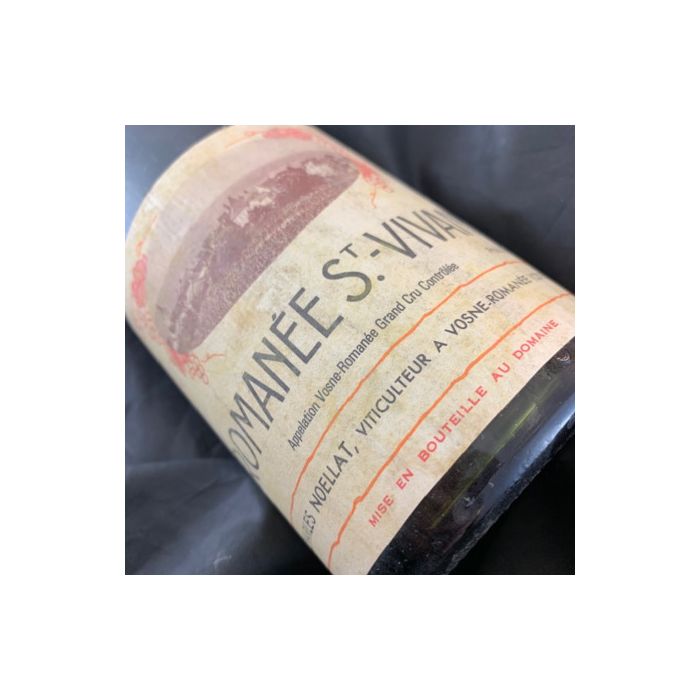
Domaine Charles Noellat Romanee Saint Vivant 1957 Magnum (150cl) -7.5cm ELA CLA
The 1957 Domaine Charles Noellat Romanée-Saint-Vivant is a red Burgundy wine from the Romanée-Saint-Vivant climat in Vosne-Romanée, classified as a Grand Cru. Crafted exclusively from Pinot Noir, it comes from a historic parcel of the estate located in one of the grand crus of the Côte de Nuits. In the 1930s, Domaine Charles Noëllat owned approximately 25 hectares of prestigious appellations around Vosne-Romanée, including Romanée-Saint-Vivant, and was among the pioneers of estate bottling.
La bouteille proposée
- Size
- Magnum (150cl)
- Packaging
- Loose
- Label Condition
- Slightly Damaged
- Fill Level
- -7.5cm
- Capsule Condition
- Lightly Damaged Capsule
Identité du vin
- Couleur
- Red
- Pays
- France
- Région
- Bourgogne
- Appellation
- Vosne Romanée
- Producteur / Domaine
- Domaine Charles Noellat
- Parcelle / Cru
- Romanée-Saint-Vivant
- Millésime
- 1957
Cépage et assemblage
- Grape Variety
- 100% Pinot Noir
Domaine Charles Noellat
Domaine Charles Noëllat was a vineyard in Vosne-Romanée, established in the early 20th century by Charles Noëllat and his wife Anne-Marie, known as Laure. Its vineyard, which included plots in Romanée-Saint-Vivant, Richebourg and Grands-Échezeaux, was broken up after 1987; the majority of the remaining land was sold to Lalou Bize-Leroy in 1988. Since 2013, a separate Maison Charles Noëllat has been reviving the family name through the selection, ageing and marketing of Burgundy wines, without this constituting a takeover of the historic wine estate.
Histoire du domaine
The Noëllat family has been involved in Burgundian wine-growing since the 17th century and was originally based in Meuilley, near Nuits-Saint-Georges. In the 19th century, Félix Noëllat established the family estate in Vosne-Romanée. His son Charles Noëllat, born in 1868, founded the estate bearing his name in the early 20th century with his wife Anne-Marie, known as Laure. Having been called up during the First World War, Charles left Laure to continue managing and developing the estate. By the 1930s, the estate covered around 25 hectares and included plots in several appellations of the Côte de Nuits, including Romanée-Saint-Vivant. Charles died in 1939; following the death of their son André in 1941, Laure and their daughter Geneviève ensured the estate’s continuity throughout the war. In 1947, Christian Moreau, Geneviève’s husband, joined the business. Their daughter Anne-Marie took over its management in 1976. Following Geneviève’s death in 1987, disputes over the estate led to the vineyard being broken up; the largest remaining portion, reported to be 12 hectares at the time of sale, was acquired by Lalou Bize-Leroy in 1988 and incorporated into Domaine Leroy. The current Maison Charles Noëllat was relaunched in 2013 by Stéphane, a descendant of Charles Noëllat, and Antoine Laurent; it selects Burgundy wines and ages and bottles its ‘Hommage à Bligny-lès-Beaune’ range.
Romanée-Saint-Vivant
Romanée-Saint-Vivant is a physically demarcated climat of Vosne-Romanée corresponding to a Grand Cru appellation reserved for red wines. Located on a gentle piedmont plateau overlooking the village, between 247 and 260 meters, it slopes gently eastward. Its shallow, clayey, carbonate-rich soils with high iron oxide content cover a well-draining limestone subsoil, with a conglomeratic formation in its eastern part.
- Vineyard commune
- Vosne-Romanée
- Origin of the vineyard name
- The name "Romanée de Saint-Vivant" is recorded in 1765. "Romanée" was borrowed from a small neighboring parcel, while "Saint-Vivant" recalls the Cluniac monastery that historically owned the vineyard.
- Exposure
- eastward
- Altitude
- 247–260 m
- Slope
- gentle slope on a slight plateau
- Soil
- Slightly developed, carbonated, and shallow soils, heavily clayey, rich in iron oxides; colluvium of scree, clays, and silts.
- Subsoil and geology
- Bajocian entroquitic limestones; to the east, a conglomerate of limestone blocks in a salmon-pink marly matrix.
Le domaine dans cette parcelle
- Year the vineyard was acquired
- 1925
- Vineyard holding status
- Former owner; estate fragmented and remaining part sold in 1988
Histoire de la parcelle
The Cluniac monastery of Saint-Vivant owned a wine estate in Vosne as early as the Middle Ages, consisting of clos precisely listed in 1512. The current climat brings together the former Cloux des Neuf Journaux, des Quatre Journaux, and du Moytant. Confiscated as ecclesiastical property during the French Revolution, it was acquired by the Marey-Monge family, who kept it until 1898 before it was partially divided. Already placed in the top categories of the 1816, 1855, and 1860 classifications, Romanée-Saint-Vivant was recognized as an appellation d'origine contrôlée on September 11, 1936.