



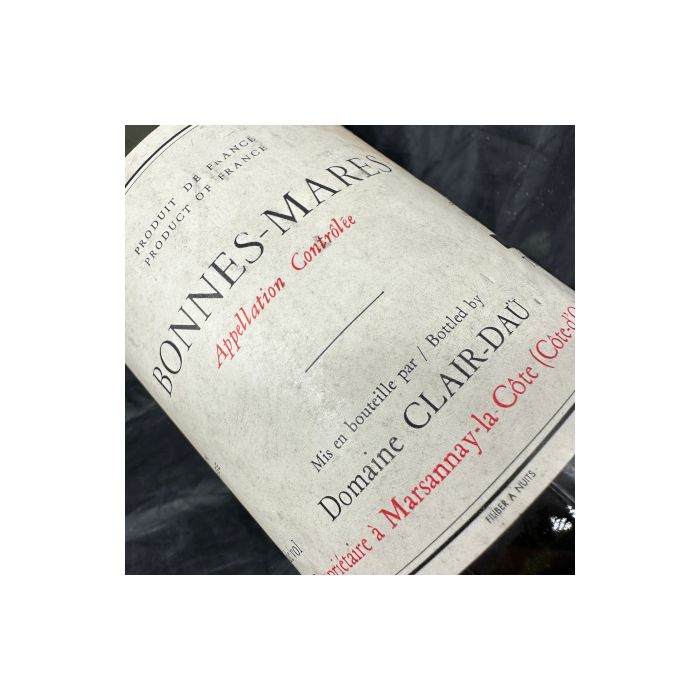
Domain Clair Daü Bonnes Mares 1982 Bottle (75cl) VSD
Domaine Clair Daü Bonnes Mares 1982 is a red Burgundy wine linked to Chambolle-Musigny, originating from the Bonnes-Mares parcel and classified as a Burgundy Grand Cru. Crafted exclusively from Pinot Noir, it comes from a Côte de Nuits grand cru whose vineyard extends between the communes of Chambolle-Musigny and Morey-Saint-Denis. This 1982 vintage belongs to the history of Domaine Clair Daü, a Burgundian property then established in Marsannay.
The bottle offered
- Size
- Bottle (75cl)
- Label Condition
- Very Slightly Damaged
- Fill Level
- -4.5cm
- Capsule Condition
- Perfect
Wine details
- Couleur
- Red
- Pays
- France
- Région
- Bourgogne
- Appellation
- Chambolle Musigny
- Producteur / Domaine
- Domaine Clair Daü
- Parcelle / Cru
- Bonnes-Mares
- Millésime
- 1982
Cépage et assemblage
- Grape Variety
- 100% Pinot Noir
Domaine Clair Daü
Clair-Daü refers to a historic Burgundy estate, established in Marsannay-la-Côte by Joseph Clair and Marguerite Daü. Its wine-growing heritage, developed in the Côte de Nuits in the mid-20th century, was divided in 1985 between the heirs and several buyers, including Maison Louis Jadot. A company called Domaine Clair Dau remains active today in Beaune, but the sources consulted do not allow us to identify with certainty any vineyard, production or winemaking team specific to this name alone.
- Owner
- Domaine Clair Daü
Histoire du domaine
Joseph Clair married Marguerite Daü in 1919, and the couple gradually developed a wine-growing estate in Marsannay-la-Côte. Between the 1930s and the 1960s, Joseph Clair acquired vineyards in several appellations of the Côte de Nuits, notably in Gevrey-Chambertin, Chambolle-Musigny and Morey-Saint-Denis. In 1954, Joseph, Marguerite, her sister and the couple’s three children founded Domaine Clair-Daü. Joseph Clair is notably credited with helping to develop Marsannay rosé and with planting Pinot Noir and Chardonnay to replace some of the grape varieties then grown in the area. Following his death in 1971, his son Bernard Clair took over the running of the estate. At its peak, the estate is said to have comprised 38 hectares of vineyards, a historical figure that cannot be taken as the current area. Disagreements amongst the heirs led to the estate being divided up in 1985. Some of the plots were acquired by Maison Louis Jadot, whilst Bruno Clair, Joseph’s grandson, later reclaimed certain family vineyards for his own estate. The company Domaine Clair Dau is still registered as active in Beaune; Pierre-Henry Gagey has been listed as its manager since 2009, although the public sources consulted do not make it possible to establish the actual ownership of the vineyards or who is directly responsible for winemaking.
Bonnes-Mares
Bonnes-Mares is a physically delineated Grand Cru of the Côte de Nuits, split between Chambolle-Musigny and Morey-Saint-Denis, with the largest portion located in Chambolle-Musigny. The vineyard forms approximately a rectangle south of Clos de Tart, on a gently sloping hillside with an easterly exposure. The light, gravelly, brown to reddish soils containing clay with flint rest on Jurassic limestone and white marl.
- Vineyard commune
- Chambolle-Musigny (principalement) et Morey-Saint-Denis
- Origin of the vineyard name
- Name attested since the late Middle Ages, of uncertain etymology. The BIVB favors the hypothesis of the old verb "marer", meaning to cultivate with care, rather than a reference to mother goddesses.
- Exposure
- east
- Altitude
- 250–280 m
- Slope
- gentle slope
- Soil
- Light and gravelly soil, brown or reddish, predominantly clayey with flint, approximately 40 cm deep.
- Subsoil and geology
- Limestone slab and white marl of Jurassic origin, dating back approximately 150 million years.
Le domaine dans cette parcelle
- Vineyard holding status
- Former owner-grower; estate dismantled in 1985
Histoire de la parcelle
The vineyard has been known as Bonnes-Mares since the late Middle Ages. The appellation of origin was recognized by the decree of December 8, 1936. Its production parcel area was subsequently approved by the INAO during the sessions of July 24, 1965 and June 1-2, 1988.