




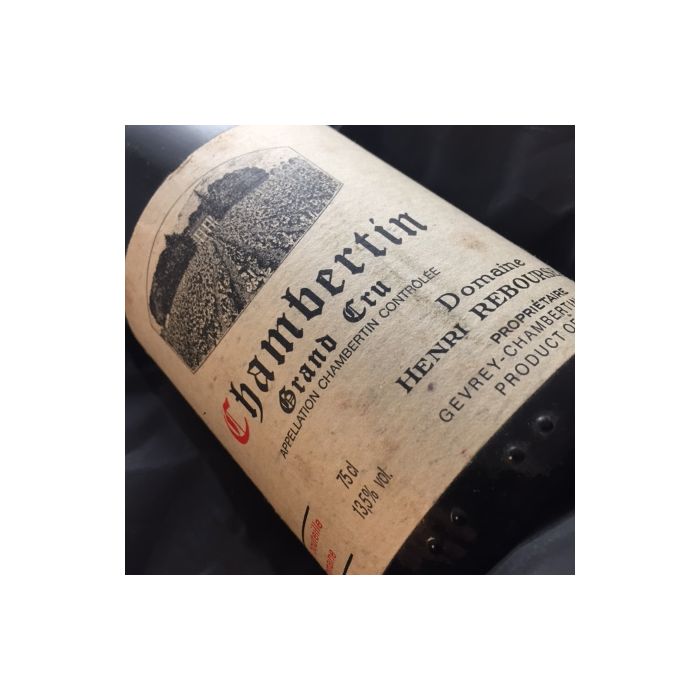
Domain Rebourseau Chambertin 1992
The 1992 Domaine Rebourseau Chambertin is a red Burgundy wine produced in Gevrey-Chambertin by Domaine Rebourseau. Classified as a Grand Cru de Bourgogne, it is made from 100% Pinot Noir and originates from the Chambertin parcel. The cuvée is crafted on a 0.46-hectare hillside plot, facing east and ventilated by northern winds. Its soils combine white marl in the upper section and brown limestone further down the slope.
La bouteille proposée
- Size
- Bottle (75cl)
- Packaging
- Loose
- Label Condition
- Perfect
- Fill Level
- Perfect
- Capsule Condition
- Perfect
Identité du vin
- Couleur
- Red
- Pays
- France
- Région
- Bourgogne
- Appellation
- Gevrey Chambertin
- Producteur / Domaine
- Domaine Rebourseau
- Parcelle / Cru
- Chambertin
- Millésime
- 1992
Cépage et assemblage
- Grape Variety
- 100% Pinot Noir
Domaine Rebourseau
Domaine Henri Rebourseau is a Côte de Nuits estate based in Gevrey-Chambertin, whose vineyards also extend as far as Vougeot. It cultivates 13.5 hectares of Pinot Noir, spread across village appellations, premiers crus and five grands crus, including Chambertin, Chambertin Clos de Bèze and Clos de Vougeot. Stemming from a wine-growing lineage dating back to the 18th century, it is now majority-owned by the Bouygues family, with the de Surrel family still associated with the estate.
- Owner
- Famille Bouygues (Martin et Olivier Bouygues, actionnaires majoritaires), aux côtés de la famille de Surrel, actionnaire minoritaire
- Maître de chais
- Bastien Giraud
- Surface (ha)
- 13.50 ha
- Production (average bottles per vintage)
- environ 60 000 bouteilles/an
Histoire du domaine
The family history dates back to 1782, when Claude Rebourseau, son of the winegrower Jacques Rebourseau, settled in La Roche-Vanneau. Born in 1839, Jean-Baptiste Rebourseau married Louise-Victoire Philippon in Gevrey in 1861. He then consolidated several plots, notably some Gevrey-Chambertin grands crus, which have remained in the family estate. The estate was subsequently passed on to his sons Émile and Henri. During the First World War, Émile Rebourseau looked after the estate whilst Henri was called up. On his return to Gevrey in 1919, General Henri Rebourseau took up residence at the Maison de la Brunelle and, in 1929, founded the Syndicat de défense du Chambertin, which he chaired for many years. In 1949, he passed the estate on to his son Pierre Rebourseau, who entrusted its management to his grandson Jean de Surrel in 1980. Jean de Surrel then began a transition towards sustainable, and subsequently organic, viticulture. In December 2018, the Bouygues family acquired a majority stake in the estate alongside the de Surrel family. Bastien Giraud took over the operational and technical management of the estate in 2023.
Chambertin
Chambertin is both a physically demarcated climat in Gevrey-Chambertin and the eponymous terroir of a Grand Cru appellation reserved for red wines. It occupies the middle of the slope, with an easterly exposure and a relatively moderate gradient compared to the neighboring Clos de Bèze. Its shallow, stony calcareous brown soils overlie entroquitic limestones and Bajocian marls, with a Bathonian component in the upper part.
- Vineyard commune
- Gevrey-Chambertin
- Origin of the vineyard name
- The toponym means "Bertin's field", named after a former owner or operator of the site; older forms such as "Champ Bretin" and "Champt Berthin" are attested in 1584.
- Exposure
- East, facing the rising sun
- Slope
- Mid-slope, relatively moderate gradient
- Soil
- Calcareous brown, stony soils beneath a thin cover of silts and scree.
- Subsoil and geology
- Entroquitic limestones and Bajocian marls; Bathonian calcareous clays towards the top.
Le domaine dans cette parcelle
- Estate holding in the vineyard (ha)
- 0.460000 ha
- Vineyard holding status
- Owner and operator of the parcel
- Indicative vine age
- Average age of the vines indicated by the estate: 59 years.
Histoire de la parcelle
The name Chambertin has been known since the 13th century, and its winegrowing potential has been recognized for centuries. Thomas Jefferson cited it among his favorite wines in 1787, while Napoleon I's predilection for this wine contributed to its renown. In 1855, Jules Lavalle classified it as "Tête de cuvée, cru hors ligne, vin extra". On October 17, 1847, its name was joined to that of Gevrey to form Gevrey-Chambertin; the Chambertin appellation was officially recognized on July 31, 1937.


