




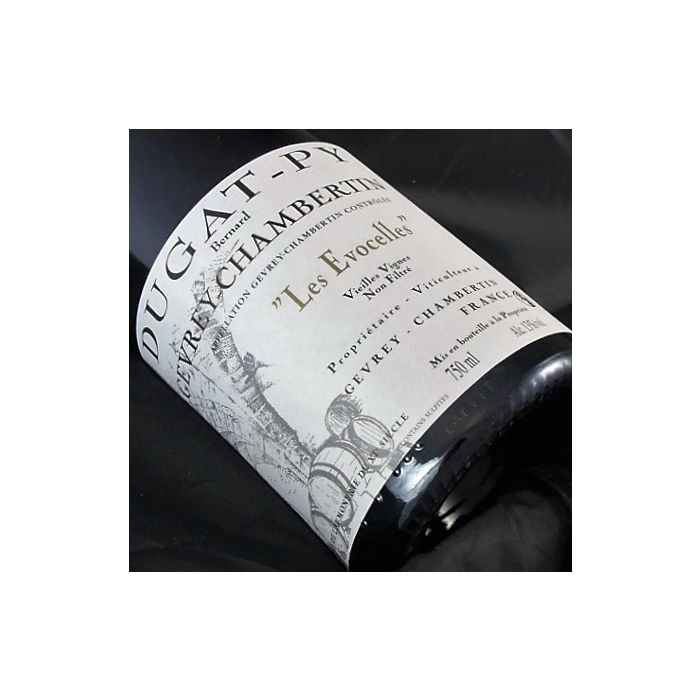
Domain Dugat Py Gevrey Chambertin Les Evocelles 2000 Bottle (75cl)
The 2000 Domaine Dugat-Py Gevrey-Chambertin Les Evocelles is a Burgundy red wine classified as a Village appellation, crafted by Domaine Dugat-Py from Pinot Noir. This single-parcel cuvée comes from the Les Evocelles climat within the Gevrey-Chambertin appellation. Documentation dedicated to this cuvee notes vines planted in 1950, standard aging of 16 to 18 months in new oak barrels, and bottling without filtration.
La bouteille proposée
- Size
- Bottle (75cl)
- Packaging
- Loose
- Label Condition
- Perfect
- Fill Level
- Perfect
- Capsule Condition
- Perfect
Identité du vin
- Couleur
- Red
- Pays
- France
- Région
- Bourgogne
- Appellation
- Gevrey Chambertin
- Producteur / Domaine
- Domaine Dugat-Py
- Parcelle / Cru
- Les Evocelles (Gevrey Chambertin)
- Millésime
- 2000
Cépage et assemblage
- Grape Variety
- 100% Pinot Noir
Domaine Dugat-Py
The Dugat-Py estate is a family-run business based in Gevrey-Chambertin, at the foot of the Combe de Lavaux, in the Côte de Nuits. Stemming from a lineage of winegrowers who have been in the village since the 17th century, it is now run by Loïc Dugat-Py, the thirteenth generation of the family. The vineyard covers 15 hectares, spread across the Côte de Nuits and the Côte de Beaune, with a strong emphasis on old vines.
- Owner
- Loïc Dugat-Py
- Maître de chais
- Loïc Dugat-Py
- Surface (ha)
- 15.00 ha
- Production (average bottles per vintage)
- 50 000 bouteilles/an
Histoire du domaine
The Dugat family’s winemaking heritage in Gevrey-Chambertin dates back to the 17th century. The Dugat estate was established in 1923 following the marriage of Fernand Dugat and Jeanne Bolnot, who also came from a family of local winegrowers. Pierre Dugat, son of Fernand and Jeanne, subsequently passed the vineyards on to his son Bernard, who produced his first vintage in 1975. Bernard Dugat married Jocelyne Py in 1979. After a period during which a significant proportion of the production was sold in bulk to wine merchants, the wines were bottled at the estate under the name Pierre Dugat from 1989 onwards. In 1994, Bernard adopted the name Dugat-Py for the estate, incorporating his wife’s surname. Their son Loïc joined the business in 1996 and produced his first vintage on his own in 2005. The vineyard expanded between 1995 and 2005 through purchases, leasehold arrangements and sharecropping, particularly in the Côte de Beaune. Trials in organic viticulture began in 1999; the estate has been fully certified organic since 2015. Loïc Dugat-Py is now the owner and is directly responsible for winemaking.
Les Evocelles (Gevrey Chambertin)
Les Évocelles is a climat of the Gevrey-Chambertin appellation located primarily in the commune of Brochon, at the northern end of the appellation and at the top of the slope. It holds Village status, despite its proximity to the premier crus Les Champeaux and Les Goulots. The site is described as steep or terraced, with an orientation ranging according to sources between east and south-east. Pedological descriptions indicate calcareous soils containing silt or clayey silt; another source mentions brown calcic soils on a marly subsoil.
- Vineyard commune
- Brochon
- Origin of the vineyard name
- Uncertain etymology: "Évocelles" is linked either to the Old French "Vaucelle", meaning a small valley, or to "Brosselles", meaning scrubby land.
- Exposure
- East to south-east
- Slope
- Sloping hillside, locally terraced
- Soil
- Calcareous soils; silt to clayey silt on the surface, sometimes described as brown calcic soils
- Subsoil and geology
- Deep silt and marly substrate; reported presence of crinoidal limestone (calcaire à entroques) and marl with Ostrea
Le domaine dans cette parcelle
- Indicative vine age
- Vines planted in 1950 according to two professional sources dedicated to this single-plot cuvée.
Histoire de la parcelle
The climat belongs to the Brochon sector authorized to produce under the Gevrey-Chambertin appellation. Vestiges of old walls and stone mounds (murgers) bear witness to the clearing and gradual cultivation of the hillside. However, consulted sources propose two competing origins for its name, without historically deciding between "Vaucelle" and "Brosselles".


