




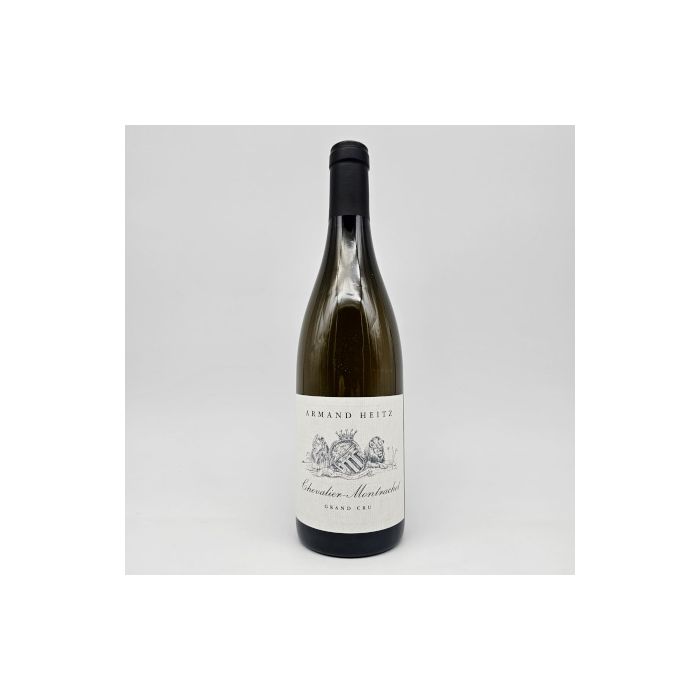
Domain Armand Chevalier Montrachet 2020 Bottle (75cl)
The 2020 Domaine Armand Heitz Chevalier Montrachet is a white Burgundy wine from the Chevalier-Montrachet parcel in Puligny-Montrachet. It is crafted exclusively from Chardonnay. The estate's vine, planted in 1952, covers 0.0966 hectares; the cuvée is aged for 11 months, using 20 to 40% new oak barrels. At the estate, the 2020 vintage was marked by a very dry summer and a harvest that began in late August.
La bouteille proposée
- Size
- Bottle (75cl)
- Packaging
- Loose
- Label Condition
- Perfect
- Fill Level
- Perfect
- Capsule Condition
- Perfect
Identité du vin
- Couleur
- White
- Pays
- France
- Région
- Bourgogne
- Producteur / Domaine
- Domaine Armand Heitz
- Parcelle / Cru
- Chevalier-Montrachet
- Millésime
- 2020
Cépage et assemblage
- Grape Variety
- 100% Chardonnay
Domaine Armand Heitz
Domaine Armand Heitz is a Burgundian estate run by Armand Heitz, historically based in Chassagne-Montrachet and with a winery in Meursault. It cultivates around 30 hectares of vineyards across the Côte de Beaune, Côte Chalonnaise and Beaujolais appellations. The estate integrates its vineyards into a diversified agricultural operation that includes livestock farming, grassland and arable farming.
- Owner
- Famille Heitz-Lochardet (actionnaires familiaux historiques du Groupe Armand Heitz, aux côtés d’investisseurs minoritaires)
- Maître de chais
- Armand Heitz
- Surface (ha)
- 30.00 ha
Histoire du domaine
The estate’s heritage dates back to the mid-19th century, with the Nié-Vantey family, who at the time owned vineyards and were active in the wine trade in the Côte de Beaune. Part of this wine-growing heritage was sold off during the phylloxera epidemic. In 1900, Georges Lochardet, a wine merchant from the Côte de Beaune, married Marcelle Nié; the family then owned around 20 hectares of vineyards and several farm buildings. Their son, Armand Lochardet, inherited part of this estate, which he subsequently passed on to his three children. In 1983, Brigitte Lochardet married Christian Heitz; the estate subsequently took the name Heitz-Lochardet. For many years, the vineyards were managed under lease and sharecropping arrangements. Armand Heitz, grandson of Armand Lochardet and a graduate in oenology from the Changins School of Engineering, took over the management of the estate in 2011. He began cultivating his first plot himself in 2012 and released his first vintage in 2013. The vineyard has gradually expanded and now covers around 30 hectares. Armand Heitz oversees the estate’s winemaking and has developed an approach based on reducing inputs, agroecology and agricultural diversification.
Chevalier-Montrachet
Chevalier-Montrachet is both a Grand Cru appellation and a physically delimited terroir in Puligny-Montrachet, reserved for white wines. It occupies an east- and southeast-facing slope in the heart of the hillside, between 260 and 300 meters in altitude according to the official specifications. Its lean, stony, well-draining, and low-fertility soils rest primarily on highly fragmented Bathonian limestone known as "calcaire de Chassagne"; a marly layer at the summit locally supports slightly richer soils. Historical shaping of the site is evidenced by ancient stone clearance, murgers (stone heaps), and dry-stone retaining walls.
- Vineyard commune
- Puligny-Montrachet
- Exposure
- East to southeast
- Altitude
- 260–300 m
- Soil
- Lean, very stony, well-draining, and low-fertility soils; slightly richer soils on the upper marly layer.
- Subsoil and geology
- Middle Jurassic formations, Bathonian stage; highly fragmented limestones, primarily "calcaire de Chassagne", with a small layer of marl at the summit.
Le domaine dans cette parcelle
- Estate holding in the vineyard (ha)
- 0.097000 ha
- Vineyard holding status
- Parcel farmed by the estate; tenure status not specified
- Indicative vine age
- Vines planted in 1952.
Histoire de la parcelle
The name Montrachet is documented as early as the 13th century in the form "Mont Rachaz"; the official heritage source interprets it as a "bald mount" (mont pelé), in reference to its stunted vegetation. In the 18th century, the wines of the Chevalier climat were still frequently assimilated with those of Montrachet, although Courtépée already distinguished true Montrachet, Chevalier, and Bâtard. A 1921 court ruling reserved the name Montrachet to Vrai Montrachet while acknowledging the customary use of Chevalier-Montrachet. The Chevalier-Montrachet AOC was recognized in 1937, and its vineyard area was subsequently adjusted in 1939 through the integration of plots from the neighboring lieu-dit Le Cailleret; the current delimitation was approved by the INAO in September 1989.


