


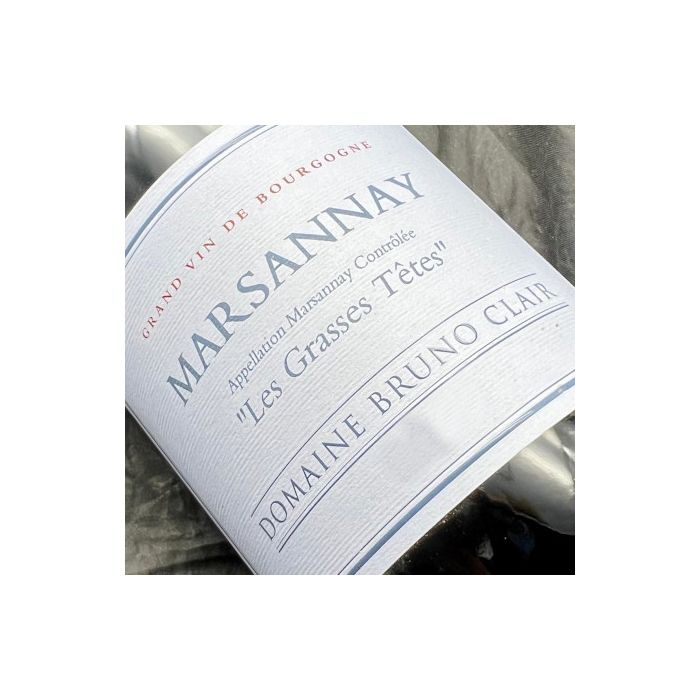
Domain Bruno Clair Marsannay Les Grasses Tetes 2021 Bottle (75cl)
The 2021 Domaine Bruno Clair Marsannay Les Grasses Têtes is a red Burgundy wine from the Marsannay appellation, classified as a Village. This single-plot cuvée is crafted from 100% Pinot Noir. The Wine Advocate awards it a score of 89-91/100, describing it as the most muscular and structured of the estate's Marsannays, with notes of spices, sweet berries, and petals, supported by powdery tannins.
The bottle offered
- Size
- Bottle (75cl)
- Packaging
- Loose
- Label Condition
- Perfect
- Fill Level
- Perfect
- Capsule Condition
- Perfect
Wine details
- Couleur
- Red
- Pays
- France
- Région
- Bourgogne
- Appellation
- Marsannay
- Producteur / Domaine
- Domaine Bruno Clair
- Parcelle / Cru
- Les Grasses Têtes
- Millésime
- 2021
Cépage et assemblage
- Grape Variety
- 100% Pinot Noir
Domaine Bruno Clair
Domaine Bruno Clair is a family-run estate based in Marsannay-la-Côte, in the Côte de Nuits. Founded by Bruno Clair in 1979, it now cultivates 27 hectares spread across eight Burgundian villages and produces 32 appellations. Édouard and Arthur Clair work together to oversee the winemaking and cellar operations.
- Owner
- Famille Clair
- Maître de chais
- Édouard Clair et Arthur Clair
- Surface (ha)
- 27.00 ha
- Production (average bottles per vintage)
- 110 000 bouteilles/an
Histoire du domaine
Bruno Clair founded the estate that bears his name in 1979, in Marsannay-la-Côte. His family’s history in wine-making, however, dates back to the early 19th century. In 1919, his grandfather Joseph Clair married Marguerite Daü, who was then running a vineyard in Marsannay-la-Côte. Between 1930 and 1960, Joseph Clair acquired plots in Gevrey-Chambertin, Morey-Saint-Denis and Chambolle-Musigny. In 1954, he founded the Clair-Daü estate with his family; following his death in 1971, his son Bernard took over the management. The break-up of the Clair-Daü estate in 1985 led Bernard and Geneviève Clair to entrust their vineyards to Bruno, who then set up a family-run wine-growing business with his brothers and sisters. From 1986 onwards, Domaine Bruno Clair managed 17 hectares, before gradually expanding into Chambolle-Musigny, Aloxe-Corton, Pernand-Vergelesses, Gevrey-Chambertin, Bonnes-Mares and, once again, Chambolle-Musigny. Isabelle Clair joined the estate in 2005 to take on administrative and commercial responsibilities. Their son Édouard joined in 2010, followed by Margaux and Arthur in 2018; Édouard is in charge of the vineyards and winemaking, whilst Arthur is in charge of the cellar and assists with winemaking. The estate now cultivates 27 hectares across eight villages.
Les Grasses Têtes
Les Grasses Têtes is a winegrowing climat and lieu-dit in Marsannay-la-Côte, located on the upper part of the slope, west of the village, with an eastern exposure. Its altitude ranges from 285 to 329 meters and its slope varies from 2 to 11%. The subsoil, which is highly calcareous and compartmentalized by faults, notably combines crinoidal limestone (calcaire à entroques), white oolite, Premeaux limestone, Comblanchien limestone, and marl with Ostrea acuminata. The soils are very stony and rather thin in the upper part, becoming somewhat thicker toward the bottom of the lieu-dit.
- Vineyard commune
- Marsannay-la-Côte
- Origin of the vineyard name
- Uncertain origin: the name could evoke either rich or 'fat' soils, or outcropping rock 'heads' indicating limestone close to the surface.
- Exposure
- East
- Altitude
- 285–329 m
- Slope
- 2 to 11% (average 5%)
- Soil
- Very stony calcareous soils, thin at the top of the slope, slightly thicker in the lower part.
- Subsoil and geology
- Crinoidal limestone, white oolite, Premeaux limestone, Comblanchien limestone and marl with Ostrea acuminata.
Le domaine dans cette parcelle
- Estate holding in the vineyard (ha)
- 2.267000 ha
- Indicative vine age
- Vines planted in 1950, 1970, 1973 and 1990.
Histoire de la parcelle
The presence of the article 'Les' in the place name is interpreted by the ODG as an indication that the name was formed after the year 1000. The lieu-dit is among the climats proposed by the ODG Marsannay for recognition as a Premier Cru, but officially remains classified at the Village level until this procedure is approved.