




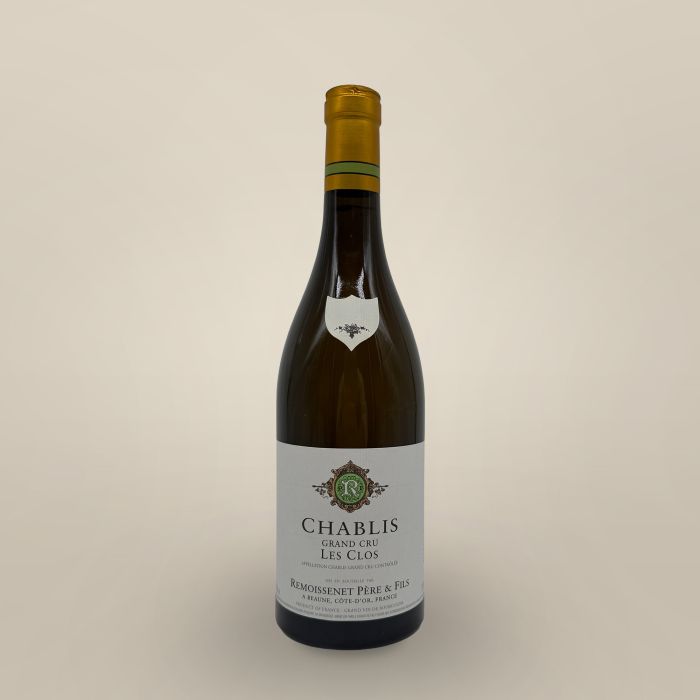
Domaine Remoissenet Père et Fils Chablis Grand Cru Les Clos 2022 Bouteille (75cl)
Domaine Remoissenet Père et Fils Chablis Grand Cru Les Clos 2022 is a white Burgundy wine made from 100% chardonnay in the Chablis appellation. Classified as Grand Cru, it comes from the Les Clos climat, crafted from purchased must sourced from a single parcel. The vines of this parcel reached one hundred years of age with the 2022 vintage. The cuvée expresses the sunny character and chalky soils of Les Clos in a full-bodied, saline and mineral register.
La bouteille proposée
- Size
- Bottle (75cl)
- Label Condition
- Perfect
- Fill Level
- Perfect
- Capsule Condition
- Perfect
Identité du vin
- Couleur
- White
- Pays
- France
- Région
- Bourgogne
- Appellation
- Chablis
- Producteur / Domaine
- Domaine Remoissenet Père et Fils
- Parcelle / Cru
- Les Clos
- Millésime
- 2022
Domaine Remoissenet Père et Fils
Remoissenet Père et Fils is a Burgundian wine house established in Beaune in 1877. It operates both as a wine estate, with around 13 hectares of its own vineyards, notably in Beaune and Gevrey-Chambertin, and as a wine merchant. The company is managed by Edward L. Milstein, whilst winemaking is overseen by Claudie Jobard.
- Owner
- Edward L. Milstein (via Remoissenet Holdings Ltd)
- Maître de chais
- Claudie Jobard
- Surface (ha)
- 13.00 ha
Histoire du domaine
Remoissenet Père et Fils was founded in Beaune in 1877 and established itself in a historic 14th-century building in the heart of the town. The company remained in the Remoissenet family until 2005. During the final decades of this period, Roland Remoissenet was at the helm. When he retired in 2005, the company, its cellars, stocks and vineyards were acquired by a group led by the American financier Edward L. Milstein. The reorganisation that followed included the appointment of Bernard Repolt as managing director and the arrival of oenologist Claudie Jobard ahead of the 2005 grape harvest. In 2008, the company reacquired plots in several Côte de Nuits appellations, including Gevrey-Chambertin, Vosne-Romanée, Nuits-Saint-Georges, Charmes-Chambertin and Clos de Vougeot. Remoissenet Père et Fils now operates as both a wine estate and a wine merchant, producing wine from grapes grown on its own vineyards as well as from grapes selected from partner growers. Recent legal filings identify Edward Milstein as the managing director of Remoissenet Père et Fils SCS, of which Remoissenet Holdings Ltd is the general partner.
Les Clos
Les Clos is one of the seven officially recognized Climats within the Chablis Grand Cru appellation and the largest of them all, covering nearly 26 hectares. It occupies the entire height of the hillside on the right bank of the Serein and benefits from a south-westerly exposure as well as a relatively steep slope. The soils become more stony and chalky towards the top, while they are deeper and more clayey at the bottom. On the general scale of Chablis Grand Cru, the hillside rests on Kimmeridgian marls and limestones containing Exogyra virgula fossils, but this geology is not detailed separately for Les Clos by the sources consulted.
- Vineyard commune
- Chablis
- Origin of the vineyard name
- The name, formerly attested in the forms "le clou", "les clous" and "le clox", refers to the dry-stone walls that once surrounded the vineyards.
- Exposure
- South-west
- Slope
- Relatively steep
- Soil
- More stony and limestone at the top; deeper and clayey at the bottom
Le domaine dans cette parcelle
- Vineyard holding status
- Négoce: purchase of must from a single parcel of Les Clos
- Indicative vine age
- 20 to 40 years according to the technical sheet for Chablis Grand Cru Les Clos 2017.
Histoire de la parcelle
The terroir was planted with vines before 1267 and may constitute the original core of the Chablis vineyard farmed by the Cistercians of Pontigny. Its former name forms evoke the walls that demarcated properties, limited erosion and protected the vines. Les Clos has been cited since the 19th century among the finest crus of Burgundy; the Chablis Grand Cru appellation was recognized on January 13, 1938.


