




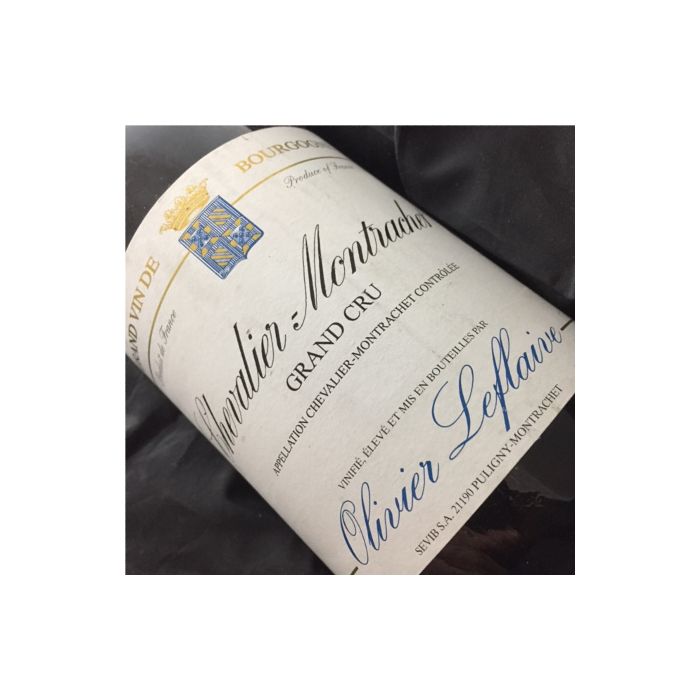
Olivier Leflaive Chevalier Montrachet 1996 Bottle (75cl)
The 1996 Olivier Leflaive Chevalier-Montrachet is a white Burgundy wine from the Chevalier-Montrachet Grand Cru in Puligny-Montrachet. Crafted exclusively from Chardonnay, it originates from a parcel of the estate located in the upper part of the Grands Crus hillside. This limestone-marl terroir, situated between 250 and 300 meters of altitude, covers 6.95 hectares within the production area. Olivier Leflaive's Chevalier-Montrachet cuvée is harvested by hand and identified as a Récolte du Domaine.
La bouteille proposée
- Size
- Bottle (75cl)
- Packaging
- Loose
- Label Condition
- Perfect
- Fill Level
- Perfect
- Capsule Condition
- Perfect
Identité du vin
- Couleur
- White
- Pays
- France
- Région
- Bourgogne
- Appellation
- Puligny Montrachet
- Producteur / Domaine
- Olivier Leflaive
- Parcelle / Cru
- Chevalier-Montrachet
- Millésime
- 1996
Cépage et assemblage
- Grape Variety
- 100% Chardonnay
Olivier Leflaive
Olivier Leflaive is a family-run Burgundian estate founded in 1984 in Puligny-Montrachet, in the heart of the Côte de Beaune. It cultivates 26 hectares of its own vineyards, spread across 82 climats, mainly in Puligny-Montrachet, Meursault and Chassagne-Montrachet, and complements its activities through partnerships with Burgundian winegrowers. Technical management and winemaking are overseen by Solène Panigai, with Philippe Grillet as the estate’s oenologist.
- Owner
- Famille Leflaive, via la SAS Olivier Leflaive Frères
- Maître de chais
- Solène Panigai
- Surface (ha)
- 26.00 ha
- Production (average bottles per vintage)
- environ 700 000 bouteilles/an
Histoire du domaine
Olivier Leflaive belongs to a family with long-standing roots in Puligny-Montrachet. Olivier Leflaive, described by the estate as the eighteenth generation of the family, founded a business bearing his name in 1984, dedicated to the winemaking and ageing of wines in Puligny-Montrachet. The estate began with four ‘premières ouvrées’ in the Les Meix vineyard, in Puligny-Montrachet. Its own vineyard was subsequently built up through family inheritance and successive acquisitions. At the same time, it developed a grape-trading business in order to produce wines from appellations in other parts of Burgundy, notably the Côte de Beaune, the Côte Chalonnaise and the Chablis region. Patrick Leflaive joined the company, followed by Julie Leflaive and Jean Soubeyrand. Olivier Leflaive Frères is now chaired by Jean Soubeyrand, whilst Olivier Leflaive chairs its supervisory board. The estate currently owns 26 hectares of vineyards comprising 82 climats. Solène Panigai, technical director, oversees winemaking and ageing decisions alongside oenologist Philippe Grillet.
Chevalier-Montrachet
Chevalier-Montrachet is both a Grand Cru appellation and a physically delimited terroir in Puligny-Montrachet, reserved for white wines. It occupies an east- and southeast-facing slope in the heart of the hillside, between 260 and 300 meters in altitude according to the official specifications. Its lean, stony, well-draining, and low-fertility soils rest primarily on highly fragmented Bathonian limestone known as "calcaire de Chassagne"; a marly layer at the summit locally supports slightly richer soils. Historical shaping of the site is evidenced by ancient stone clearance, murgers (stone heaps), and dry-stone retaining walls.
- Vineyard commune
- Puligny-Montrachet
- Exposure
- East to southeast
- Altitude
- 260–300 m
- Soil
- Lean, very stony, well-draining, and low-fertility soils; slightly richer soils on the upper marly layer.
- Subsoil and geology
- Middle Jurassic formations, Bathonian stage; highly fragmented limestones, primarily "calcaire de Chassagne", with a small layer of marl at the summit.
Le domaine dans cette parcelle
- Vineyard holding status
- Estate harvest, from a single estate parcel
- Indicative vine age
- Parcel planted in 1974; indicated average age of 49 years for the 2023 vintage.
Histoire de la parcelle
The name Montrachet is documented as early as the 13th century in the form "Mont Rachaz"; the official heritage source interprets it as a "bald mount" (mont pelé), in reference to its stunted vegetation. In the 18th century, the wines of the Chevalier climat were still frequently assimilated with those of Montrachet, although Courtépée already distinguished true Montrachet, Chevalier, and Bâtard. A 1921 court ruling reserved the name Montrachet to Vrai Montrachet while acknowledging the customary use of Chevalier-Montrachet. The Chevalier-Montrachet AOC was recognized in 1937, and its vineyard area was subsequently adjusted in 1939 through the integration of plots from the neighboring lieu-dit Le Cailleret; the current delimitation was approved by the INAO in September 1989.


