




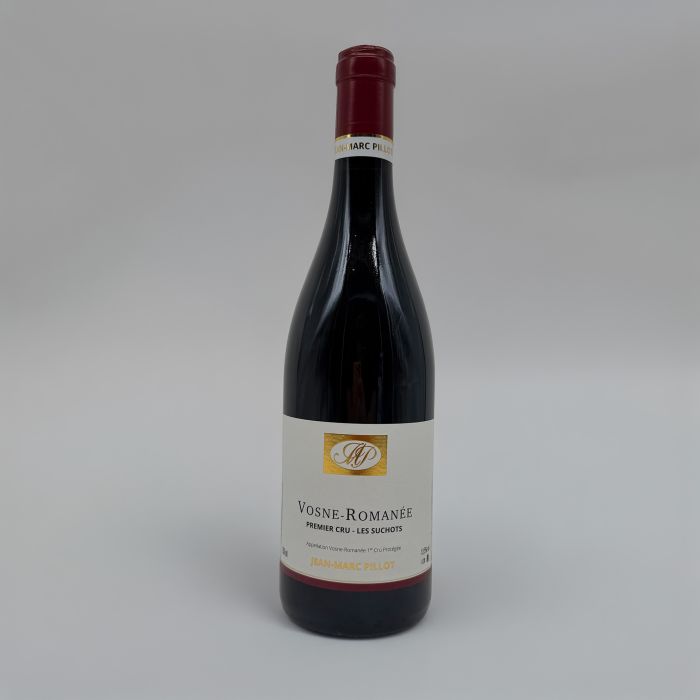
Domaine Jean-Marc Pillot Vosne Romanee 1er Cru Les Suchots 2020 Bouteille (75cl)
The Domaine Jean-Marc Pillot Vosne-Romanée 1er Cru Les Suchots 2020 is a red Burgundy wine made from 100% Pinot Noir. Produced by Jean-Marc Pillot in the Vosne-Romanée appellation, it comes from the Les Suchots climat, classified as a Premier Cru of Burgundy. This single-plot cuvée expresses the identity of a great terroir in the Côte de Nuits.
La bouteille proposée
- Size
- Bottle (75cl)
- Label Condition
- Perfect
- Fill Level
- Perfect
- Capsule Condition
- Perfect
Identité du vin
- Couleur
- Red
- Pays
- France
- Région
- Bourgogne
- Appellation
- Vosne Romanée
- Producteur / Domaine
- Jean-Marc Pillot
- Parcelle / Cru
- Les Suchots
- Millésime
- 2020
Jean-Marc Pillot
Domaine Jean-Marc & Antonin Pillot is a family-run estate in Chassagne-Montrachet, spanning approximately 12 hectares of vineyards, complemented by a négociant activity. Jean-Marc and his son Antonin craft white and red wines originating mainly from Chassagne-Montrachet, along with parcels or sourcing in Puligny-Montrachet, Santenay, Meursault, Remigny, Rully, and Montagny. Their approach is based on plowing, manual harvesting, and extended aging in barrels followed by stainless steel tanks.
- Owner
- Famille Pillot
- Maître de chais
- Jean-Marc Pillot et Antonin Pillot
- Surface (ha)
- 12.00 ha
- Production (average bottles per vintage)
- 60000
Histoire du domaine
The estate belongs to a branch of the Pillot family established for several generations in Chassagne-Montrachet. Jean-Marc Pillot joined his father Jean in 1985, when the estate covered around five hectares and still sold a significant portion of its grapes to négociants. In 1991, he took over alongside his wife Nadine and his sister Béatrice, gradually expanding estate-bottling under his own name and growing the vineyard surface area. In 1996, he established a négociant activity to complement production with grapes sourced from regular partners; since 2007, the entire production of the estate has been commercialized in bottles. A new vat room subsequently accompanied the expansion of the operation. Antonin Pillot, Jean-Marc's son, joined the estate in 2019 and now participates in both viticulture and vinification alongside his father. The estate farms approximately 12 hectares of its own vineyards and produces roughly 60,000 bottles per year, to which its négociant activity contributes. The reference "Les Suchots" mentioned in the database likely corresponds to Domaine Jean-Marc Millot from Nuits-Saint-Georges, and not Domaine Jean-Marc Pillot from Chassagne-Montrachet.
Les Suchots
Les Suchots is a climat of Vosne-Romanée officially recognized among the designations that can accompany the Premier Cru mention. It is located to the north of Romanée-Saint-Vivant and Richebourg, bordering Les Échezeaux, in a sector of the hillside exposed mainly to the east, locally to the south-east. Descriptions dedicated to the climat point to clay-limestone or reddish-brown, stony soils resting on limestone and marly materials; Oligocene conglomeratic deposits are also observed. A talweg and a soil thickness gradient introduce a certain internal heterogeneity.
- Vineyard commune
- Vosne-Romanée
- Origin of the vineyard name
- Two etymologies are documented: "Suchot" may derive from "souche" (vine stock), in reference to land that was cleared and grubbed, or be related to "suc/suquet", designating a hill or steep slope.
- Exposure
- East to south-east
- Soil
- Clay-limestone, stony soils, locally described as reddish-brown; their thickness generally increases from the top to the bottom of the climat.
- Subsoil and geology
- Limestone and marly subsoil; documented presence of limestone rocks and salmon-colored clayey limestone conglomerates attributed to the Oligocene.
Le domaine dans cette parcelle
- Vineyard holding status
- negociant / grape purchase
Histoire de la parcelle
Viticulture has been attested in Vosne-Romanée since the Middle Ages, notably under the influence of the Abbey of Saint-Vivant. The Vosne-Romanée AOC was recognized in 1936 and the list of its climats eligible for the Premier Cru mention, including Les Suchots, in 1943, based on 19th-century wine-growing classifications. The name preserves the possible memory of former clearing and grubbing, but a topographical origin meaning "hill" is also advocated.


