




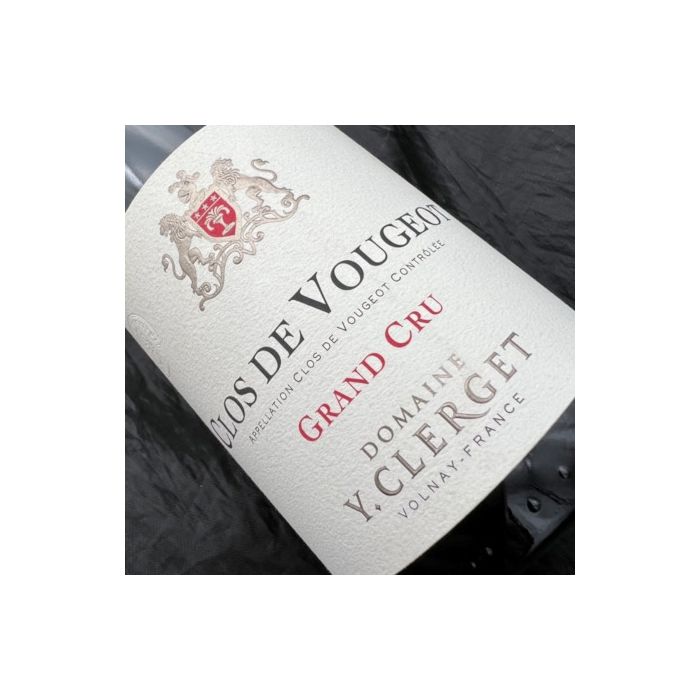
Domain Yvon Clerget Clos Vougeot 2018 Magnum
Domaine Yvon Clerget Clos Vougeot 2018 is a Burgundy red wine from the Clos de Vougeot Grand Cru in the Vougeot appellation. Made 100% from Pinot Noir, it comes from the Clos de Vougeot parcel. The Wine Advocate awards it 94/100 and recommends drinking between 2028 and 2048. The critic describes an ample and powerful wine, still very youthfully structured with firm tannins and lively acidity, driven by notes of blackcurrant, cherry, warm spices, grilled meat, and dark chocolate.
La bouteille proposée
- Size
- Magnum (150cl)
- Label Condition
- Perfect
- Fill Level
- Perfect
- Capsule Condition
- Perfect
Identité du vin
- Couleur
- Red
- Pays
- France
- Région
- Bourgogne
- Appellation
- Vougeot
- Producteur / Domaine
- Domaine Yvon Clerget
- Parcelle / Cru
- Clos de Vougeot
- Millésime
- 2018
Cépage et assemblage
- Grape Variety
- 100% Pinot Noir
Domaine Yvon Clerget
Domaine Y. Clerget, formerly marketed under the name Domaine Yvon Clerget, is a family-run Burgundy estate based in Volnay and producing wine in Pommard. Run by Thibaud Clerget, it cultivates 10 hectares spread across the Côte de Beaune and a plot in Clos de Vougeot. Its vineyards include plots in Volnay, Pommard, Meursault and Clos de Vougeot.
- Owner
- Thibaud Clerget
- Maître de chais
- Thibaud Clerget
- Surface (ha)
- 10.00 ha
- Production (average bottles per vintage)
- 25 000 bouteilles/an
Histoire du domaine
According to the estate’s history, the Clerget family’s history in Volnay dates back to 1268. The first precisely documented milestone in the history of the current estate is the acquisition in 1936 of the Clos du Verseuil Premier Cru in Volnay, which was operated as a monopoly. Yvon Clerget took charge of winemaking in 1983. The last vintage released under his name was 2009. Whilst the estate’s bottling operations were suspended, the grapes were sold to Henri Boillot. Thibaud Clerget subsequently undertook training in viticulture and completed a work placement at the Hudelot-Noëllat estate. He took over the family estate in 2015, the year of his first vintage to be vinified and bottled by the estate since that hiatus. Thibaud Clerget is now the owner and oversees the winemaking process himself. *La Revue du vin de France* reports that the estate obtained organic certification in 2019.
Clos de Vougeot
The Clos de Vougeot is a vast, single-piece vineyard enclosure, surrounded by walls and located at the foot of the Côte de Nuits slope, in the commune of Vougeot. Its terroir varies markedly from top to bottom: thin, gravelly soils on Bajocian limestone in the upper part, more clayey brown soils on limestone debris in the middle, and deeper, clayey and silty soils on a marly layer in the lower part. The site simultaneously constitutes a physically demarcated Burgundian climat and the emblematic parcel area of the AOC Grand Cru Clos de Vougeot or Clos Vougeot.
- Vineyard commune
- Vougeot
- Origin of the vineyard name
- "Clos" designates the vineyard historically enclosed by walls; "Vougeot" takes up the name of the place, linked to the Vouge which marks a historical boundary of the estate.
- Altitude
- 240–265 m
- Slope
- gentle, average of about 3.8%
- Soil
- At the top, shallow, granular soils rich in gravel; in the middle, shallow, more clayey brown soils on limestone debris; at the bottom, deeper brown soils rich in clay and fine silt.
- Subsoil and geology
- Jurassic complex; Bajocian limestone slab in the upper part, limestone debris in the middle, and marly layer in the lower part, with the influence of superficial formations linked to the outlet of the combe d'Orveau.
Histoire de la parcelle
The wine estate was gradually established by the Cistercian abbey of Cîteaux starting from the early 12th century; a medieval agreement set boundaries that have remained almost unchanged, and the wall was built before the end of that century. The farm buildings were developed from the 12th to the 15th century, then complemented in 1551 by the Renaissance residence that became the château du Clos de Vougeot. The abbey kept the estate until the Revolution; the buildings and vineyards were confiscated and then sold as national property in 1791, subsequently leading to the fragmentation of the property. The appellation d'origine contrôlée Clos de Vougeot or Clos Vougeot was recognized by decree on July 31, 1937.


