




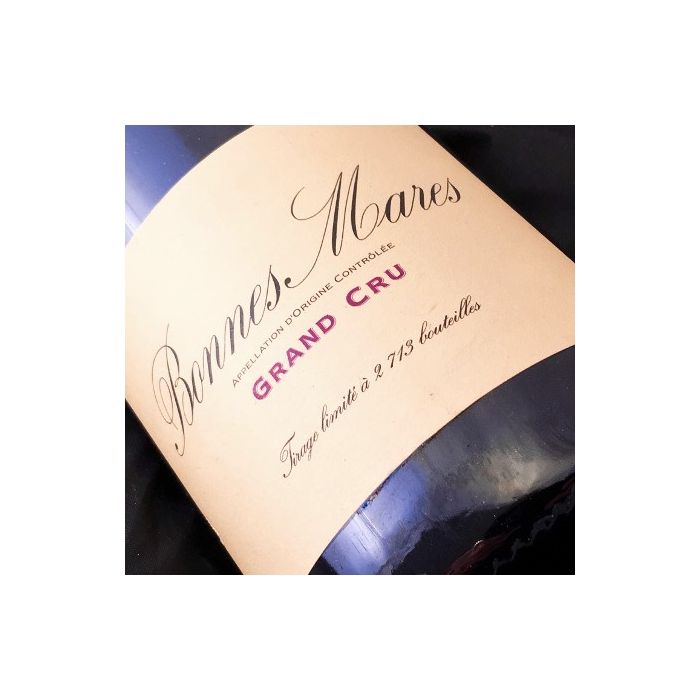
Domain Vougeraie Bonnes Mares 2000 Bottle (75cl)
The 2000 Domaine de la Vougeraie Bonnes Mares is a Grand Cru red Burgundy wine from the Bonnes-Mares climat in Chambolle-Musigny. Crafted by Domaine de la Vougeraie from 100% Pinot Noir, it comes from a collection of plots totaling 0.7002 hectares, with an eastern exposure, planted between 1901 and 1998. Located in the commune of Chambolle-Musigny, on the border with Morey-Saint-Denis, these vines benefit from a microclimate partially sheltered by the rock face of an old quarry.
La bouteille proposée
- Size
- Bottle (75cl)
- Packaging
- Loose
- Label Condition
- Perfect
- Fill Level
- Perfect
- Capsule Condition
- Perfect
Identité du vin
- Couleur
- Red
- Pays
- France
- Région
- Bourgogne
- Appellation
- Chambolle Musigny
- Producteur / Domaine
- Domaine de la Vougeraie
- Parcelle / Cru
- Bonnes-Mares
- Millésime
- 2000
Cépage et assemblage
- Grape Variety
- 100% Pinot Noir
Domaine de la Vougeraie
Domaine de la Vougeraie is a family-run Burgundy estate, established in 1999 and based in Premeaux-Prissey. Its vineyards stretch from the Côte de Nuits to the Côte de Beaune and are cultivated using biodynamic methods. It is owned by the Boisset family, represented in particular by Nathalie Berges-Boisset and Jean-Charles Boisset, and holds, amongst other things, the exclusive rights to the Vougeot Premier Cru ‘Le Clos Blanc de Vougeot’.
- Owner
- Famille Boisset (Nathalie Berges-Boisset et Jean-Charles Boisset)
- Maître de chais
- Camille Leynaud-Prince
- Surface (ha)
- 52.15 ha
Histoire du domaine
The Boisset family’s winemaking history, which lies at the origins of Domaine de la Vougeraie, dates back to the 1960s, with the Evocelles vineyards in Gevrey-Chambertin. Over the decades, the family acquired plots in the Côte de Nuits, particularly around Vougeot, and later in the Côte de Beaune. The estate was established under the name Domaine de la Vougeraie in 1999, through the consolidation of these family-owned vineyards and estates acquired gradually. Nathalie Berges-Boisset and her brother Jean-Charles Boisset were involved in its creation. The vineyard has been managed organically since the estate’s inception and has been entirely biodynamic since 2011, according to documentation from the Boisset Group. The estate has developed a plot-by-plot approach, with winemaking and ageing methods tailored to each specific plot. Whole-bunch vinification was introduced for red wines from 2008 onwards, depending on the cuvée and vintage. The winery is located in Premeaux-Prissey, between the Côte de Nuits and the Côte de Beaune. Today, Camille Leynaud-Prince is responsible for the estate’s oenology and winemaking.
Bonnes-Mares
Bonnes-Mares is a physically delineated Grand Cru of the Côte de Nuits, split between Chambolle-Musigny and Morey-Saint-Denis, with the largest portion located in Chambolle-Musigny. The vineyard forms approximately a rectangle south of Clos de Tart, on a gently sloping hillside with an easterly exposure. The light, gravelly, brown to reddish soils containing clay with flint rest on Jurassic limestone and white marl.
- Vineyard commune
- Chambolle-Musigny (principalement) et Morey-Saint-Denis
- Origin of the vineyard name
- Name attested since the late Middle Ages, of uncertain etymology. The BIVB favors the hypothesis of the old verb "marer", meaning to cultivate with care, rather than a reference to mother goddesses.
- Exposure
- east
- Altitude
- 250–280 m
- Slope
- gentle slope
- Soil
- Light and gravelly soil, brown or reddish, predominantly clayey with flint, approximately 40 cm deep.
- Subsoil and geology
- Limestone slab and white marl of Jurassic origin, dating back approximately 150 million years.
Le domaine dans cette parcelle
- Estate holding in the vineyard (ha)
- 0.700000 ha
- Indicative vine age
- Staggered plantings from 1901 to 1998.
Histoire de la parcelle
The vineyard has been known as Bonnes-Mares since the late Middle Ages. The appellation of origin was recognized by the decree of December 8, 1936. Its production parcel area was subsequently approved by the INAO during the sessions of July 24, 1965 and June 1-2, 1988.


