




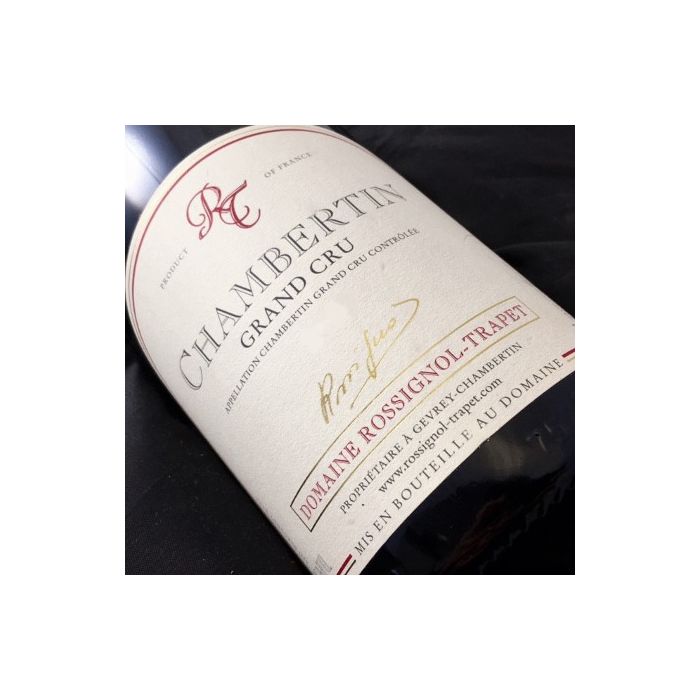
Domaine Rossignol Trapet Chambertin 2020 Bottle (75cl)
The 2020 Le Chambertin from Domaine Rossignol Trapet is a red Burgundy wine from the Chambertin grand cru within the Gevrey-Chambertin appellation. Crafted from 100% Pinot Noir, it comes from the Chambertin parcel. Jancis Robinson awards it 18+/20 and recommends drinking it from 2023 to 2040. The critic describes a wine with notes of black cherry and ripe red fruit, supported by balanced freshness, elegant tannins, and high-quality oak ageing.
La bouteille proposée
- Size
- Bottle (75cl)
- Packaging
- Loose
- Label Condition
- Perfect
- Fill Level
- Perfect
- Capsule Condition
- Perfect
Identité du vin
- Couleur
- Red
- Pays
- France
- Région
- Bourgogne
- Appellation
- Gevrey Chambertin
- Producteur / Domaine
- Domaine Rossignol Trapet
- Parcelle / Cru
- Chambertin
- Millésime
- 2020
Cépage et assemblage
- Grape Variety
- 100% Pinot Noir
Domaine Rossignol Trapet
Domaine Rossignol-Trapet is a family-run estate based in Gevrey-Chambertin, in the Côte de Nuits. Run by brothers David and Nicolas Rossignol, it cultivates 13 hectares of Pinot Noir, mainly in Gevrey-Chambertin, with plots also in Beaune and Savigny-lès-Beaune. The vineyard is managed using certified organic and biodynamic farming methods.
- Owner
- David et Nicolas Rossignol
- Maître de chais
- David et Nicolas Rossignol
- Surface (ha)
- 13.00 ha
- Production (average bottles per vintage)
- 60 000 bouteilles/an
Histoire du domaine
Domaine Rossignol-Trapet has its roots in two families of Burgundian winegrowers: the Rossignols, long established in Volnay, and the Trapets, originally from Chambolle-Musigny who later settled in Gevrey-Chambertin. In 1961, Jacques Rossignol married Mado Trapet, daughter of Louis Trapet, and the couple joined forces with Domaine Louis Trapet. The latter ceased operations after the 1989 vintage. The division of the family’s vineyards in 1990 led to the creation of Domaine Rossignol-Trapet, whilst another part gave rise to Domaine Trapet, run by Jean-Louis Trapet. Nicolas and David Rossignol then took over the management of the family estate. The vineyards are mainly concentrated in Gevrey-Chambertin, whilst also comprising a few plots in the Côte de Beaune. The brothers began the transition to biodynamic farming in 1997, and the entire estate was converted by 2004. The estate is now certified as organic and biodynamic.
Chambertin
Chambertin is both a physically demarcated climat in Gevrey-Chambertin and the eponymous terroir of a Grand Cru appellation reserved for red wines. It occupies the middle of the slope, with an easterly exposure and a relatively moderate gradient compared to the neighboring Clos de Bèze. Its shallow, stony calcareous brown soils overlie entroquitic limestones and Bajocian marls, with a Bathonian component in the upper part.
- Vineyard commune
- Gevrey-Chambertin
- Origin of the vineyard name
- The toponym means "Bertin's field", named after a former owner or operator of the site; older forms such as "Champ Bretin" and "Champt Berthin" are attested in 1584.
- Exposure
- East, facing the rising sun
- Slope
- Mid-slope, relatively moderate gradient
- Soil
- Calcareous brown, stony soils beneath a thin cover of silts and scree.
- Subsoil and geology
- Entroquitic limestones and Bajocian marls; Bathonian calcareous clays towards the top.
Le domaine dans cette parcelle
- Estate holding in the vineyard (ha)
- 1.600000 ha
- Year the vineyard was acquired
- 1990
- Vineyard holding status
- Family-owned estate
- Indicative vine age
- Average age of 55 years; a quarter of the parcel was planted in 1919.
Histoire de la parcelle
The name Chambertin has been known since the 13th century, and its winegrowing potential has been recognized for centuries. Thomas Jefferson cited it among his favorite wines in 1787, while Napoleon I's predilection for this wine contributed to its renown. In 1855, Jules Lavalle classified it as "Tête de cuvée, cru hors ligne, vin extra". On October 17, 1847, its name was joined to that of Gevrey to form Gevrey-Chambertin; the Chambertin appellation was officially recognized on July 31, 1937.


