




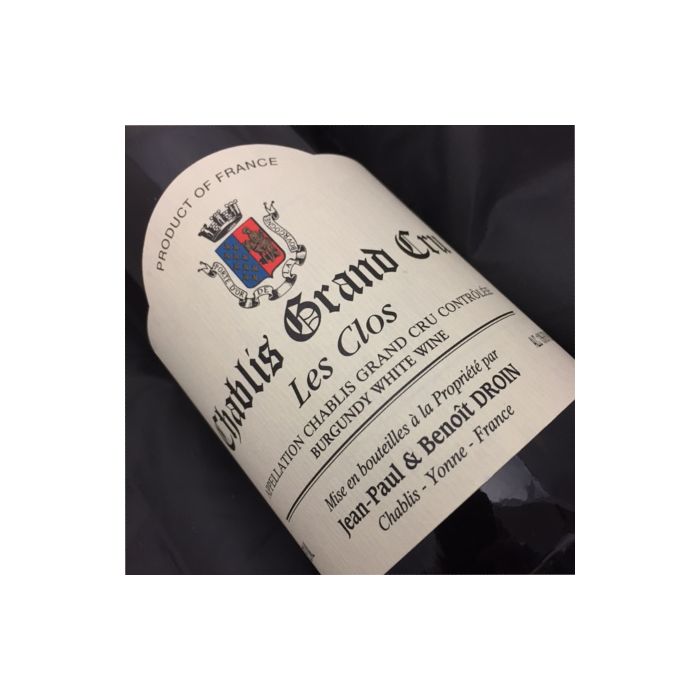
Domaine Jean Paul et Benoit Droin Chablis Les Clos 2019 Bottle (75cl)
The 2019 Domaine Jean Paul et Benoit Droin Chablis Les Clos is a Grand Cru white Burgundy wine from the Les Clos climat in the Chablis appellation. Produced exclusively from Chardonnay, it comes from a west/southwest-facing hillside where the estate describes Kimmeridgian soils that are more calcareous and stony at the top of the slope, more clayey at the bottom, with a vein of blue clay. The cuvée is vinified partly in stainless steel vats and partly in barrels, with native yeast fermentation and malolactic fermentation.
La bouteille proposée
- Size
- Bottle (75cl)
- Packaging
- Loose
- Label Condition
- Perfect
- Fill Level
- Perfect
- Capsule Condition
- Perfect
Identité du vin
- Couleur
- White
- Pays
- France
- Région
- Bourgogne
- Appellation
- Chablis
- Producteur / Domaine
- Domaine Jean Paul et Benoit Droin
- Parcelle / Cru
- Les Clos
- Millésime
- 2019
Cépage et assemblage
- Grape Variety
- 100% Chardonnay
Domaine Jean Paul et Benoit Droin
The Jean-Paul & Benoît Droin estate is a family-run estate based in Chablis, in the Yonne department. It cultivates 26 hectares spread across Petit Chablis, Chablis, nine Premiers Crus and five Grands Crus. Benoît Droin, representing the thirteenth generation of the family’s winegrowers in Chablis, now runs the estate and oversees its winemaking.
- Owner
- Famille Droin (Benoît Droin)
- Maître de chais
- Benoît Droin
- Surface (ha)
- 26.00 ha
Histoire du domaine
The Jean-Paul & Benoît Droin estate is part of the Droin family’s long-standing presence in the Chablis vineyards. The estate states that families bearing this name already owned vineyards in Chablis prior to 1537, whilst presenting this ancient lineage as plausible. The family has been cultivating vines in Chablis for nearly four centuries and, according to the estate’s website, Benoît Droin represents the thirteenth generation. In 1908, Louis Droin helped found the Chablis Winegrowers’ Union to combat fraud. He became president of the Union of Chablis Winegrowers and Owners in 1923, a year which also marked the start of the estate’s wines being sold in bottles. Marcel Droin co-founded the Yonne Wine Exhibition in 1949 and chaired the Yonne wine-growing associations from 1952 onwards. From 1973, Paul Droin began replanting the vineyard and developed the bottling of the estate’s production. Jean-Paul Droin joined the family estate in 1965; a first wine storehouse was built in 1981, and between 1984 and 1987 he and his wife Catherine acquired and rebuilt cellars in the centre of Chablis. Benoît Droin joined the estate in 1999 after training at the Beaune wine-growing college and obtaining the national oenology diploma in Dijon. Jean-Paul retired in 2014, whilst Benoît continues to run the estate, which bottles its entire production.
Les Clos
Les Clos is one of the seven officially recognized Climats within the Chablis Grand Cru appellation and the largest of them all, covering nearly 26 hectares. It occupies the entire height of the hillside on the right bank of the Serein and benefits from a south-westerly exposure as well as a relatively steep slope. The soils become more stony and chalky towards the top, while they are deeper and more clayey at the bottom. On the general scale of Chablis Grand Cru, the hillside rests on Kimmeridgian marls and limestones containing Exogyra virgula fossils, but this geology is not detailed separately for Les Clos by the sources consulted.
- Vineyard commune
- Chablis
- Origin of the vineyard name
- The name, formerly attested in the forms "le clou", "les clous" and "le clox", refers to the dry-stone walls that once surrounded the vineyards.
- Exposure
- South-west
- Slope
- Relatively steep
- Soil
- More stony and limestone at the top; deeper and clayey at the bottom
Le domaine dans cette parcelle
- Estate holding in the vineyard (ha)
- 1.419000 ha
- Vineyard holding status
- Farmed by the estate across three parcels; ownership not specified.
- Indicative vine age
- Average vine age: 40 years.
Histoire de la parcelle
The terroir was planted with vines before 1267 and may constitute the original core of the Chablis vineyard farmed by the Cistercians of Pontigny. Its former name forms evoke the walls that demarcated properties, limited erosion and protected the vines. Les Clos has been cited since the 19th century among the finest crus of Burgundy; the Chablis Grand Cru appellation was recognized on January 13, 1938.


