




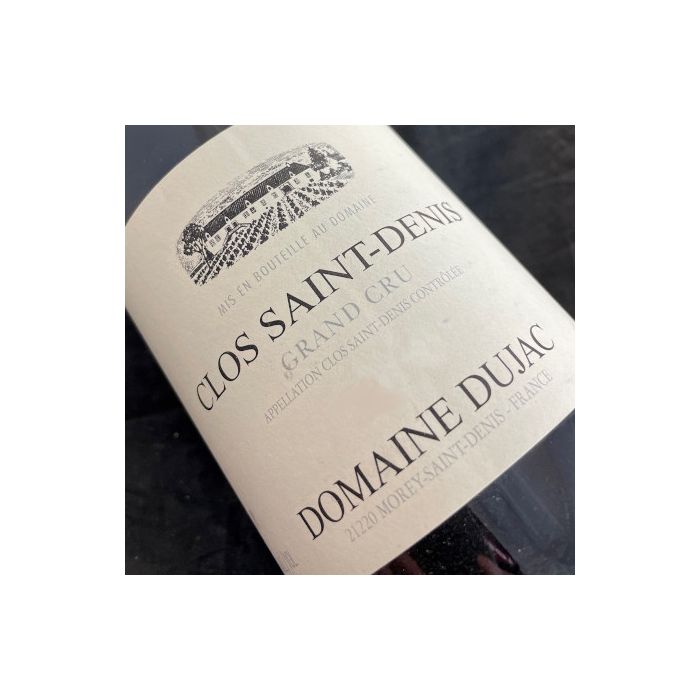
Domain Dujac Clos Saint Denis 2005
The 2005 Domaine Dujac Clos Saint-Denis is a red Burgundy from the Clos-Saint-Denis Grand Cru in the Morey-Saint-Denis appellation. Crafted from 100% Pinot Noir, it comes from the Clos-Saint-Denis parcel. The Wine Advocate awards it 95/100. The review describes a dense and firm wine, driven by ripe black cherry, smoky, herbal and brown spice nuances, a stony mineral backbone and abundant fine tannins. Its finish stands out for its length, with an aging potential of over ten years noted during the tasting.
La bouteille proposée
- Size
- Bottle (75cl)
- Packaging
- Loose
- Label Condition
- Perfect
- Fill Level
- Perfect
- Capsule Condition
- Perfect
Identité du vin
- Couleur
- Red
- Pays
- France
- Région
- Bourgogne
- Appellation
- Morey Saint Denis
- Producteur / Domaine
- Domaine Dujac
- Parcelle / Cru
- Clos-Saint-Denis
- Millésime
- 2005
Cépage et assemblage
- Grape Variety
- 100% Pinot Noir
Domaine Dujac
Domaine Dujac is a family-run estate based in Morey-Saint-Denis, in the Côte de Nuits, founded in 1968 by Jacques Seysses. Cultivating 17.5 hectares spread across the Côte de Nuits and leased vineyards in Puligny-Montrachet, it is now run by the Seysses family. The vineyard has been certified organic since 2011.
- Owner
- Famille Seysses
- Maître de chais
- Diana Snowden Seysses
- Surface (ha)
- 17.50 ha
- Production (average bottles per vintage)
- environ 70 000 bouteilles/an
Histoire du domaine
Jacques Seysses founded Domaine Dujac in 1968 after learning the art of winemaking from Gérard Potel at the Domaine de la Pousse d’Or in Volnay during the 1966 and 1967 harvests. He then acquired the Domaine Graillet in Morey-Saint-Denis and renamed it Dujac, a name derived from ‘du Jacques’. His wife Rosalind joined him in this venture after their marriage in 1973 and helped develop the estate. The vineyard, which initially covered around 5 hectares, expanded to 11 hectares in 1977 and then to 15.5 hectares in 2005 following a series of acquisitions. In 1998, their son Jeremy joined the estate, followed by Diana Snowden, who became his wife, in 2001, and then by his brother Alec in 2003. Jacques Seysses handed over the running of the estate to Jeremy and Alec in 2007, whilst Diana Snowden Seysses took charge of the winery. In 2011, the estate obtained organic farming certification. In 2014, it took on the lease of vineyards in Puligny-Montrachet, notably in the Premier Cru vineyards Les Folatières and Les Combettes. The estate now cultivates 17.5 hectares and remains owned by the Seysses family.
Clos-Saint-Denis
Clos Saint-Denis is both a Grand Cru appellation and a physically demarcated terroir in Morey-Saint-Denis. Its vineyard area includes the historical clos as well as plots from neighboring lieux-dits recognized for equivalent quality, notably Calouère, Les Chaffots, and Maison Brûlée. Located in the lower half of the Côte, it benefits from the rising sun, a moderate slope, and shallow, well-draining soils over a fractured marly-limestone substrate.
- Vineyard commune
- Morey-Saint-Denis
- Origin of the vineyard name
- The name recalls the medieval attachment of the clos to the collegiate church of Saint-Denis de Vergy, chapel of the Château de Vergy.
- Exposure
- facing the rising sun, primarily east
- Altitude
- 280–310 m
- Slope
- moderate, gentler in the lower part
- Soil
- Slightly developed soils, generally carbonated, shallow and well-draining, with a high clay content; clayey colluvium with limestone gravel and pebbles. The Clos Saint-Denis sector also features brown calcareous soils free of gravel.
- Subsoil and geology
- Jurassic marly-limestone substrate: Bajocian crinoidal limestone in the lower part, intermediate marly level, and hard yet frost-susceptible Bathonian limestone towards the top; fractured limestone substrate beneath thin scree deposits, clays, and red silts.
Le domaine dans cette parcelle
- Estate holding in the vineyard (ha)
- 1.460000 ha
- Year the vineyard was acquired
- 1968
- Vineyard holding status
- owner of two plots
- Indicative vine age
- Two plots planted in several stages, with vines of various ages.
Histoire de la parcelle
The origin of Clos Saint-Denis dates back to the 11th century, when it depended on the collegiate church of Saint-Denis de Vergy; its first known written mention dates from 1367. The historical clos, measuring just over two hectares, appears never to have been truly enclosed by walls; long consisting of a single plot, it was divided in the 20th century. Owned by the canons until the French Revolution, it was dispersed after it, and its name was extended from the early 19th century to the wines of a larger neighborhood. The cru was classified as first growth in the 1860 Beaune Viticulture Committee classification; its geographical entity was stabilized in the early 20th century, and the AOC was recognized by decree on December 8, 1936.


