




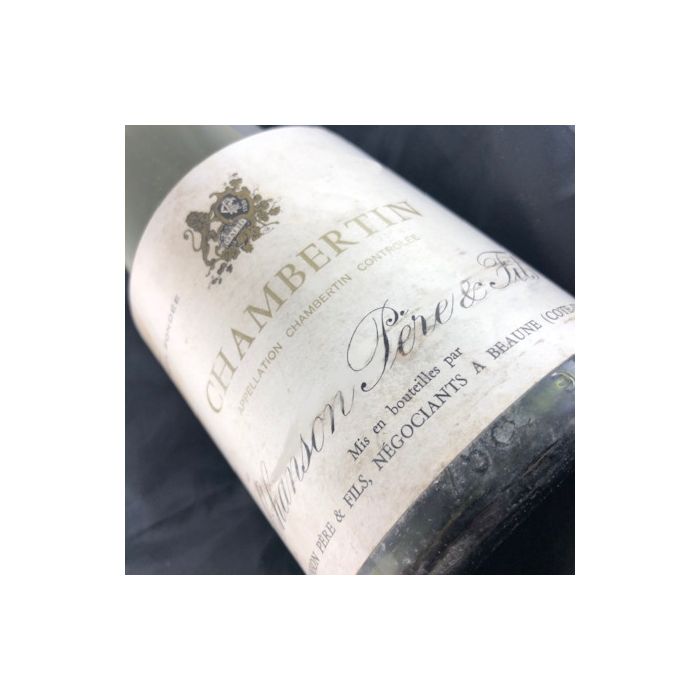
Domain Chanson Chambertin 1979 -6cm
The 1979 Domaine Chanson Chambertin is a red Burgundy wine produced by Domaine Chanson Père et Fils, originating from the Chambertin climat in Gevrey-Chambertin. Classified as a Burgundy Grand Cru, it is crafted exclusively from Pinot Noir. The Chambertin climat belongs to the collection of Côte de Nuits grands crus located within the commune of Gevrey-Chambertin, a parcel origin that defines the identity of this 1979 cuvée.
La bouteille proposée
- Size
- Bottle (75cl)
- Packaging
- Loose
- Label Condition
- Perfect
- Fill Level
- -6cm
- Capsule Condition
- Perfect
Identité du vin
- Couleur
- Red
- Pays
- France
- Région
- Bourgogne
- Appellation
- Gevrey Chambertin
- Producteur / Domaine
- Domaine Chanson Père et Fils
- Parcelle / Cru
- Chambertin
- Millésime
- 1979
Cépage et assemblage
- Grape Variety
- 100% Pinot Noir
Domaine Chanson Père et Fils
Domaine Chanson Père et Fils is a Burgundian wine house and estate established in Beaune since 1750. Owned by the Bollinger Group since 1999, it cultivates 88 hectares spread across the Côte de Beaune and the Côte Chalonnaise, notably in Beaune, Pernand-Vergelesses, Savigny-lès-Beaune, Mercurey and Rully. The wines are matured at the Bastion de l’Oratoire, a former 15th-century defensive tower situated within the ramparts of Beaune.
- Owner
- Groupe Bollinger
- Maître de chais
- Lucy Auger
- Surface (ha)
- 88.00 ha
Histoire du domaine
The estate was founded in 1750 by Simon Verry in Beaune. In 1794, his widow acquired the Bastion de l’Oratoire, a 15th-century building which remains a site for ageing the estate’s wines. The Chanson family took over from the Verry family in 1847, under the leadership of Alexis Chanson. In 1900, the Clos des Fèves was awarded a gold medal at the Paris World’s Fair. The house’s wines have been sold on the American market since 1916. A modern winery was built in Savigny-lès-Beaune in 1972, then extended in 1980 and refurbished in 2009. In 1999, Philippe and François Marion-Chanson sold the estate to the Bollinger Group, which still owns it today. New plots were acquired in 2007, notably in Chassagne-Montrachet and Puligny-Montrachet. In 2023, the acquisition of Château d’Etroyes added 45 hectares in the Côte Chalonnaise, mainly in Mercurey and Rully, bringing the vineyard area to 88 hectares. The Côte de Beaune vineyard will be certified organic from the 2024 vintage onwards. Lucy Auger, who has been at the helm of the winery since 2020, is currently responsible for winemaking and ageing.
Chambertin
Chambertin is both a physically demarcated climat in Gevrey-Chambertin and the eponymous terroir of a Grand Cru appellation reserved for red wines. It occupies the middle of the slope, with an easterly exposure and a relatively moderate gradient compared to the neighboring Clos de Bèze. Its shallow, stony calcareous brown soils overlie entroquitic limestones and Bajocian marls, with a Bathonian component in the upper part.
- Vineyard commune
- Gevrey-Chambertin
- Origin of the vineyard name
- The toponym means "Bertin's field", named after a former owner or operator of the site; older forms such as "Champ Bretin" and "Champt Berthin" are attested in 1584.
- Exposure
- East, facing the rising sun
- Slope
- Mid-slope, relatively moderate gradient
- Soil
- Calcareous brown, stony soils beneath a thin cover of silts and scree.
- Subsoil and geology
- Entroquitic limestones and Bajocian marls; Bathonian calcareous clays towards the top.
Histoire de la parcelle
The name Chambertin has been known since the 13th century, and its winegrowing potential has been recognized for centuries. Thomas Jefferson cited it among his favorite wines in 1787, while Napoleon I's predilection for this wine contributed to its renown. In 1855, Jules Lavalle classified it as "Tête de cuvée, cru hors ligne, vin extra". On October 17, 1847, its name was joined to that of Gevrey to form Gevrey-Chambertin; the Chambertin appellation was officially recognized on July 31, 1937.


