




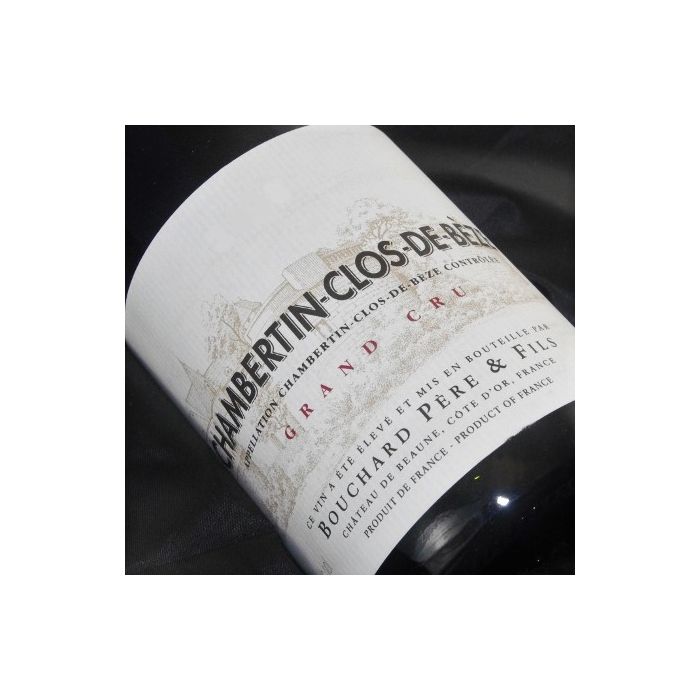
Domain Bouchard Chambertin Clos de Beze 2009 Double-Magnum
The 2009 Domaine Bouchard Père et Fils Chambertin-Clos-de-Bèze Grand Cru is a red Burgundy wine from the Gevrey-Chambertin appellation. Crafted exclusively from Pinot Noir, it originates from the Chambertin-Clos-de-Bèze parcel and holds the Bourgogne Grand Cru classification. Jancis Robinson awards it 18,5/20 and recommends drinking from 2018 to 2030. Critics highlight its dry density, intensity, and vibrant freshness, with a dry finish devoid of any drying character.
La bouteille proposée
- Size
- Jeroboam (300cl)
- Packaging
- Original Wooden Case of 1
- Label Condition
- Perfect
- Fill Level
- Perfect
- Capsule Condition
- Perfect
Identité du vin
- Couleur
- Red
- Pays
- France
- Région
- Bourgogne
- Appellation
- Gevrey Chambertin
- Producteur / Domaine
- Domaine Bouchard Père et Fils
- Parcelle / Cru
- Chambertin-Clos-de-Bèze
- Millésime
- 2009
Cépage et assemblage
- Grape Variety
- 100% Pinot Noir
Domaine Bouchard Père et Fils
Based in Beaune, Bouchard Père & Fils is a Burgundian estate whose commercial activities date back to 1731 and whose first vineyards were planted in 1775. Having joined Artémis Domaines in late 2022, it now cultivates around 60 hectares in the Côte de Beaune, mainly in Beaune, Volnay, Monthélie, Pommard and Meursault. All of its plots will be certified organic from the 2025 vintage onwards.
- Owner
- Artémis Domaines
- Maître de chais
- Mickaël Baroin
- Surface (ha)
- 60.00 ha
Histoire du domaine
Michel Bouchard, a cloth and fabric merchant originally from the Dauphiné region, settled in Beaune in 1731 and simultaneously established a wine trading business. His son Joseph became his partner in 1746, before taking over the business in 1750. In 1775, Joseph Bouchard acquired his first plots in the Les Combes vineyard in Pommard, marking the birth of the wine estate. In 1820, Bernard Bouchard purchased the Château de Beaune, whose underground galleries were gradually converted into ageing cellars; the estate’s headquarters have been based there since 1872. The Henriot family took control of Bouchard Père & Fils in 1995, and Joseph Henriot began acquiring further vineyards in 1996. The estate joined Artémis Domaines at the end of 2022. From 2024, the wine merchant business was discontinued in order to focus on the estate’s own vineyards and those under lease. As part of a reorganisation of the Côte de Beaune vineyard, Bouchard Père & Fils now focuses on around 60 hectares; Mickaël Baroin, technical director, oversees the winemaking. The conversion to organic farming, which began in 2009, will result in all plots being certified from the 2025 vintage onwards.
Chambertin-Clos-de-Bèze
Chambertin-Clos de Bèze is a physically delimited Grand Cru appellation whose parcel area corresponds exclusively to the "Clos de Bèze" lieu-dit in Gevrey-Chambertin. The terroir occupies an east-facing hillside, with piedmont plots at the heart of a small amphitheater. The shallow, well-draining, carbonated clay-limestone soils combine scree, clays, and red silts. They primarily overlie a Bajocian substratum of crinoidal limestone and marly levels.
- Vineyard commune
- Gevrey-Chambertin
- Origin of the vineyard name
- The name "Clos de Bèze" recalls the former wine estate of the Abbaye de Bèze, which owned the site as early as the 7th century; the term "clos" has survived despite the disappearance of its walls.
- Exposure
- Levant, generally east-facing
- Slope
- Piedmont, at the heart of a small amphitheater
- Soil
- Shallow, carbonated, and well-draining clay-limestone soils, with scree, clays, and red silts.
- Subsoil and geology
- Plateau of hard Bajocian crinoidal limestone, with marly levels; Bathonian towards the upper part.
Le domaine dans cette parcelle
- Vineyard holding status
- Purchase of grapes under multi-year agreement, ended after the 2022 vintage
- Indicative vine age
- Vines aged approximately 45 to 50 years for the plot supplying the 2022 vintage.
Histoire de la parcelle
Clos de Bèze has been known since the 7th century, and the BIVB dates its entry into history to 640 as a monastic property of the Abbaye de Bèze. It was transferred to the Chapter of Langres in the early 13th century, then remained in the hands of the canons until the French Revolution, when it was divided among multiple owners. The Chambertin-Clos de Bèze appellation d'origine contrôlée was recognized by the decree of July 31, 1937; its delimited parcel area corresponds exclusively to the lieu-dit Clos de Bèze.


