




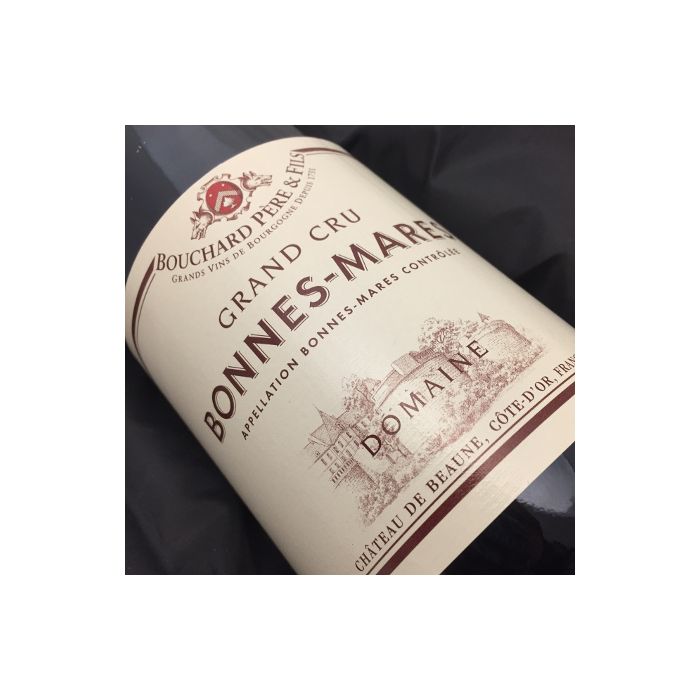
Domain Bouchard Pere et Fils Bonnes Mares 2005
The 2005 Domaine Bouchard Père et Fils Bonnes-Mares is a red Burgundy wine from the Bonnes-Mares parcel in the Chambolle-Musigny appellation, classified as a Grand Cru. Crafted exclusively from Pinot Noir, it comes from a 0.24-hectare plot acquired by the estate in 1996, with an annual production of just over 1,000 bottles. Harvesting is done by hand, followed by vinification in small vats; aging lasts 12 to 14 months in French oak barrels, with 45 to 60% new wood.
La bouteille proposée
- Size
- Bottle (75cl)
- Packaging
- Loose
- Label Condition
- Perfect
- Fill Level
- Perfect
- Capsule Condition
- Perfect
Identité du vin
- Couleur
- Red
- Pays
- France
- Région
- Bourgogne
- Appellation
- Chambolle Musigny
- Producteur / Domaine
- Domaine Bouchard Père et Fils
- Parcelle / Cru
- Bonnes-Mares
- Millésime
- 2005
Cépage et assemblage
- Grape Variety
- 100% Pinot Noir
Domaine Bouchard Père et Fils
Based in Beaune, Bouchard Père & Fils is a Burgundian estate whose commercial activities date back to 1731 and whose first vineyards were planted in 1775. Having joined Artémis Domaines in late 2022, it now cultivates around 60 hectares in the Côte de Beaune, mainly in Beaune, Volnay, Monthélie, Pommard and Meursault. All of its plots will be certified organic from the 2025 vintage onwards.
- Owner
- Artémis Domaines
- Maître de chais
- Mickaël Baroin
- Surface (ha)
- 60.00 ha
Histoire du domaine
Michel Bouchard, a cloth and fabric merchant originally from the Dauphiné region, settled in Beaune in 1731 and simultaneously established a wine trading business. His son Joseph became his partner in 1746, before taking over the business in 1750. In 1775, Joseph Bouchard acquired his first plots in the Les Combes vineyard in Pommard, marking the birth of the wine estate. In 1820, Bernard Bouchard purchased the Château de Beaune, whose underground galleries were gradually converted into ageing cellars; the estate’s headquarters have been based there since 1872. The Henriot family took control of Bouchard Père & Fils in 1995, and Joseph Henriot began acquiring further vineyards in 1996. The estate joined Artémis Domaines at the end of 2022. From 2024, the wine merchant business was discontinued in order to focus on the estate’s own vineyards and those under lease. As part of a reorganisation of the Côte de Beaune vineyard, Bouchard Père & Fils now focuses on around 60 hectares; Mickaël Baroin, technical director, oversees the winemaking. The conversion to organic farming, which began in 2009, will result in all plots being certified from the 2025 vintage onwards.
Bonnes-Mares
Bonnes-Mares is a physically delineated Grand Cru of the Côte de Nuits, split between Chambolle-Musigny and Morey-Saint-Denis, with the largest portion located in Chambolle-Musigny. The vineyard forms approximately a rectangle south of Clos de Tart, on a gently sloping hillside with an easterly exposure. The light, gravelly, brown to reddish soils containing clay with flint rest on Jurassic limestone and white marl.
- Vineyard commune
- Chambolle-Musigny (principalement) et Morey-Saint-Denis
- Origin of the vineyard name
- Name attested since the late Middle Ages, of uncertain etymology. The BIVB favors the hypothesis of the old verb "marer", meaning to cultivate with care, rather than a reference to mother goddesses.
- Exposure
- east
- Altitude
- 250–280 m
- Slope
- gentle slope
- Soil
- Light and gravelly soil, brown or reddish, predominantly clayey with flint, approximately 40 cm deep.
- Subsoil and geology
- Limestone slab and white marl of Jurassic origin, dating back approximately 150 million years.
Le domaine dans cette parcelle
- Estate holding in the vineyard (ha)
- 0.240000 ha
- Year the vineyard was acquired
- 1996
- Vineyard holding status
- Owned by Bouchard, but farmed by Domaine d’Eugénie since the 2023 harvest.
- Indicative vine age
- Old vines according to a professional source, with no verifiable numerical age published.
Histoire de la parcelle
The vineyard has been known as Bonnes-Mares since the late Middle Ages. The appellation of origin was recognized by the decree of December 8, 1936. Its production parcel area was subsequently approved by the INAO during the sessions of July 24, 1965 and June 1-2, 1988.


