




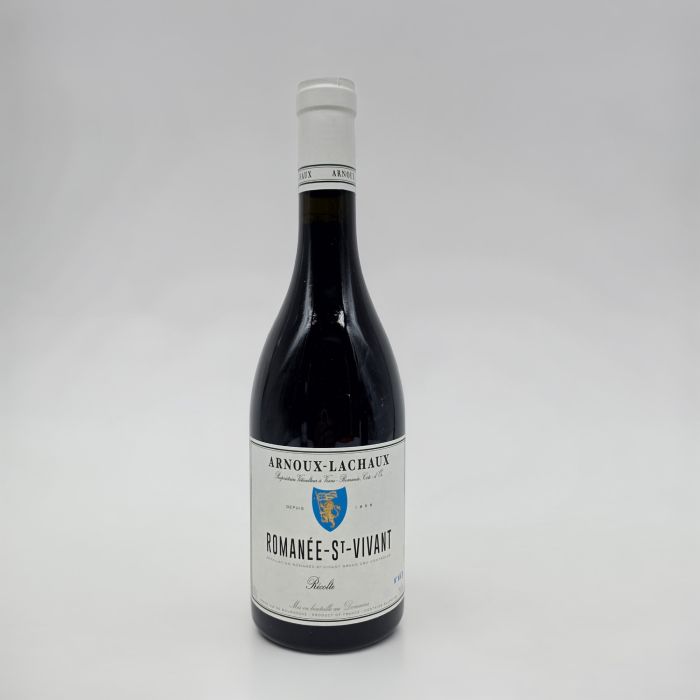
Domaine Arnoux Lachaux Romanee Saint Vivant 2021 Bouteille (75cl)
Le Domaine Arnoux-Lachaux Romanée-Saint-Vivant 2021 is a red Burgundy wine produced in Vosne-Romanée. Sourced from the Romanée-Saint-Vivant parcel and classified as a Grand Cru de Bourgogne, it is made exclusively from Pinot Noir. The estate, founded in Vosne-Romanée in 1858, is currently managed by Florence Arnoux-Lachaux along with her son Charles Lachaux. This vintage has an alcohol by volume of 13.5%.
La bouteille proposée
- Size
- Bottle (75cl)
- Packaging
- Loose
- Label Condition
- Perfect
- Fill Level
- Perfect
- Capsule Condition
- Perfect
Identité du vin
- Couleur
- Red
- Pays
- France
- Région
- Bourgogne
- Appellation
- Vosne Romanée
- Producteur / Domaine
- Domaine Arnoux Lachaux
- Parcelle / Cru
- Romanée-Saint-Vivant
- Millésime
- 2021
Cépage et assemblage
- Grape Variety
- 100% Pinot Noir
Domaine Arnoux Lachaux
Domaine Arnoux-Lachaux is a 14-hectare family-run estate based in Vosne-Romanée, in the Côte de Nuits. Founded in 1858, it is now run by Florence Arnoux-Lachaux, alongside her son Charles Lachaux, who is responsible for the vineyards and winemaking. The vineyard is managed using regenerative and biodynamic farming practices.
- Owner
- Florence Arnoux-Lachaux
- Maître de chais
- Charles Lachaux
- Surface (ha)
- 14.00 ha
- Production (average bottles per vintage)
- 40 000 bouteilles/an
Histoire du domaine
The estate was founded in Vosne-Romanée in 1858, following the union of the Arnoux and Salbreux winegrowing families. It subsequently took the name Domaine Robert Arnoux when Robert Arnoux took over the estate in 1957 following the death of his father, Charles Arnoux. Robert Arnoux developed the estate’s in-house bottling operations from the late 1950s and early 1960s onwards. Following his death in February 1995, his daughter Florence Arnoux and her husband Pascal Lachaux continued to run the estate. The estate took the name Domaine Arnoux-Lachaux from the 2007 vintage onwards. Charles Lachaux joined the family business in 2011 and has been in charge of winemaking since the 2012 vintage. Under his leadership, the estate has adopted practices including biodynamics, eco-grazing, goblet pruning, higher trellising and the cessation of leaf removal. Since 2012, winemaking has been carried out using whole bunches, with short vatting periods and minimal intervention. From the 2022 harvest onwards, the estate has replaced oak barrels with stoneware vessels for ageing.
Romanée-Saint-Vivant
Romanée-Saint-Vivant is a physically demarcated climat of Vosne-Romanée corresponding to a Grand Cru appellation reserved for red wines. Located on a gentle piedmont plateau overlooking the village, between 247 and 260 meters, it slopes gently eastward. Its shallow, clayey, carbonate-rich soils with high iron oxide content cover a well-draining limestone subsoil, with a conglomeratic formation in its eastern part.
- Vineyard commune
- Vosne-Romanée
- Origin of the vineyard name
- The name "Romanée de Saint-Vivant" is recorded in 1765. "Romanée" was borrowed from a small neighboring parcel, while "Saint-Vivant" recalls the Cluniac monastery that historically owned the vineyard.
- Exposure
- eastward
- Altitude
- 247–260 m
- Slope
- gentle slope on a slight plateau
- Soil
- Slightly developed, carbonated, and shallow soils, heavily clayey, rich in iron oxides; colluvium of scree, clays, and silts.
- Subsoil and geology
- Bajocian entroquitic limestones; to the east, a conglomerate of limestone blocks in a salmon-pink marly matrix.
Le domaine dans cette parcelle
- Estate holding in the vineyard (ha)
- 0.350000 ha
- Year the vineyard was acquired
- 1984
- Vineyard holding status
- Owner
- Indicative vine age
- Vines planted in 1926.
Histoire de la parcelle
The Cluniac monastery of Saint-Vivant owned a wine estate in Vosne as early as the Middle Ages, consisting of clos precisely listed in 1512. The current climat brings together the former Cloux des Neuf Journaux, des Quatre Journaux, and du Moytant. Confiscated as ecclesiastical property during the French Revolution, it was acquired by the Marey-Monge family, who kept it until 1898 before it was partially divided. Already placed in the top categories of the 1816, 1855, and 1860 classifications, Romanée-Saint-Vivant was recognized as an appellation d'origine contrôlée on September 11, 1936.


