




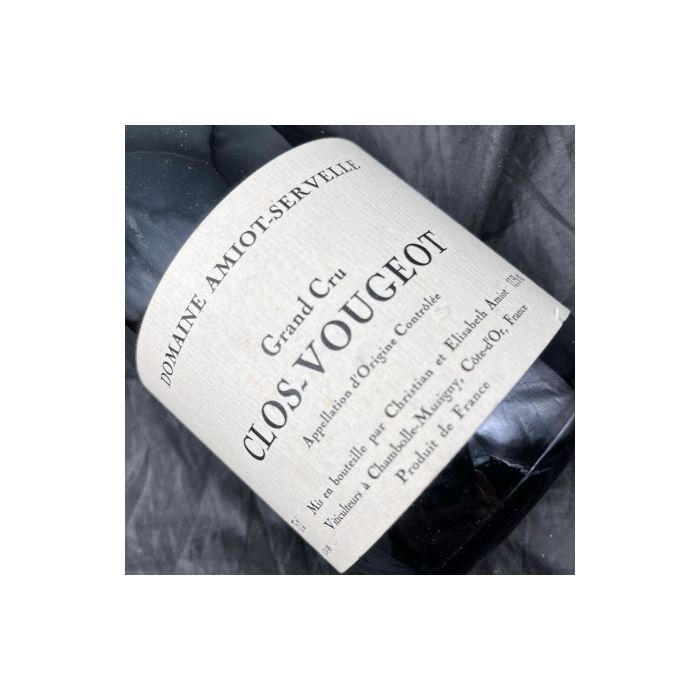
Domain Amiot Servelle Clos Vougeot 1995
The 1995 Domaine Amiot Servelle Clos Vougeot is a red Burgundy wine from the Vougeot appellation, classified as a Grand Cru. Produced by Domaine Amiot Servelle from the Clos de Vougeot parcel, it is crafted from 100% Pinot Noir, sourced from vines planted in 1942. The Wine Advocate awarded it 92/100 and recommended drinking it from 2004 to 2012. Critics describe a powerful and structured wine with ripe tannins, driven by red fruits, spices, floral notes, and a hint of fresh ginger.
Identité du vin
- Couleur
- Red
- Pays
- France
- Région
- Bourgogne
- Appellation
- Vougeot
- Producteur / Domaine
- Domaine Amiot Servelle
- Parcelle / Cru
- Clos de Vougeot
Cépage et assemblage
- Grape Variety
- 100% Pinot Noir
Domaine Amiot Servelle
Domaine Amiot-Servelle is a family-run estate in Chambolle-Musigny, in the heart of the Côte de Nuits. It cultivates 8 hectares, mainly in the commune of Chambolle-Musigny, supplemented by plots in Morey-Saint-Denis and Gevrey-Chambertin. Certified as an organic wine estate since 2008, it is now run by Prune and Antoine Amiot.
- Owner
- Prune et Antoine Amiot
- Maître de chais
- Prune Amiot
- Surface (ha)
- 8.00 ha
- Production (average bottles per vintage)
- 30 000 bouteilles/an
Histoire du domaine
The estate’s origins date back to the 1920s, when Clément Tachot began cultivating a few vines in Chambolle-Musigny. In the 1950s, his daughter Cécile Tachot and her husband Jean Servelle took over the business and established Domaine Servelle-Tachot. Christian Amiot, from a family of winegrowers in Morey-Saint-Denis and husband of Élisabeth Servelle, joined the estate in 1980. Following the death of Jean Servelle in 1989, Christian and Élisabeth took over the estate, which was then renamed Amiot-Servelle. The estate switched its vineyards to organic farming in 2003 and obtained AB certification in 2008. In 2010, it expanded to include around one hectare of family-owned vineyards in Morey-Saint-Denis and Gevrey-Chambertin, notably comprising plots in Clos Saint-Denis and Charmes-Chambertin. Prune Amiot, who graduated with a degree in oenology in 2004, returned to work at the estate in 2011 after gaining several years’ professional experience. Antoine Amiot subsequently joined the business, and the two siblings have since taken over the management of the estate. Prune Amiot is responsible for winemaking. A new cellar and vinification facility, to be used from the 2022 harvest onwards, will allow for greater use of gravity in the winemaking process.
Clos de Vougeot
The Clos de Vougeot is a vast, single-piece vineyard enclosure, surrounded by walls and located at the foot of the Côte de Nuits slope, in the commune of Vougeot. Its terroir varies markedly from top to bottom: thin, gravelly soils on Bajocian limestone in the upper part, more clayey brown soils on limestone debris in the middle, and deeper, clayey and silty soils on a marly layer in the lower part. The site simultaneously constitutes a physically demarcated Burgundian climat and the emblematic parcel area of the AOC Grand Cru Clos de Vougeot or Clos Vougeot.
- Vineyard commune
- Vougeot
- Origin of the vineyard name
- "Clos" designates the vineyard historically enclosed by walls; "Vougeot" takes up the name of the place, linked to the Vouge which marks a historical boundary of the estate.
- Altitude
- 240–265 m
- Slope
- gentle, average of about 3.8%
- Soil
- At the top, shallow, granular soils rich in gravel; in the middle, shallow, more clayey brown soils on limestone debris; at the bottom, deeper brown soils rich in clay and fine silt.
- Subsoil and geology
- Jurassic complex; Bajocian limestone slab in the upper part, limestone debris in the middle, and marly layer in the lower part, with the influence of superficial formations linked to the outlet of the combe d'Orveau.
Le domaine dans cette parcelle
- Vineyard holding status
- Historically documented sharecropping
Histoire de la parcelle
The wine estate was gradually established by the Cistercian abbey of Cîteaux starting from the early 12th century; a medieval agreement set boundaries that have remained almost unchanged, and the wall was built before the end of that century. The farm buildings were developed from the 12th to the 15th century, then complemented in 1551 by the Renaissance residence that became the château du Clos de Vougeot. The abbey kept the estate until the Revolution; the buildings and vineyards were confiscated and then sold as national property in 1791, subsequently leading to the fragmentation of the property. The appellation d'origine contrôlée Clos de Vougeot or Clos Vougeot was recognized by decree on July 31, 1937.


