




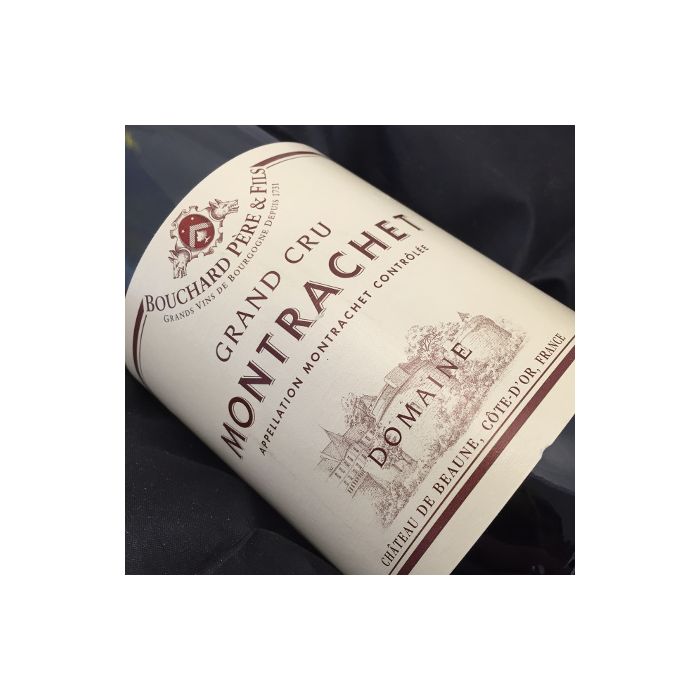
Domain Bouchard Pere et Fils Montrachet 1998
Domaine Bouchard Père et Fils Montrachet 1998 is a white Burgundy wine from the Grand Cru-classified Montrachet appellation, made from 100% Chardonnay. This cuvée comes from the Montrachet parcel owned by the estate, whose productive surface area reaches 0.89 hectares. Located between Puligny-Montrachet and Chassagne-Montrachet, this vineyard benefits from an east to southeast exposure and clay-marl soils that are deeper and richer than those of Chevalier-Montrachet.
La bouteille proposée
- Size
- Bottle (75cl)
- Packaging
- Gift Box
- Label Condition
- Perfect
- Fill Level
- Perfect
- Capsule Condition
- Perfect
Identité du vin
- Couleur
- White
- Pays
- France
- Région
- Bourgogne
- Appellation
- Puligny Montrachet
- Producteur / Domaine
- Domaine Bouchard Père et Fils
- Parcelle / Cru
- Montrachet
- Millésime
- 1998
Cépage et assemblage
- Grape Variety
- 100% Chardonnay
Domaine Bouchard Père et Fils
Based in Beaune, Bouchard Père & Fils is a Burgundian estate whose commercial activities date back to 1731 and whose first vineyards were planted in 1775. Having joined Artémis Domaines in late 2022, it now cultivates around 60 hectares in the Côte de Beaune, mainly in Beaune, Volnay, Monthélie, Pommard and Meursault. All of its plots will be certified organic from the 2025 vintage onwards.
- Owner
- Artémis Domaines
- Maître de chais
- Mickaël Baroin
- Surface (ha)
- 60.00 ha
Histoire du domaine
Michel Bouchard, a cloth and fabric merchant originally from the Dauphiné region, settled in Beaune in 1731 and simultaneously established a wine trading business. His son Joseph became his partner in 1746, before taking over the business in 1750. In 1775, Joseph Bouchard acquired his first plots in the Les Combes vineyard in Pommard, marking the birth of the wine estate. In 1820, Bernard Bouchard purchased the Château de Beaune, whose underground galleries were gradually converted into ageing cellars; the estate’s headquarters have been based there since 1872. The Henriot family took control of Bouchard Père & Fils in 1995, and Joseph Henriot began acquiring further vineyards in 1996. The estate joined Artémis Domaines at the end of 2022. From 2024, the wine merchant business was discontinued in order to focus on the estate’s own vineyards and those under lease. As part of a reorganisation of the Côte de Beaune vineyard, Bouchard Père & Fils now focuses on around 60 hectares; Mickaël Baroin, technical director, oversees the winemaking. The conversion to organic farming, which began in 2009, will result in all plots being certified from the 2025 vintage onwards.
Montrachet
Montrachet is a physically delimited climat and Grand Cru appellation shared between Puligny-Montrachet and Chassagne-Montrachet. Its vines occupy a narrow, elongated strip, perpendicular to the slope, in a slight concavity in the lower part of the east- and southeast-facing hillside. The terroir combines red, clayey, calcareous, and very stony soils with Jurassic substrates differentiated by a fault. Its rapid drainage and nocturnal air drainage limit humidity and frost risks.
- Vineyard commune
- Puligny-Montrachet et Chassagne-Montrachet
- Origin of the vineyard name
- The name comes from "Mont Rachet," understood as "bald mountain" or "barren mountain," probably referring to the sparsely vegetated promontory overlooking the site; "râche" is a regional term designating ringworm or scurf.
- Exposure
- East to southeast
- Altitude
- 250–270 m
- Slope
- Lower part of the hillside; strip perpendicular to the slope
- Soil
- Red, clayey, calcareous, very stony, and well-structured soils; locally lean and very stoney soils.
- Subsoil and geology
- Fault separating two sectors; Oxfordian marls rich in iron oxides over Bajocian/Callovian flaggy limestones, with locally highly fragmented Bathonian limestones.
Le domaine dans cette parcelle
- Estate holding in the vineyard (ha)
- 0.890000 ha
- Year the vineyard was acquired
- 1838
- Vineyard holding status
- Owner, estate parcel in production
Histoire de la parcelle
The cru is attested as early as the 13th century in the form "Mont Rachaz." It truly took off in the 18th century under the impetus of the Clermont-Montoison family, lords of Chagny, and Thomas Jefferson placed it on par with Chambertin in 1787. Puligny and Chassagne appended the name Montrachet to their village names in 1878. A Beaune court ruling defined the appellation of origin in 1921, and the Montrachet AOC was subsequently recognized on July 31, 1937.


