




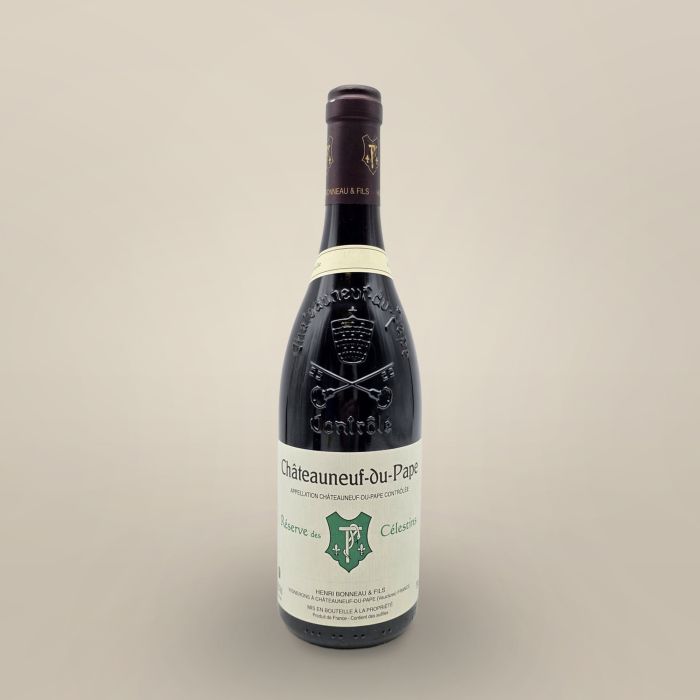
Henri Bonneau CDP Rouge Reserve des Celestins 1984
Domaine Henri Bonneau Réserve des Célestins 1984 is a red Châteauneuf-du-Pape wine from the Rhône Valley. This cuvée blends Counoise, Grenache, Mourvèdre, and Syrah. Réserve des Célestins corresponds to a selection of the estate's finest barrels, produced only in certain vintages. Vinification is traditionally carried out in concrete vats with unstemmed grapes, followed by aging in old foudres and French oak barrels for several years.
La bouteille proposée
- Size
- Bottle (75cl)
- Packaging
- Loose
- Label Condition
- Perfect
- Fill Level
- Perfect
- Capsule Condition
- Perfect
Identité du vin
- Couleur
- Red
- Pays
- France
- Région
- Rhone
- Appellation
- Châteauneuf Du Pape
- Producteur / Domaine
- Domaine Henri Bonneau
- Cuvée
- Réserve des Célestins
- Millésime
- 1984
Cépage et assemblage
- Grape Variety
- Counoise, Grenache, Mourvèdre, Syrah
Domaine Henri Bonneau
Domaine Henri Bonneau is a Châteauneuf-du-Pape producer based in the heart of the village of the same name, in the southern Rhône. Henri Bonneau, the twelfth generation of a local family of winegrowers, produced his first vintage in 1956. The estate mainly cultivates Grenache on small plots, notably on the La Crau plateau, and continues its operations under the supervision of Daniel Combin, with Régis Charmasson in charge of vineyard and cellar operations.
- Owner
- Famille Bonneau (succession d’Henri Bonneau, dont Marcel Bonneau)
- Maître de chais
- Régis Charmasson
- Surface (ha)
- 10.00 ha
- Production (average bottles per vintage)
- 25 000 bouteilles/an
Histoire du domaine
According to the *Revue du vin de France*, the Bonneau family has been established in the Châteauneuf-du-Pape vineyards since 1667. Born in 1938, Henri Bonneau represented the twelfth generation of winemakers in the family. He left school at the age of fourteen to work in the vineyards with his father and produced his first vintage in 1956. His Châteauneuf-du-Pape vineyard consisted mainly of Grenache, supplemented in particular by Mourvèdre, Counoise and Vaccarèse. The wines were vinified in concrete vats using indigenous yeasts, then aged for a long time in old wooden casks before blending and bottling. In 2001, Henri Bonneau and his son Marcel acquired vineyards in the Gard region, which gave rise to the ‘Les Rouliers’ cuvée, marketed as a ‘Vin de France’. Henri Bonneau passed away on 21 March 2016. Following his death, his former business partner Daniel Combin took over the estate and entrusted Régis Charmasson with the day-to-day management of the vineyards and the winery. Marcel Bonneau, who previously worked with his father, remains associated with the estate’s name and history, but recent sources primarily identify Daniel Combin and Régis Charmasson as being responsible for its day-to-day management.
Réserve des Célestins
Réserve des Célestins is the estate's flagship great wine, produced only when quality permits. It does not correspond to a fixed parcel selection: its blend is decided late through the tasting of various lots, with a generally significant contribution from wines originating from La Crau. The cuvée benefits from traditional vinification and the particularly long aging in old vessels that is characteristic of the estate.
- Cuvée creation year
- 1927
- Style of the cuvée
- Traditional red Châteauneuf-du-Pape, dominated by Grenache, generally powerful, deep and concentrated, with great aromatic complexity and a strong aging potential. Its extended aging in old wood fosters an evolving and patinaed profile rather than a new oak character.
- Position within the range
- Flagship great wine of the estate, crafted exclusively when the selection reaches the required level.
Histoire de la cuvée
The reference dates back to 1927, the documented year of the estate's first bottling and the initial registration of the name "Clos des Célestins"; this phrasing was reportedly refused because the vineyard in question was not a walled clos. Having become Réserve des Célestins, it has been maintained as the estate's most demanding selection: certain vintages or certain casks initially considered could be set aside or redirected into another cuvée after tasting.


