




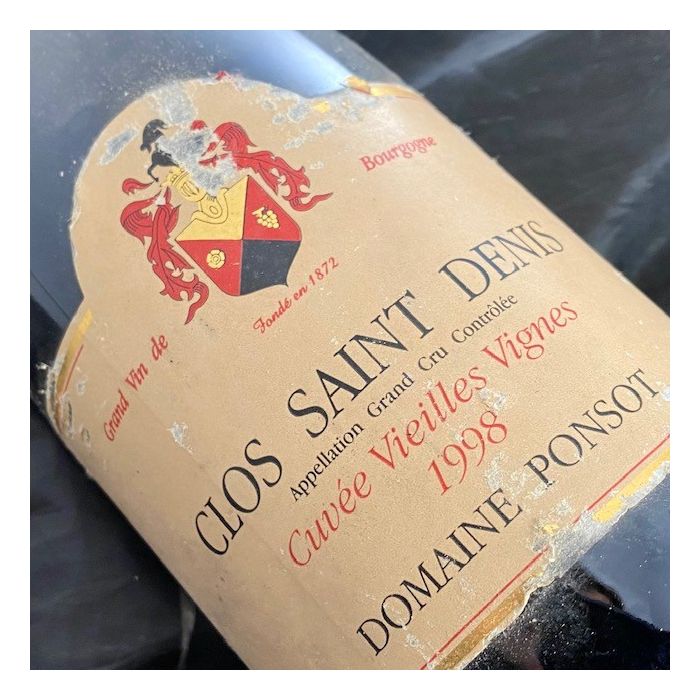
Domain Ponsot Clos Saint Denis 2011 Bottle (75cl)
The 2011 Domaine Ponsot Clos Saint-Denis is a red Burgundy wine from the Clos-Saint-Denis Grand Cru in the village of Morey-Saint-Denis, Côte de Nuits. This old-vine cuvée is crafted exclusively from Pinot Noir. The Clos Saint-Denis appellation, reserved for red wines and recognized as a Grand Cru since 1936, covers 6.23 hectares in production. The 2011 vintage thus expresses the distinctive identity of one of Morey-Saint-Denis's Grands Crus signed by Domaine Ponsot.
La bouteille proposée
- Size
- Bottle (75cl)
- Packaging
- Loose
- Label Condition
- Perfect
- Fill Level
- Perfect
- Capsule Condition
- Perfect
Identité du vin
- Couleur
- Red
- Pays
- France
- Région
- Bourgogne
- Appellation
- Morey Saint Denis
- Producteur / Domaine
- Domaine Ponsot
- Parcelle / Cru
- Clos-Saint-Denis
- Cuvée
- Cuvée
- Millésime
- 2011
Cépage et assemblage
- Grape Variety
- 100% Pinot Noir
Domaine Ponsot
Domaine Ponsot is a family-run estate based in Morey-Saint-Denis, in the Côte de Nuits, whose origins date back to 1872. In particular, it cultivates plots in Clos de la Roche and holds the exclusive rights to the white premier cru Clos des Monts-Luisants, planted with Aligoté. The estate is managed by Rose-Marie Ponsot, with Alexandre Abel in charge of winemaking.
- Owner
- Famille Ponsot (Rose-Marie, Catherine et Stéphanie Ponsot)
- Maître de chais
- Alexandre Abel
- Surface (ha)
- 8.00 ha
- Production (average bottles per vintage)
- environ 50 000 bouteilles/an
Histoire du domaine
Domaine Ponsot traces its origins back to 1872, when William Ponsot acquired the Clos des Monts-Luisants and a plot of the Clos de la Roche in Morey-Saint-Denis. Following the phylloxera crisis, in 1911 he replanted his white wine plot at Monts-Luisants with Aligoté; some of these vines are still in the ground today. His godson, Hippolyte Ponsot, succeeded him in 1920 and expanded the estate by acquiring another plot of Clos de la Roche. He then embarked on a programme to replant Pinot Noir vines during the 1920s and 1930s. Hippolyte began bottling on the estate in 1921, and the wines were exported from the 1930s onwards. A lawyer by training, he played a part in the work to safeguard Burgundy’s appellations contrôlées. From the 1950s onwards, Jean-Marie Ponsot developed soil management practices and continued massal selections of Pinot Noir, which led to the clones released in the 1970s and 1980s. Laurent Ponsot joined the estate in 1981, before taking over its management alongside his sister Rose-Marie from 1997 onwards. Laurent Ponsot stepped down from the family business in 2017 to found his own winery; Rose-Marie Ponsot then took over the management of the estate. Alexandre Abel has been in charge of winemaking since 2017, whilst Rose-Marie Ponsot has been chair of Domaine Ponsot since 2020.
Clos-Saint-Denis
Clos Saint-Denis is both a Grand Cru appellation and a physically demarcated terroir in Morey-Saint-Denis. Its vineyard area includes the historical clos as well as plots from neighboring lieux-dits recognized for equivalent quality, notably Calouère, Les Chaffots, and Maison Brûlée. Located in the lower half of the Côte, it benefits from the rising sun, a moderate slope, and shallow, well-draining soils over a fractured marly-limestone substrate.
- Vineyard commune
- Morey-Saint-Denis
- Origin of the vineyard name
- The name recalls the medieval attachment of the clos to the collegiate church of Saint-Denis de Vergy, chapel of the Château de Vergy.
- Exposure
- facing the rising sun, primarily east
- Altitude
- 280–310 m
- Slope
- moderate, gentler in the lower part
- Soil
- Slightly developed soils, generally carbonated, shallow and well-draining, with a high clay content; clayey colluvium with limestone gravel and pebbles. The Clos Saint-Denis sector also features brown calcareous soils free of gravel.
- Subsoil and geology
- Jurassic marly-limestone substrate: Bajocian crinoidal limestone in the lower part, intermediate marly level, and hard yet frost-susceptible Bathonian limestone towards the top; fractured limestone substrate beneath thin scree deposits, clays, and red silts.
Le domaine dans cette parcelle
- Year the vineyard was acquired
- 1982
- Vineyard holding status
- Former sharecropping agreement, farmed from 1982 to 2015; no longer farmed by Domaine Ponsot starting from the 2016 vintage.
Histoire de la parcelle
The origin of Clos Saint-Denis dates back to the 11th century, when it depended on the collegiate church of Saint-Denis de Vergy; its first known written mention dates from 1367. The historical clos, measuring just over two hectares, appears never to have been truly enclosed by walls; long consisting of a single plot, it was divided in the 20th century. Owned by the canons until the French Revolution, it was dispersed after it, and its name was extended from the early 19th century to the wines of a larger neighborhood. The cru was classified as first growth in the 1860 Beaune Viticulture Committee classification; its geographical entity was stabilized in the early 20th century, and the AOC was recognized by decree on December 8, 1936.


