




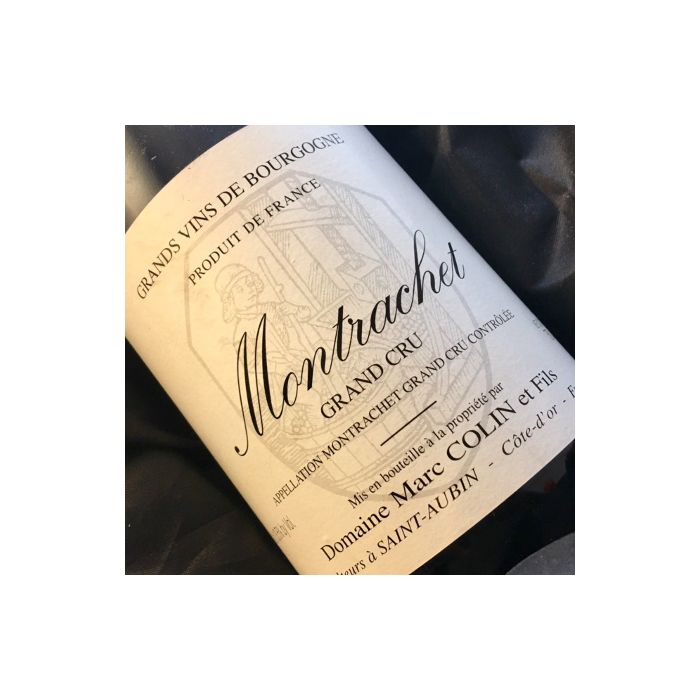
Domain Marc Colin Montrachet 1996 SD
The 1996 Domaine Marc Colin Montrachet is a white Grand Cru Burgundy wine, crafted from 100% Chardonnay in the Montrachet appellation. Coming from the estate's Montrachet plot, it was awarded 96/100 by The Wine Advocate, with an indicated drinking window of 2004 to 2015. The publication describes a concentrated, powerful wine with great definition, combining mineral richness, white flowers, almond, anise, and fresh butter, while retaining balance and elegance.
Identité du vin
- Couleur
- White
- Pays
- France
- Région
- Bourgogne
- Appellation
- Puligny Montrachet
- Producteur / Domaine
- Domaine Marc Colin
- Parcelle / Cru
- Montrachet
Cépage et assemblage
- Grape Variety
- 100% Chardonnay
Domaine Marc Colin
Domaine Marc Colin et Fils is a family-run estate based in Saint-Aubin, in the Côte de Beaune. It is currently run by Caroline and Damien Colin, on 11.50 hectares spread mainly across Saint-Aubin, with plots also situated in Puligny-Montrachet, Chassagne-Montrachet and Santenay. The vineyard spans 24 appellations, predominantly planted with Chardonnay.
- Owner
- Caroline et Damien Colin
- Maître de chais
- Damien Colin
- Surface (ha)
- 11.50 ha
- Production (average bottles per vintage)
- environ 80 000 bouteilles/an
Histoire du domaine
The estate was founded in the late 1970s by Marc Colin and his wife Michèle Ponavoy, using family vineyards inherited from the Colin and Ponavoy families. In 1979, the estate comprised around 6 hectares in the communes of Saint-Aubin and Chassagne-Montrachet. The vineyard expanded over the following decades. Marc and Michèle’s children subsequently became involved in running the family business. Pierre-Yves Colin left the estate to set up his own estate in 2005. Joseph Colin, in turn, struck out on his own in 2017. Domaine Marc Colin et Fils is now run by Caroline and Damien Colin. Damien Colin is responsible for winemaking, whilst the estate practises sustainable viticulture, with soil cultivation and hand-harvesting. The estate currently cultivates 11.50 hectares, mainly in Saint-Aubin, supplemented by vineyards in Puligny-Montrachet, Chassagne-Montrachet and Santenay.
Montrachet
Montrachet is a physically delimited climat and Grand Cru appellation shared between Puligny-Montrachet and Chassagne-Montrachet. Its vines occupy a narrow, elongated strip, perpendicular to the slope, in a slight concavity in the lower part of the east- and southeast-facing hillside. The terroir combines red, clayey, calcareous, and very stony soils with Jurassic substrates differentiated by a fault. Its rapid drainage and nocturnal air drainage limit humidity and frost risks.
- Vineyard commune
- Puligny-Montrachet et Chassagne-Montrachet
- Origin of the vineyard name
- The name comes from "Mont Rachet," understood as "bald mountain" or "barren mountain," probably referring to the sparsely vegetated promontory overlooking the site; "râche" is a regional term designating ringworm or scurf.
- Exposure
- East to southeast
- Altitude
- 250–270 m
- Slope
- Lower part of the hillside; strip perpendicular to the slope
- Soil
- Red, clayey, calcareous, very stony, and well-structured soils; locally lean and very stoney soils.
- Subsoil and geology
- Fault separating two sectors; Oxfordian marls rich in iron oxides over Bajocian/Callovian flaggy limestones, with locally highly fragmented Bathonian limestones.
Le domaine dans cette parcelle
- Estate holding in the vineyard (ha)
- 0.110000 ha
- Vineyard holding status
- estate owner-operator of a plot located on the Chassagne-Montrachet side
Histoire de la parcelle
The cru is attested as early as the 13th century in the form "Mont Rachaz." It truly took off in the 18th century under the impetus of the Clermont-Montoison family, lords of Chagny, and Thomas Jefferson placed it on par with Chambertin in 1787. Puligny and Chassagne appended the name Montrachet to their village names in 1878. A Beaune court ruling defined the appellation of origin in 1921, and the Montrachet AOC was subsequently recognized on July 31, 1937.


