




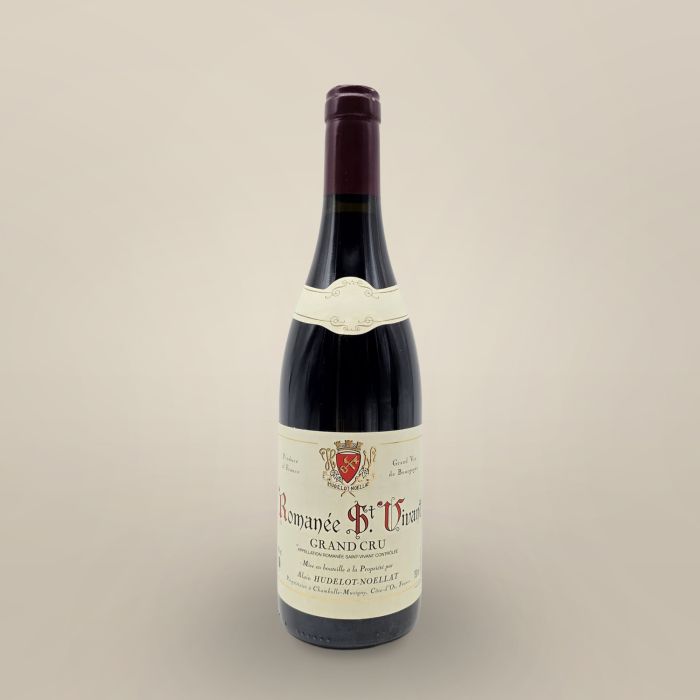
Domaine Hudelot Noellat Romanee Saint Vivant 2009 Bouteille (75cl)
The 2009 Domaine Hudelot-Noëllat Romanée-Saint-Vivant is a red Burgundy Grand Cru from the Romanée-Saint-Vivant climat in the commune of Vosne-Romanée. Crafted exclusively from Pinot Noir, it comes from a 0.48-hectare, east-facing parcel with deep clay-limestone soils over a limestone bedrock. The estate practices manual harvesting and sorting, 80% destemming, native yeast fermentation, and 16 months of aging in oak barrels (50% new), without fining or filtration.
La bouteille proposée
- Size
- Bottle (75cl)
- Label Condition
- Perfect
- Fill Level
- Perfect
- Capsule Condition
- Perfect
Identité du vin
- Couleur
- Red
- Pays
- France
- Région
- Bourgogne
- Appellation
- Vosne Romanée
- Producteur / Domaine
- Domaine Hudelot Noellat
- Parcelle / Cru
- Romanée-Saint-Vivant
- Millésime
- 2009
Cépage et assemblage
- Grape Variety
- 100% Pinot Noir
Domaine Hudelot Noellat
The Hudelot-Noëllat estate is a family-run business in the Côte de Nuits, based in Chambolle-Musigny, near Vougeot. Founded in 1962 by Alain Hudelot, it cultivates 10 hectares spread across four villages and fifteen appellations. The estate is now run by Charles van Canneyt, the founder’s grandson.
- Owner
- Famille Hudelot-Noëllat
- Maître de chais
- Charles van Canneyt
- Surface (ha)
- 10.00 ha
- Production (average bottles per vintage)
- 60 000 bouteilles/an
Histoire du domaine
The Hudelot-Noëllat estate was founded in 1962 by Alain Hudelot. Originally, its vineyard comprised, in particular, two plots located in Chambolle-Musigny. In the 1970s, the estate expanded thanks to the addition of vines from the family of Odile Noëllat, wife of Alain Hudelot. This family inheritance enabled the estate to acquire plots in the areas of Chambolle-Musigny, Vougeot, Vosne-Romanée and Nuits-Saint-Georges. The vineyard now covers 10 hectares and comprises fifteen appellations. Charles van Canneyt, grandson of Alain Hudelot and Odile Noëllat, took over the running of the estate in 2008. He personally oversees the winemaking process, which uses indigenous yeasts and barrel ageing. The estate’s landholdings are structured primarily around the GFV Hudelot Noellat, which is linked to members of the Hudelot and van Canneyt families.
Romanée-Saint-Vivant
Romanée-Saint-Vivant is a physically demarcated climat of Vosne-Romanée corresponding to a Grand Cru appellation reserved for red wines. Located on a gentle piedmont plateau overlooking the village, between 247 and 260 meters, it slopes gently eastward. Its shallow, clayey, carbonate-rich soils with high iron oxide content cover a well-draining limestone subsoil, with a conglomeratic formation in its eastern part.
- Vineyard commune
- Vosne-Romanée
- Origin of the vineyard name
- The name "Romanée de Saint-Vivant" is recorded in 1765. "Romanée" was borrowed from a small neighboring parcel, while "Saint-Vivant" recalls the Cluniac monastery that historically owned the vineyard.
- Exposure
- eastward
- Altitude
- 247–260 m
- Slope
- gentle slope on a slight plateau
- Soil
- Slightly developed, carbonated, and shallow soils, heavily clayey, rich in iron oxides; colluvium of scree, clays, and silts.
- Subsoil and geology
- Bajocian entroquitic limestones; to the east, a conglomerate of limestone blocks in a salmon-pink marly matrix.
Le domaine dans cette parcelle
- Estate holding in the vineyard (ha)
- 0.480000 ha
- Year the vineyard was acquired
- 1978
- Vineyard holding status
- owner, plot originating from the heritage of the Charles Noëllat family
- Indicative vine age
- Vines planted in 1920; the estate's technical sheet indicates an age of 95 years.
Histoire de la parcelle
The Cluniac monastery of Saint-Vivant owned a wine estate in Vosne as early as the Middle Ages, consisting of clos precisely listed in 1512. The current climat brings together the former Cloux des Neuf Journaux, des Quatre Journaux, and du Moytant. Confiscated as ecclesiastical property during the French Revolution, it was acquired by the Marey-Monge family, who kept it until 1898 before it was partially divided. Already placed in the top categories of the 1816, 1855, and 1860 classifications, Romanée-Saint-Vivant was recognized as an appellation d'origine contrôlée on September 11, 1936.


