




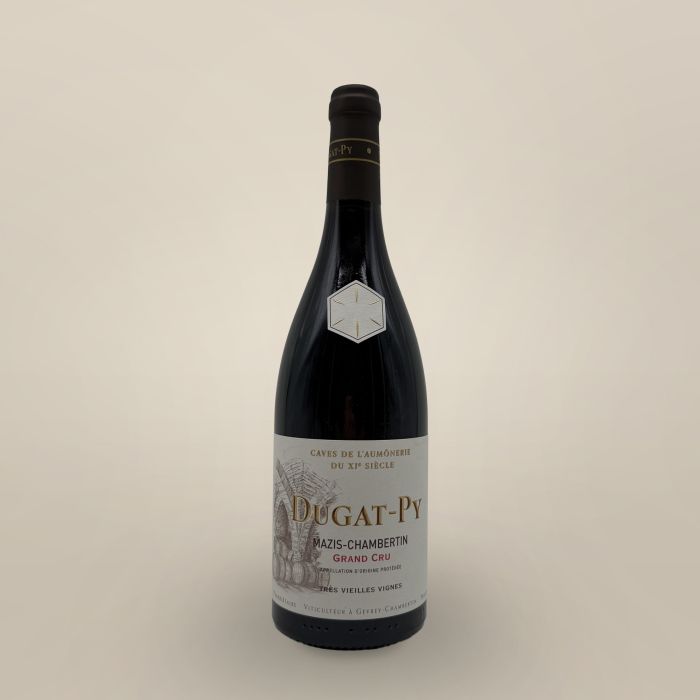
Domaine Dugat Py Mazis Chambertin 2018
The 2018 Domaine Dugat-Py Mazis-Chambertin Grand Cru is a red Burgundy wine from the Gevrey-Chambertin appellation, produced from the Mazis-Chambertin plot. Crafted by Domaine Dugat-Py from 100% Pinot Noir, it holds Grand Cru status in Burgundy. The Wine Advocate awards it 98/100, describing a full-bodied, multidimensional, and highly concentrated wine with rich, already integrated tannins. The publication recommends drinking it between 2030 and 2065.
La bouteille proposée
- Size
- Bottle (75cl)
- Packaging
- Loose
- Label Condition
- Perfect
- Fill Level
- Perfect
- Capsule Condition
- Perfect
Identité du vin
- Couleur
- Red
- Pays
- France
- Région
- Bourgogne
- Appellation
- Gevrey Chambertin
- Producteur / Domaine
- Domaine Dugat-Py
- Parcelle / Cru
- Mazis-Chambertin
- Millésime
- 2018
Cépage et assemblage
- Grape Variety
- 100% Pinot Noir
Domaine Dugat-Py
The Dugat-Py estate is a family-run business based in Gevrey-Chambertin, at the foot of the Combe de Lavaux, in the Côte de Nuits. Stemming from a lineage of winegrowers who have been in the village since the 17th century, it is now run by Loïc Dugat-Py, the thirteenth generation of the family. The vineyard covers 15 hectares, spread across the Côte de Nuits and the Côte de Beaune, with a strong emphasis on old vines.
- Owner
- Loïc Dugat-Py
- Maître de chais
- Loïc Dugat-Py
- Surface (ha)
- 15.00 ha
- Production (average bottles per vintage)
- 50 000 bouteilles/an
Histoire du domaine
The Dugat family’s winemaking heritage in Gevrey-Chambertin dates back to the 17th century. The Dugat estate was established in 1923 following the marriage of Fernand Dugat and Jeanne Bolnot, who also came from a family of local winegrowers. Pierre Dugat, son of Fernand and Jeanne, subsequently passed the vineyards on to his son Bernard, who produced his first vintage in 1975. Bernard Dugat married Jocelyne Py in 1979. After a period during which a significant proportion of the production was sold in bulk to wine merchants, the wines were bottled at the estate under the name Pierre Dugat from 1989 onwards. In 1994, Bernard adopted the name Dugat-Py for the estate, incorporating his wife’s surname. Their son Loïc joined the business in 1996 and produced his first vintage on his own in 2005. The vineyard expanded between 1995 and 2005 through purchases, leasehold arrangements and sharecropping, particularly in the Côte de Beaune. Trials in organic viticulture began in 1999; the estate has been fully certified organic since 2015. Loïc Dugat-Py is now the owner and is directly responsible for winemaking.
Mazis-Chambertin
Mazis-Chambertin is a Grand Cru appellation corresponding to a physically demarcated terroir in Gevrey-Chambertin, comprising the lieux-dits Les Mazis-Hauts and Les Mazis-Bas. Located on the foothills on a slight plateau facing east, it extends Clos de Bèze to the north and features a slightly concave topography. Its superficial, carbonate, clayey soils rich in iron oxides overlie a Jurassic marl-limestone substrate ensuring efficient drainage and regulated water supply.
- Vineyard commune
- Gevrey-Chambertin
- Origin of the vineyard name
- The place name "Mazis" evokes dwellings that disappeared in the Middle Ages, a presence corroborated by ashlar stones and fragments of tiles.
- Exposure
- East (levant)
- Slope
- gentle plateau; lower section with a slight slope
- Soil
- Scarcely developed, carbonated, thin, well-draining, clayey soils rich in iron oxides.
- Subsoil and geology
- Hard limestones and Bajocian marly level; Bathonian frost-susceptible limestone in the upper section, beneath scree deposits, clays, and red silts.
Le domaine dans cette parcelle
- Estate holding in the vineyard (ha)
- 0.210000 ha
- Indicative vine age
- Pinot noir parcel planted in 1964.
Histoire de la parcelle
The reputation of the climat is attested in the 18th century: Abbot Courtépée cited the "Mazy" among the renowned climats in 1774. In 1855, Doctor Lavalle distinguished the upper part as "1ère cuvée" and the lower part as "2ème cuvée". A judgment by the Dijon tribunal in 1931 recognized the Mazis-Chambertin appellation of origin and established its boundaries; the AOC was subsequently recognized by decree on July 31, 1937.


