




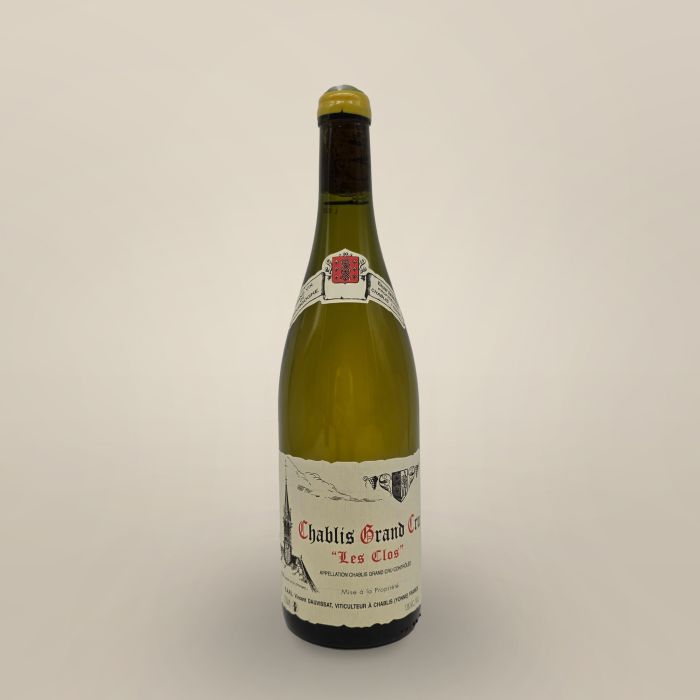
Domain Dauvissat Chablis Les Clos 2018
The 2018 Domaine Dauvissat Chablis Les Clos is a white Burgundy from the Les Clos climat in the Chablis Grand Cru appellation. Made from 100% Chardonnay, it combines density, roundness and a sleek texture. James Suckling awards it 95/100, describing a profile marked by smoke, minerals, creamy lemon, spices and a saline finish. The publication recommends cellaring it for two to three years before tasting.
La bouteille proposée
- Size
- Bottle (75cl)
- Packaging
- Loose
- Label Condition
- Perfect
- Fill Level
- Perfect
- Capsule Condition
- Perfect
Identité du vin
- Couleur
- White
- Pays
- France
- Région
- Bourgogne
- Appellation
- Chablis
- Producteur / Domaine
- Domaine Dauvissat
- Parcelle / Cru
- Les Clos
- Millésime
- 2018
Cépage et assemblage
- Grape Variety
- 100% Chardonnay
Domaine Dauvissat
Domaine Vincent Dauvissat is a family-run estate based in Chablis, in the Yonne department. It cultivates 12 hectares spread across Petit Chablis, Chablis, premiers crus and grands crus, notably Les Clos and Les Preuses. Vincent Dauvissat now works alongside his children, Ghislain and Étiennette, who are involved in managing the vineyard and the winemaking process.
- Owner
- Vincent, Ghislain et Étiennette Dauvissat
- Maître de chais
- Vincent, Ghislain et Étiennette Dauvissat
- Surface (ha)
- 12.00 ha
Histoire du domaine
The estate in question is Domaine Vincent Dauvissat, a producer of Chablis whose origins date back to the 1930s. Robert Dauvissat began bottling his own wines – rather than selling his entire harvest to wine merchants – from a one-hectare plot situated in the Les Clos and La Forest climats. In 1950, his son René and his wife Madeleine took over the estate. They gradually expanded the vineyard through the purchase and lease of plots, notably in the grands crus Les Clos and Les Preuses, as well as in the premiers crus La Forest and Séchet. Vincent Dauvissat joined his parents in the late 1970s. He took over the management of the estate when they retired in 1989. The estate has been using biodynamic methods in the vineyards since 2002. Ghislain and Étiennette Dauvissat now work alongside their father and are involved in both the management of the vineyards and the winemaking process. Some of the family’s vineyards may also be labelled as ‘Dauvissat-Camus’, Camus being the maiden name of Vincent Dauvissat’s mother.
Les Clos
Les Clos is one of the seven officially recognized Climats within the Chablis Grand Cru appellation and the largest of them all, covering nearly 26 hectares. It occupies the entire height of the hillside on the right bank of the Serein and benefits from a south-westerly exposure as well as a relatively steep slope. The soils become more stony and chalky towards the top, while they are deeper and more clayey at the bottom. On the general scale of Chablis Grand Cru, the hillside rests on Kimmeridgian marls and limestones containing Exogyra virgula fossils, but this geology is not detailed separately for Les Clos by the sources consulted.
- Vineyard commune
- Chablis
- Origin of the vineyard name
- The name, formerly attested in the forms "le clou", "les clous" and "le clox", refers to the dry-stone walls that once surrounded the vineyards.
- Exposure
- South-west
- Slope
- Relatively steep
- Soil
- More stony and limestone at the top; deeper and clayey at the bottom
Le domaine dans cette parcelle
- Estate holding in the vineyard (ha)
- 1.400000 ha
- Indicative vine age
- An average of about 55 years in 2019; one plot had been grubbed up with a view to subsequent replanting.
Histoire de la parcelle
The terroir was planted with vines before 1267 and may constitute the original core of the Chablis vineyard farmed by the Cistercians of Pontigny. Its former name forms evoke the walls that demarcated properties, limited erosion and protected the vines. Les Clos has been cited since the 19th century among the finest crus of Burgundy; the Chablis Grand Cru appellation was recognized on January 13, 1938.


