




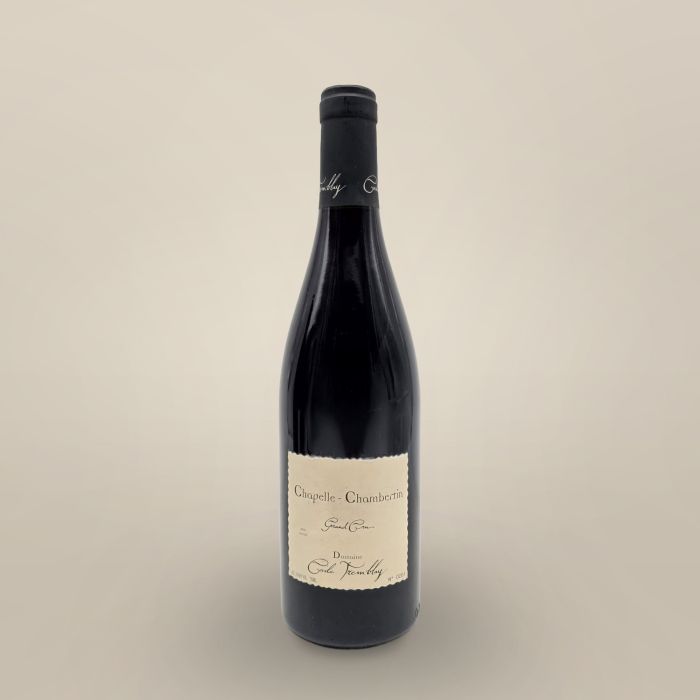
Domain Cecile Tremblay Chapelle Chambertin 2012
The 2012 Domaine Cécile Tremblay Chapelle-Chambertin is a red Burgundy wine from the Chapelle-Chambertin Grand Cru within the Gevrey-Chambertin appellation. Crafted from 100% Pinot Noir, it combines depth, power, and a velvety texture, underpinned by vibrant acidity and exceptionally refined tannins. The Wine Advocate awards it 94/100 and recommends a drinking window from 2022 to 2042, highlighting its bouquet of wild berries, briar rose, exotic spices, musk, and vine smoke.
La bouteille proposée
- Size
- Bottle (75cl)
- Packaging
- Loose
- Label Condition
- Perfect
- Fill Level
- Perfect
- Capsule Condition
- Perfect
Identité du vin
- Couleur
- Red
- Pays
- France
- Région
- Bourgogne
- Appellation
- Gevrey Chambertin
- Producteur / Domaine
- Domaine Cécile Tremblay
- Parcelle / Cru
- Chapelle-Chambertin
- Millésime
- 2012
Cépage et assemblage
- Grape Variety
- 100% Pinot Noir
Domaine Cécile Tremblay
Domaine Cécile Tremblay is a Côte de Nuits estate run by Cécile Tremblay, based in Morey-Saint-Denis. Its 7-hectare vineyard is spread across eleven appellations, from Nuits-Saint-Georges to Gevrey-Chambertin, with plots notably in Vosne-Romanée, Chambolle-Musigny and Morey-Saint-Denis. The vines are cultivated using organic and biodynamic farming methods.
- Owner
- Cécile Tremblay
- Maître de chais
- Cécile Tremblay
- Surface (ha)
- 7.00 ha
Histoire du domaine
Cécile Tremblay comes from a family that owned vineyards in Vosne-Romanée, whose land had historically been leased out. In 2002, when three out of six hectares were due to come to the end of their lease, she took over these vineyards herself. She officially established Domaine Cécile Tremblay on 1 January 2003, at the age of 25, starting with four hectares of family vineyards. The first vintage was characterised by very low yields, whilst 2004 was marked by hail. The estate has cultivated its vines according to organic principles since its inception; Cécile Tremblay states that she transitioned these practices towards biodynamics in 2016, without seeking certification. In 2022, she took over further family-owned plots whose leases had also come to an end. The estate now comprises 7 hectares spread across eleven Côte de Nuits appellations. Cécile Tremblay is the owner and personally oversees both the vineyard work and winemaking decisions.
Chapelle-Chambertin
Chapelle-Chambertin is both a Grand Cru appellation and a physically delimited terroir in Gevrey-Chambertin, consisting of the lieux-dits "En la Chapelle" and "Les Gémeaux". Located on the foothills, in the immediate vicinity of Clos de Bèze from which it is separated by the Route des Grands Crus, it occupies the edge of a slight plateau exposed to the rising sun. Its clayey, carbonated, stony, and shallow soils cover a hard Bajocian limestone substrate and ensure favorable drainage.
- Vineyard commune
- Gevrey-Chambertin
- Origin of the vineyard name
- The name recalls the chapel Notre-Dame de Bèze built in 1155 by the monks of the Bèze abbey, who were then owners of the site and the neighboring Clos de Bèze.
- Exposure
- East-facing (east)
- Slope
- Gentle slope, on the edge of a slight plateau
- Soil
- Clayey, carbonated, stony, shallow, and well-draining soils, with scree, clays, and red silts.
- Subsoil and geology
- Hard Bajocian limestone substrate, known as entroquitic limestone, locally close to the surface.
Le domaine dans cette parcelle
- Estate holding in the vineyard (ha)
- 0.362000 ha
- Year the vineyard was acquired
- 2003
- Vineyard holding status
- Family plot taken back from a sharecropping arrangement and farmed by the estate
- Indicative vine age
- Vines indicated as being 80 years old in a professional sheet dedicated to the 2017 vintage.
Histoire de la parcelle
The chapel Notre-Dame de Bèze was built in 1155 by the monks of the Bèze abbey and demolished around 1830. The reputation of the climat is attested in the 18th century, notably by Abbé Courtépée in 1774. The ruling of the Dijon court in 1931 established the use of the name "Chapelle-Chambertin" and defined its geographical limits; the appellation d'origine contrôlée was subsequently recognized by the decree of July 31, 1937.


