




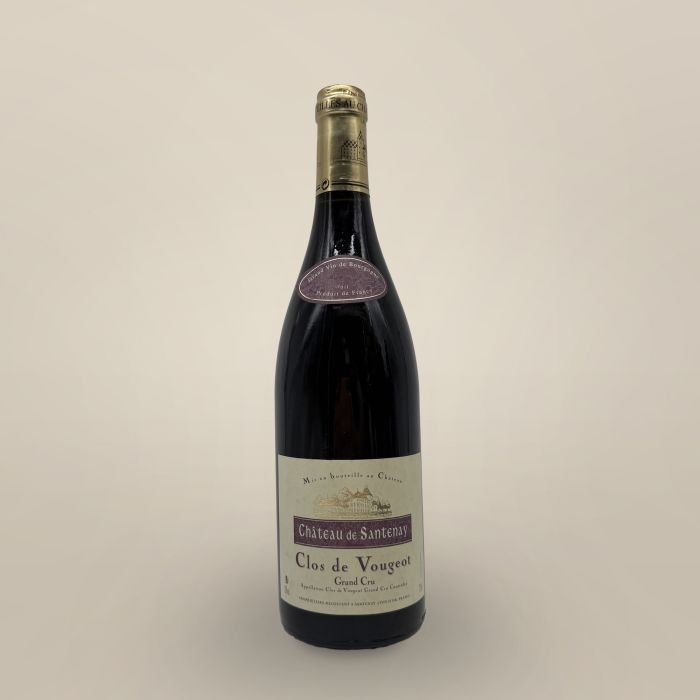
Chateau de Santenay Clos Vougeot Grand Cru 2009 Bouteille (75cl)
The Château de Santenay Clos de Vougeot Grand Cru 2009 is a red Burgundy wine produced by Château de Santenay in the Vougeot appellation. Made from 100% Pinot Noir, it comes from the Clos de Vougeot parcel and benefits from the Burgundy Grand Cru classification. Jancis Robinson awards it 15/20 and indicates a drinking window from 2015 to 2019. Critics describe a discreet nose and a style marked by notes of old wood, with a structured body.
La bouteille proposée
- Size
- Bottle (75cl)
- Label Condition
- Perfect
- Fill Level
- Perfect
- Capsule Condition
- Perfect
Identité du vin
- Couleur
- Red
- Pays
- France
- Région
- Bourgogne
- Appellation
- Vougeot
- Producteur / Domaine
- Château de Santenay
- Parcelle / Cru
- Clos de Vougeot
- Millésime
- 2009
Cépage et assemblage
- Grape Variety
- 100% Pinot Noir
Château de Santenay
Formerly marketed under the name Château de Santenay, Domaine du Château Philippe le Hardi farms 98 hectares spread across Gevrey-Chambertin and Mercurey, including parcels in Clos de Vougeot Grand Cru. Its vineyard covers 35 climats and predominantly combines Pinot Noir with Chardonnay. François Desmoutis, cellar master and winemaker, manages vinifications under the direction of Jean-Philippe Archambaud.
- Owner
- Grands Crus Investissements (GCI), société détenue par des structures du groupe Crédit Agricole
- Maître de chais
- François Desmoutis
- Surface (ha)
- 98.00 ha
- Production (average bottles per vintage)
- 540000
Histoire du domaine
A castrum has been recorded on the site since the 9th century, prior to the construction in the 14th century of a keep, a drawbridge, and a rampart. Philippe le Hardi, Duke of Burgundy, took possession of the lordship and the Château de Santenay in 1372; his 1395 ordinance banned Gamay in red wines in favor of Pinot Noir. The estate subsequently remained in the hands of noble families until the Revolution and escaped destruction; an inventory from 1796 mentions two wine presses, attesting to winemaking activity. After several transmissions through inheritance or marriage, the Pidault family carried out major works between 1965 and 1976 and expanded plantings in Mercurey. Grands Crus Investissements acquired the entirety of Château de Santenay in 1997, opening a new phase of investments under the aegis of the Crédit Agricole group. In 2019, the estate completed its heritage with parcels in Chambolle-Musigny and Gevrey-Chambertin as well as an additional 65 ares in Clos de Vougeot. Conversion to organic farming began in 2021. The former name Château de Santenay was subsequently replaced by Domaine du Château Philippe le Hardi in order to avoid confusion between the estate's name and the Santenay appellation, particularly for wines such as Clos de Vougeot.
Clos de Vougeot
The Clos de Vougeot is a vast, single-piece vineyard enclosure, surrounded by walls and located at the foot of the Côte de Nuits slope, in the commune of Vougeot. Its terroir varies markedly from top to bottom: thin, gravelly soils on Bajocian limestone in the upper part, more clayey brown soils on limestone debris in the middle, and deeper, clayey and silty soils on a marly layer in the lower part. The site simultaneously constitutes a physically demarcated Burgundian climat and the emblematic parcel area of the AOC Grand Cru Clos de Vougeot or Clos Vougeot.
- Vineyard commune
- Vougeot
- Origin of the vineyard name
- "Clos" designates the vineyard historically enclosed by walls; "Vougeot" takes up the name of the place, linked to the Vouge which marks a historical boundary of the estate.
- Altitude
- 240–265 m
- Slope
- gentle, average of about 3.8%
- Soil
- At the top, shallow, granular soils rich in gravel; in the middle, shallow, more clayey brown soils on limestone debris; at the bottom, deeper brown soils rich in clay and fine silt.
- Subsoil and geology
- Jurassic complex; Bajocian limestone slab in the upper part, limestone debris in the middle, and marly layer in the lower part, with the influence of superficial formations linked to the outlet of the combe d'Orveau.
Le domaine dans cette parcelle
- Estate holding in the vineyard (ha)
- 0.820000 ha
- Year the vineyard was acquired
- 1989
- Vineyard holding status
- owner of two plots
Histoire de la parcelle
The wine estate was gradually established by the Cistercian abbey of Cîteaux starting from the early 12th century; a medieval agreement set boundaries that have remained almost unchanged, and the wall was built before the end of that century. The farm buildings were developed from the 12th to the 15th century, then complemented in 1551 by the Renaissance residence that became the château du Clos de Vougeot. The abbey kept the estate until the Revolution; the buildings and vineyards were confiscated and then sold as national property in 1791, subsequently leading to the fragmentation of the property. The appellation d'origine contrôlée Clos de Vougeot or Clos Vougeot was recognized by decree on July 31, 1937.


