




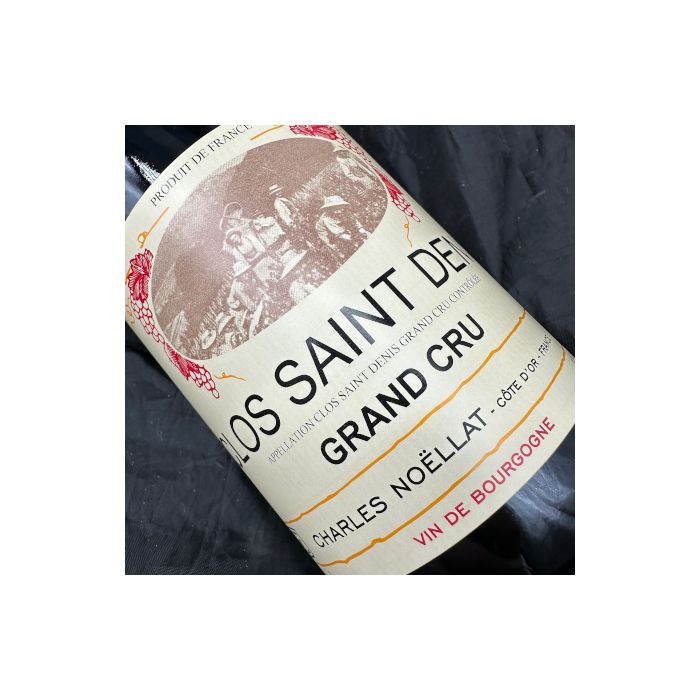
Domaine Charles Noellat Clos Saint Denis Grand Cru 2022 Bouteille (75cl)
The Domaine Charles Noellat Clos Saint Denis Grand Cru 2022 is a red Burgundy wine from the Clos-Saint-Denis climat in the commune of Morey-Saint-Denis, within the Côte de Nuits. Owned by the Noellat family, it is made exclusively from Pinot Noir. This Grand Cru comes from a red-wine appellation exclusively dedicated to Pinot Noir, covering 6.23 hectares. Clos-Saint-Denis is traditionally distinguished by a profile built more on nuance and finesse than on sheer power.
La bouteille proposée
- Size
- Bottle (75cl)
- Label Condition
- Perfect
- Fill Level
- Perfect
- Capsule Condition
- Perfect
Identité du vin
- Couleur
- Red
- Pays
- France
- Région
- Bourgogne
- Appellation
- Morey Saint Denis
- Producteur / Domaine
- Domaine Charles Noellat
- Parcelle / Cru
- Clos-Saint-Denis
- Millésime
- 2022
Domaine Charles Noellat
Domaine Charles Noëllat was a vineyard in Vosne-Romanée, established in the early 20th century by Charles Noëllat and his wife Anne-Marie, known as Laure. Its vineyard, which included plots in Romanée-Saint-Vivant, Richebourg and Grands-Échezeaux, was broken up after 1987; the majority of the remaining land was sold to Lalou Bize-Leroy in 1988. Since 2013, a separate Maison Charles Noëllat has been reviving the family name through the selection, ageing and marketing of Burgundy wines, without this constituting a takeover of the historic wine estate.
- Owner
- Famille Noellat
Histoire du domaine
The Noëllat family has been involved in Burgundian wine-growing since the 17th century and was originally based in Meuilley, near Nuits-Saint-Georges. In the 19th century, Félix Noëllat established the family estate in Vosne-Romanée. His son Charles Noëllat, born in 1868, founded the estate bearing his name in the early 20th century with his wife Anne-Marie, known as Laure. Having been called up during the First World War, Charles left Laure to continue managing and developing the estate. By the 1930s, the estate covered around 25 hectares and included plots in several appellations of the Côte de Nuits, including Romanée-Saint-Vivant. Charles died in 1939; following the death of their son André in 1941, Laure and their daughter Geneviève ensured the estate’s continuity throughout the war. In 1947, Christian Moreau, Geneviève’s husband, joined the business. Their daughter Anne-Marie took over its management in 1976. Following Geneviève’s death in 1987, disputes over the estate led to the vineyard being broken up; the largest remaining portion, reported to be 12 hectares at the time of sale, was acquired by Lalou Bize-Leroy in 1988 and incorporated into Domaine Leroy. The current Maison Charles Noëllat was relaunched in 2013 by Stéphane, a descendant of Charles Noëllat, and Antoine Laurent; it selects Burgundy wines and ages and bottles its ‘Hommage à Bligny-lès-Beaune’ range.
Clos-Saint-Denis
Clos Saint-Denis is both a Grand Cru appellation and a physically demarcated terroir in Morey-Saint-Denis. Its vineyard area includes the historical clos as well as plots from neighboring lieux-dits recognized for equivalent quality, notably Calouère, Les Chaffots, and Maison Brûlée. Located in the lower half of the Côte, it benefits from the rising sun, a moderate slope, and shallow, well-draining soils over a fractured marly-limestone substrate.
- Vineyard commune
- Morey-Saint-Denis
- Origin of the vineyard name
- The name recalls the medieval attachment of the clos to the collegiate church of Saint-Denis de Vergy, chapel of the Château de Vergy.
- Exposure
- facing the rising sun, primarily east
- Altitude
- 280–310 m
- Slope
- moderate, gentler in the lower part
- Soil
- Slightly developed soils, generally carbonated, shallow and well-draining, with a high clay content; clayey colluvium with limestone gravel and pebbles. The Clos Saint-Denis sector also features brown calcareous soils free of gravel.
- Subsoil and geology
- Jurassic marly-limestone substrate: Bajocian crinoidal limestone in the lower part, intermediate marly level, and hard yet frost-susceptible Bathonian limestone towards the top; fractured limestone substrate beneath thin scree deposits, clays, and red silts.
Histoire de la parcelle
The origin of Clos Saint-Denis dates back to the 11th century, when it depended on the collegiate church of Saint-Denis de Vergy; its first known written mention dates from 1367. The historical clos, measuring just over two hectares, appears never to have been truly enclosed by walls; long consisting of a single plot, it was divided in the 20th century. Owned by the canons until the French Revolution, it was dispersed after it, and its name was extended from the early 19th century to the wines of a larger neighborhood. The cru was classified as first growth in the 1860 Beaune Viticulture Committee classification; its geographical entity was stabilized in the early 20th century, and the AOC was recognized by decree on December 8, 1936.


