




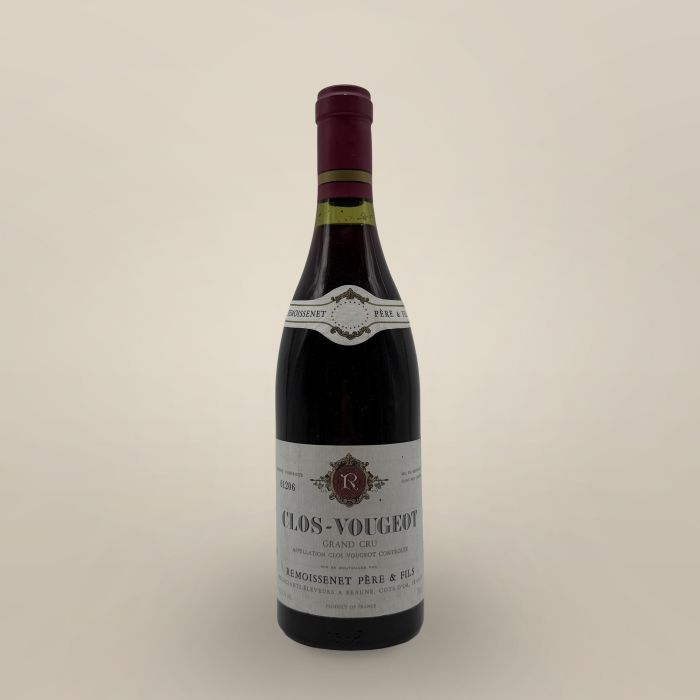
Domaine Remoissenet Père et Fils Clos Vougeot 1985 Bouteille (75cl)
The 1985 Domaine Remoissenet Père et Fils Clos de Vougeot is a red Burgundy wine from the Vougeot appellation, classified as a Burgundy Grand Cru. Produced by Domaine Remoissenet Père et Fils, it comes from the Clos de Vougeot parcel and is crafted from 100% Pinot Noir. The Wine Advocate awarded it 88/100 and recommended drinking it between 2014 and 2017. The publication describes a mature wine with integrated tannins, a suave fruit core, and a firmer finish.
La bouteille proposée
- Size
- Bottle (75cl)
- Label Condition
- Perfect
- Fill Level
- Perfect
- Capsule Condition
- Perfect
Identité du vin
- Couleur
- Red
- Pays
- France
- Région
- Bourgogne
- Appellation
- Vougeot
- Producteur / Domaine
- Domaine Remoissenet Père et Fils
- Parcelle / Cru
- Clos de Vougeot
- Millésime
- 1985
Domaine Remoissenet Père et Fils
Remoissenet Père et Fils is a Burgundian wine house established in Beaune in 1877. It operates both as a wine estate, with around 13 hectares of its own vineyards, notably in Beaune and Gevrey-Chambertin, and as a wine merchant. The company is managed by Edward L. Milstein, whilst winemaking is overseen by Claudie Jobard.
- Owner
- Edward L. Milstein (via Remoissenet Holdings Ltd)
- Maître de chais
- Claudie Jobard
- Surface (ha)
- 13.00 ha
Histoire du domaine
Remoissenet Père et Fils was founded in Beaune in 1877 and established itself in a historic 14th-century building in the heart of the town. The company remained in the Remoissenet family until 2005. During the final decades of this period, Roland Remoissenet was at the helm. When he retired in 2005, the company, its cellars, stocks and vineyards were acquired by a group led by the American financier Edward L. Milstein. The reorganisation that followed included the appointment of Bernard Repolt as managing director and the arrival of oenologist Claudie Jobard ahead of the 2005 grape harvest. In 2008, the company reacquired plots in several Côte de Nuits appellations, including Gevrey-Chambertin, Vosne-Romanée, Nuits-Saint-Georges, Charmes-Chambertin and Clos de Vougeot. Remoissenet Père et Fils now operates as both a wine estate and a wine merchant, producing wine from grapes grown on its own vineyards as well as from grapes selected from partner growers. Recent legal filings identify Edward Milstein as the managing director of Remoissenet Père et Fils SCS, of which Remoissenet Holdings Ltd is the general partner.
Clos de Vougeot
The Clos de Vougeot is a vast, single-piece vineyard enclosure, surrounded by walls and located at the foot of the Côte de Nuits slope, in the commune of Vougeot. Its terroir varies markedly from top to bottom: thin, gravelly soils on Bajocian limestone in the upper part, more clayey brown soils on limestone debris in the middle, and deeper, clayey and silty soils on a marly layer in the lower part. The site simultaneously constitutes a physically demarcated Burgundian climat and the emblematic parcel area of the AOC Grand Cru Clos de Vougeot or Clos Vougeot.
- Vineyard commune
- Vougeot
- Origin of the vineyard name
- "Clos" designates the vineyard historically enclosed by walls; "Vougeot" takes up the name of the place, linked to the Vouge which marks a historical boundary of the estate.
- Altitude
- 240–265 m
- Slope
- gentle, average of about 3.8%
- Soil
- At the top, shallow, granular soils rich in gravel; in the middle, shallow, more clayey brown soils on limestone debris; at the bottom, deeper brown soils rich in clay and fine silt.
- Subsoil and geology
- Jurassic complex; Bajocian limestone slab in the upper part, limestone debris in the middle, and marly layer in the lower part, with the influence of superficial formations linked to the outlet of the combe d'Orveau.
Le domaine dans cette parcelle
- Estate holding in the vineyard (ha)
- 0.500000 ha
- Vineyard holding status
- Owner; parcel farmed biodynamically by the estate
- Indicative vine age
- Vines aged 40 to 60 years.
Histoire de la parcelle
The wine estate was gradually established by the Cistercian abbey of Cîteaux starting from the early 12th century; a medieval agreement set boundaries that have remained almost unchanged, and the wall was built before the end of that century. The farm buildings were developed from the 12th to the 15th century, then complemented in 1551 by the Renaissance residence that became the château du Clos de Vougeot. The abbey kept the estate until the Revolution; the buildings and vineyards were confiscated and then sold as national property in 1791, subsequently leading to the fragmentation of the property. The appellation d'origine contrôlée Clos de Vougeot or Clos Vougeot was recognized by decree on July 31, 1937.


