




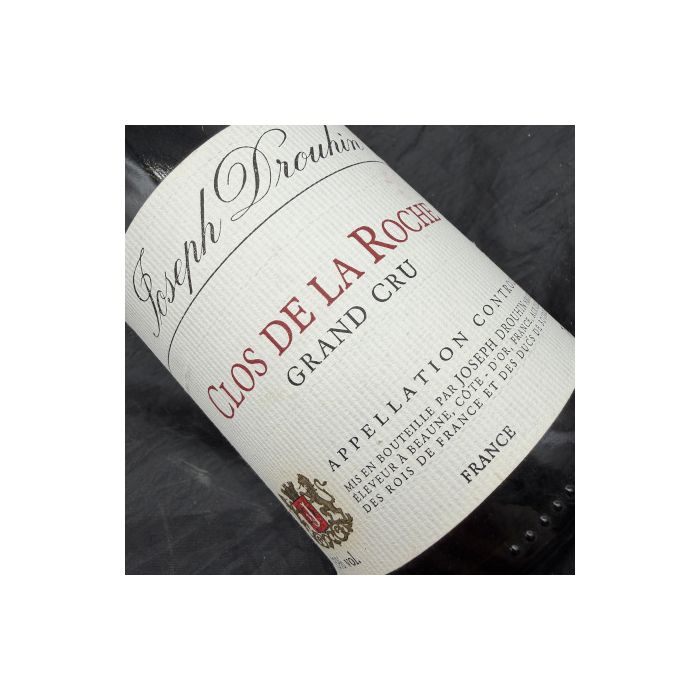
Domaine Drouhin Clos de La Roche 1988 Bouteille (75cl)
Domaine Drouhin Clos de La Roche 1988 is a red Burgundy wine from Morey-Saint-Denis, classified as a Grand Cru de Bourgogne. Made from 100% Pinot Noir, it comes from the Clos-de-la-Roche climat, located in the northern part of the Morey-Saint-Denis village terroir, near Gevrey-Chambertin. For this cuvée, Maison Joseph Drouhin relies on grapes and musts from partner producers selected according to strict specifications.
La bouteille proposée
- Size
- Bottle (75cl)
- Packaging
- Loose
- Label Condition
- Perfect
- Fill Level
- Perfect
- Capsule Condition
- Perfect
Identité du vin
- Couleur
- Red
- Pays
- France
- Région
- Bourgogne
- Appellation
- Morey Saint Denis
- Producteur / Domaine
- Domaine Drouhin
- Parcelle / Cru
- Clos-de-la-Roche
- Millésime
- 1988
Domaine Drouhin
Maison Joseph Drouhin is a family-run wine merchant and estate established in Beaune since 1880. Its own vineyards cover 100 hectares spread across the regions from Chablis to the Mâconnais, notably in the Côte de Nuits, Côte de Beaune and Côte Chalonnaise. The Drouhin family, now represented by the founder’s great-grandchildren, continues to run the business.
- Owner
- Famille Drouhin
- Maître de chais
- Véronique Boss-Drouhin
- Surface (ha)
- 100.00 ha
Histoire du domaine
Maison Joseph Drouhin was founded in Beaune in 1880, when Joseph Drouhin, aged 22, took over an established business in the town’s historic centre. From 1918 onwards, his son Maurice began developing an estate-owned vineyard. In 1921, he acquired his first plot at Clos des Mouches, in Beaune. Robert Drouhin took over in 1957 and continued to expand the estate, notably through the acquisition of Premier Crus and Grands Crus in the Côte de Nuits. In the late 1960s, he significantly expanded the estate’s presence in Chablis, acquiring nearly 40 hectares and the Moulin de Vaudon. In 1987, Robert Drouhin founded Domaine Drouhin Oregon with his daughter Véronique. Philippe Drouhin took over the management of the estates in 1988 and gradually shifted viticultural practices towards organic and biodynamic farming. The company is now run by Philippe, Véronique Boss-Drouhin, Laurent and Frédéric Drouhin; Véronique Boss-Drouhin is responsible for the cellar and winemaking. In 2023, the acquisition of two estates in Saint-Romain and Saint-Véran brought the estate’s own vineyard area to nearly 100 hectares.
Clos-de-la-Roche
Clos de la Roche is both a Grand Cru appellation and a physically delimited winegrowing terroir located solely within the commune of Morey-Saint-Denis. Its area includes the lieu-dit Clos de la Roche, which is now devoid of walls despite its name, as well as all or part of six neighboring lieux-dits: Les Chabiots, Les Fremières, Les Froichots, Les Genavrières, Les Mochamps, and Monts Luisants. The parcels occupy the lower half of the Côte, between 270 and 300 meters in altitude, on shallow and well-draining soils. The east-facing exposure, sometimes slightly east-south-east, is officially described for all neighboring Grands Crus of Morey-Saint-Denis rather than for this single area alone.
- Vineyard commune
- Morey-Saint-Denis
- Origin of the vineyard name
- The name "Roche" is attributed to the large blocks of stone present in the terroir.
- Altitude
- 270–300 m
- Slope
- Gentle in the lower part of the relief
- Soil
- Slightly developed soils, generally carbonatated, shallow, clayey, and well-draining, with scree, clays, and red silts.
- Subsoil and geology
- Bajocian entroquitic limestones in the lower part, intermediate marly level, and hard yet frost-susceptible Bathonian limestone towards the top.
Le domaine dans cette parcelle
- Vineyard holding status
- Negoce: purchases of grapes and musts from partner producers
Histoire de la parcelle
In 1860, the Viticultural Committee of the arrondissement of Beaune classified the lieu-dit Clos de la Roche and all or part of the neighboring lieux-dits as first class. The Clos de la Roche appellation d'origine contrôlée was recognized by the decree of December 8, 1936, with its area incorporating the main lieu-dit and neighboring parcels in accordance with historical usages. The terroir has long been divided among numerous owners, a land-ownership feature characteristic of this part of Morey-Saint-Denis.


