




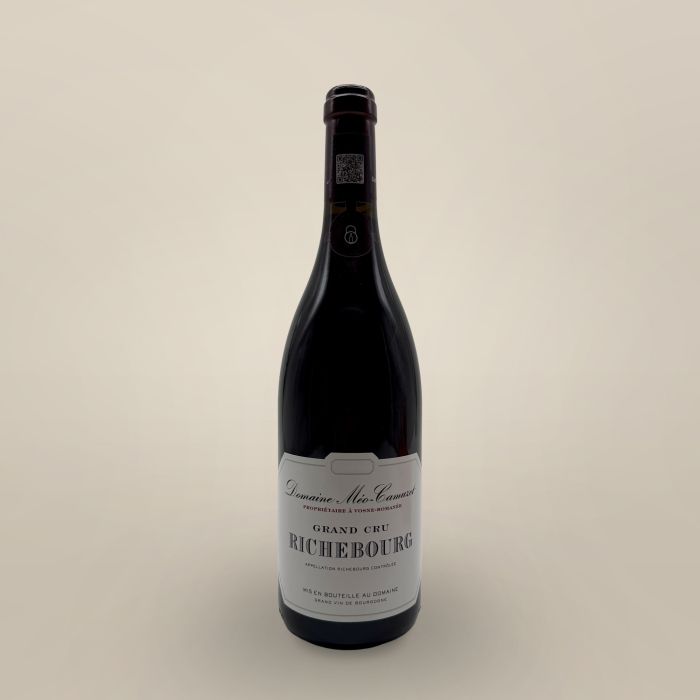
Domain Meo Camuzet Richebourg 2022 Bottle (75cl)
The 2022 Domaine Méo-Camuzet Richebourg is a Pinot Noir red Grand Cru from Burgundy originating from the Richebourg parcel in Vosne-Romanée. The estate farms just over 34 ares here, split between the lieux-dits Les Verroilles and Les Richebourg, just below Cros Parantoux. For this vintage, the estate describes a deep bouquet of black fruits, truffle, meaty notes, and a smoky touch, prolonged by a soft texture, a fine and flavorful mid-palate, and a tight, very long finish. Its full potential is expected from 2035.
La bouteille proposée
- Size
- Bottle (75cl)
- Packaging
- Loose
- Label Condition
- Perfect
- Fill Level
- Perfect
- Capsule Condition
- Perfect
Identité du vin
- Couleur
- Red
- Pays
- France
- Région
- Bourgogne
- Appellation
- Vosne Romanée
- Producteur / Domaine
- Domaine Méo Camuzet
- Parcelle / Cru
- Richebourg
- Millésime
- 2022
Cépage et assemblage
- Grape Variety
- 100% Pinot Noir
Domaine Méo Camuzet
Domaine Méo-Camuzet is a family-run estate based in Vosne-Romanée, in the Côte de Nuits. Its vineyard comprises plots in the Côte de Nuits and, following the acquisition of vineyards in Volnay and Pommard in 2025, in the Côte de Beaune. The estate is managed by Jean-Nicolas Méo, whilst winemaking is overseen by the oenologist María Ignacia Navarro González.
- Owner
- Famille Méo (Jean-Nicolas Méo, gérant du domaine)
- Maître de chais
- María Ignacia Navarro González
- Surface (ha)
- 21.40 ha
- Production (average bottles per vintage)
- 70 000 bouteilles/an
Histoire du domaine
The estate’s history is linked to Étienne Camuzet (1867–1946), a winegrower, mayor of Vosne-Romanée and Member of Parliament for the Côte-d’Or, who gradually built up a substantial portfolio of vineyards in the early 20th century. In particular, he acquired the Château du Clos de Vougeot in 1920 and retained three hectares of vines within the clos after the château was sold to the Confrérie des Chevaliers du Tastevin in November 1944. On his death in 1946, his daughter Maria Noirot-Camuzet inherited the estate. Having no children of her own, she bequeathed it in 1959 to her nephew Jean Méo, who was then working in General de Gaulle’s office. Jean Méo maintained the sharecropping agreements, notably with the Faurois and Tardy families as well as with Henri Jayer. The estate adopted the name Méo-Camuzet in 1981, and its first bottles marketed under this label date from 1983. In 1984, Jean Méo gradually handed over the management to his son Jean-Nicolas, who moved to Vosne-Romanée in 1989 after studying business management and oenology. As all the sharecroppers ceased their activities in 2008, Jean-Nicolas Méo has since been managing all the estate’s vineyards. A separate wine-trading company, Méo-Camuzet Frère et Sœurs, was established in the early 2000s with the same family shareholders. In 2025, the estate acquired 3.4 hectares of Pinot Noir in Volnay and Pommard, bringing the total area under its direct management to approximately 21.4 hectares.
Richebourg
Richebourg is both a Grand Cru appellation and a physically delimited climat of Vosne-Romanée, consisting of the lieux-dits Les Richebourgs and Les Véroilles ou Richebourgs. It occupies the foothills of the slope between 260 and 290 meters, on a gentle slope facing east. Its shallow, clayey, carbonate-rich soils with high iron oxide content rest on Bajocian marls and soft limestones, beneath a colluvial cover blending scree, clays, and silts.
- Vineyard commune
- Vosne-Romanée
- Exposure
- facing east
- Altitude
- 260–290 m
- Slope
- gentle to slight slope
- Soil
- Sparsely developed, carbonate-rich, shallow and heavily clayey soils, rich in iron oxides; colluvium of scree, clays, and silts.
- Subsoil and geology
- Bajocian calcareous marls and soft, frost-susceptible limestones, resting on the Jurassic limestone series of the Côte de Nuits.
Le domaine dans cette parcelle
- Estate holding in the vineyard (ha)
- 0.352000 ha
- Vineyard holding status
- Owner
- Indicative vine age
- Vines planted during the 1950s.
Histoire de la parcelle
The name Richebourg is attested as early as 1512. The Abbey of Cîteaux owned vines on the site, probably since the 17th century, and contributed to its renown. Recognized among the finest crus in the classifications of the 18th and 19th centuries, Richebourg was extended in 1924 to include Les Véroilles sous Richebourg following an agreement between owners ratified by the Court of Appeal of Dijon. The appellation d'origine contrôlée was recognized on September 11, 1936, with the boundaries defined in 1924.


