



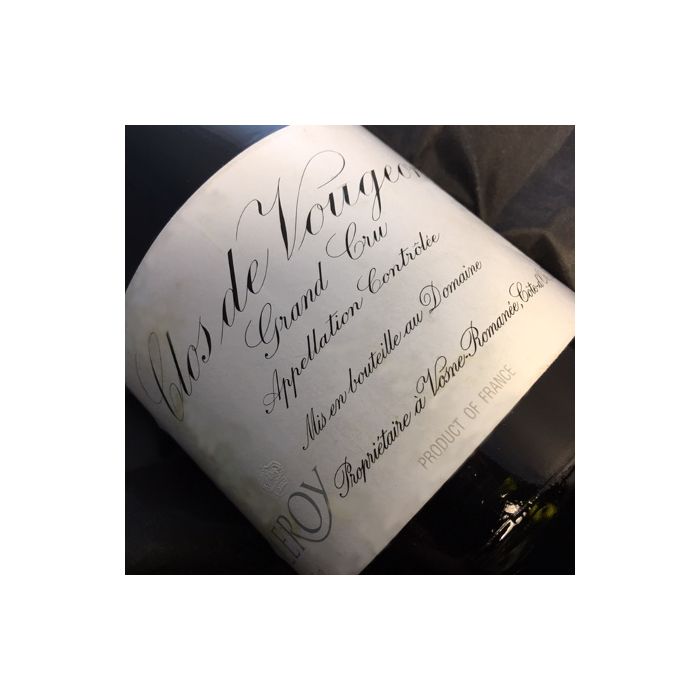
Domain Leroy Clos Vougeot 1998
Domaine Leroy Clos Vougeot 1998 is a red Burgundy wine from the Clos de Vougeot climat, classified as a Grand Cru in the Vougeot appellation. It is made exclusively from Pinot Noir. The Wine Advocate awards it 92/100 and describes a nose of talcum powder, rose, spices, blackberry, and cassis. The palate combines a rich, soft attack with black fruits, leading to a finish structured by firm and rustic tannins.
The bottle offered
- Size
- Bottle (75cl)
- Packaging
- Loose
- Label Condition
- Perfect
- Fill Level
- Perfect
- Capsule Condition
- Perfect
Wine details
- Couleur
- Red
- Pays
- France
- Région
- Bourgogne
- Appellation
- Vougeot
- Producteur / Domaine
- Domaine Leroy
- Parcelle / Cru
- Clos de Vougeot
- Millésime
- 1998
Cépage et assemblage
- Grape Variety
- 100% Pinot Noir
Domaine Leroy
Domaine Leroy is a Burgundian wine estate based in Vosne-Romanée, with vineyards spread across several appellations in the Côte de Nuits and Côte de Beaune. It was founded in 1988 by Lalou Bize-Leroy, a descendant of the family that founded Maison Leroy. The estate cultivates nearly 22 hectares using biodynamic methods and produces, in particular, village wines, premiers crus and grands crus.
- Owner
- Lalou Bize-Leroy
- Maître de chais
- Lalou Bize-Leroy
- Surface (ha)
- 21.99 ha
- Production (average bottles per vintage)
- 40 000 bouteilles/an
Histoire du domaine
The Leroy family’s history in the wine industry began in 1868, when François Leroy founded Maison Leroy in Auxey-Duresses, a wine merchant business distinct from the current Domaine Leroy. His son Joseph expanded the business, and his grandson Henri Leroy joined the company in 1919. In 1942, Henri Leroy acquired a stake of approximately half of the Domaine de la Romanée-Conti. His daughter, Lalou Bize-Leroy, joined the family business in 1955 and became its chairwoman in 1971. She was co-manager of the Domaine de la Romanée-Conti from 1974 to 1992. In the late 1980s, she acquired vineyards from the Charles Noëllat estate in Vosne-Romanée in 1988, followed by the Philippe-Rémy estate in Gevrey-Chambertin in 1989: these acquisitions form the Domaine Leroy as it stands today. The transition to biodynamic viticulture began during this period. Lalou Bize-Leroy remains the owner of the estate and is directly involved in the winemaking and ageing processes.
Clos de Vougeot
The Clos de Vougeot is a vast, single-piece vineyard enclosure, surrounded by walls and located at the foot of the Côte de Nuits slope, in the commune of Vougeot. Its terroir varies markedly from top to bottom: thin, gravelly soils on Bajocian limestone in the upper part, more clayey brown soils on limestone debris in the middle, and deeper, clayey and silty soils on a marly layer in the lower part. The site simultaneously constitutes a physically demarcated Burgundian climat and the emblematic parcel area of the AOC Grand Cru Clos de Vougeot or Clos Vougeot.
- Vineyard commune
- Vougeot
- Origin of the vineyard name
- "Clos" designates the vineyard historically enclosed by walls; "Vougeot" takes up the name of the place, linked to the Vouge which marks a historical boundary of the estate.
- Altitude
- 240–265 m
- Slope
- gentle, average of about 3.8%
- Soil
- At the top, shallow, granular soils rich in gravel; in the middle, shallow, more clayey brown soils on limestone debris; at the bottom, deeper brown soils rich in clay and fine silt.
- Subsoil and geology
- Jurassic complex; Bajocian limestone slab in the upper part, limestone debris in the middle, and marly layer in the lower part, with the influence of superficial formations linked to the outlet of the combe d'Orveau.
Le domaine dans cette parcelle
- Estate holding in the vineyard (ha)
- 1.907000 ha
- Vineyard holding status
- estate owner and operator
Histoire de la parcelle
The wine estate was gradually established by the Cistercian abbey of Cîteaux starting from the early 12th century; a medieval agreement set boundaries that have remained almost unchanged, and the wall was built before the end of that century. The farm buildings were developed from the 12th to the 15th century, then complemented in 1551 by the Renaissance residence that became the château du Clos de Vougeot. The abbey kept the estate until the Revolution; the buildings and vineyards were confiscated and then sold as national property in 1791, subsequently leading to the fragmentation of the property. The appellation d'origine contrôlée Clos de Vougeot or Clos Vougeot was recognized by decree on July 31, 1937.