




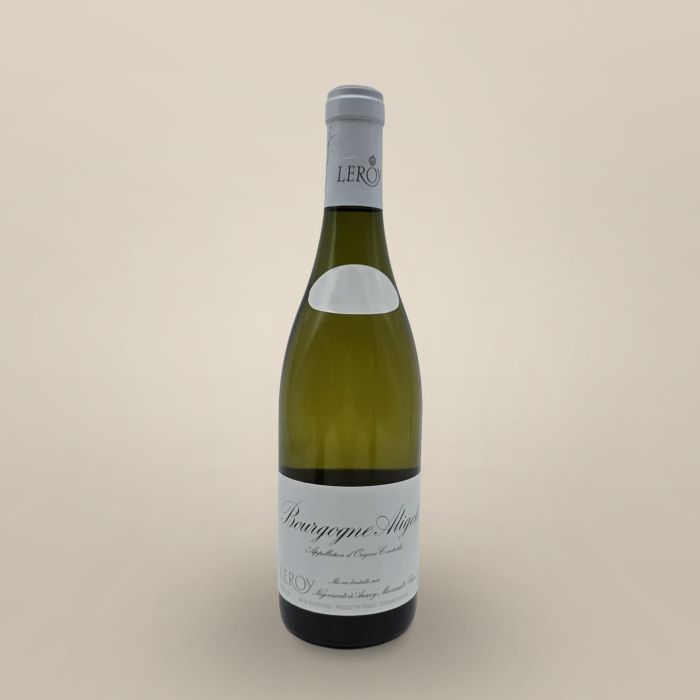
Domaine Leroy Aligote 2022 Bouteille (75cl)
Leroy Aligoté 2022 is a white Burgundy wine produced by Domaine Leroy, classified as Village and linked to the Puligny-Montrachet appellation. It is made from 100% Chardonnay. This 2022 vintage thus combines the Leroy identity with a white expression of Puligny-Montrachet.
La bouteille proposée
- Size
- Bottle (75cl)
- Packaging
- Loose
- Label Condition
- Perfect
- Fill Level
- Perfect
- Capsule Condition
- Perfect
Identité du vin
- Couleur
- White
- Pays
- France
- Région
- Bourgogne
- Appellation
- Puligny Montrachet
- Producteur / Domaine
- Domaine Leroy
- Millésime
- 2022
Cépage et assemblage
- Grape Variety
- 100% Chardonnay
Domaine Leroy
Domaine Leroy is a Burgundian wine estate based in Vosne-Romanée, with vineyards spread across several appellations in the Côte de Nuits and Côte de Beaune. It was founded in 1988 by Lalou Bize-Leroy, a descendant of the family that founded Maison Leroy. The estate cultivates nearly 22 hectares using biodynamic methods and produces, in particular, village wines, premiers crus and grands crus.
- Owner
- Lalou Bize-Leroy
- Maître de chais
- Lalou Bize-Leroy
- Surface (ha)
- 21.99 ha
- Production (average bottles per vintage)
- 40 000 bouteilles/an
Histoire du domaine
The Leroy family’s history in the wine industry began in 1868, when François Leroy founded Maison Leroy in Auxey-Duresses, a wine merchant business distinct from the current Domaine Leroy. His son Joseph expanded the business, and his grandson Henri Leroy joined the company in 1919. In 1942, Henri Leroy acquired a stake of approximately half of the Domaine de la Romanée-Conti. His daughter, Lalou Bize-Leroy, joined the family business in 1955 and became its chairwoman in 1971. She was co-manager of the Domaine de la Romanée-Conti from 1974 to 1992. In the late 1980s, she acquired vineyards from the Charles Noëllat estate in Vosne-Romanée in 1988, followed by the Philippe-Rémy estate in Gevrey-Chambertin in 1989: these acquisitions form the Domaine Leroy as it stands today. The transition to biodynamic viticulture began during this period. Lalou Bize-Leroy remains the owner of the estate and is directly involved in the winemaking and ageing processes.


