




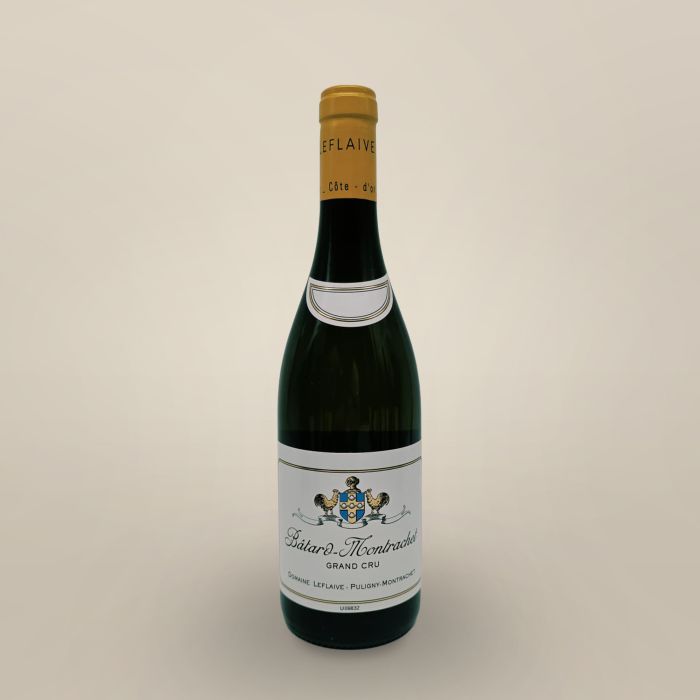
Domaine Leflaive Batard Montrachet 2017
The 2017 Domaine Leflaive Bâtard-Montrachet is a white Burgundy wine from the Bâtard-Montrachet grand cru in the Puligny-Montrachet appellation. Crafted exclusively from Chardonnay, it combines concentration and structure. The Wine Advocate awards it 94-96/100, while James Suckling rates it 96/100. Critics describe a full-bodied, still reserved white, driven by precise fruit, vibrant acidity and a long finish. James Suckling recommends giving it two to three years to open up.
La bouteille proposée
- Size
- Bottle (75cl)
- Packaging
- Loose
- Label Condition
- Perfect
- Fill Level
- Perfect
- Capsule Condition
- Perfect
Identité du vin
- Couleur
- White
- Pays
- France
- Région
- Bourgogne
- Appellation
- Puligny Montrachet
- Producteur / Domaine
- Domaine Leflaive
- Parcelle / Cru
- Bâtard-Montrachet (Puligny Montrachet)
- Millésime
- 2017
Cépage et assemblage
- Grape Variety
- 100% Chardonnay
Domaine Leflaive
Domaine Leflaive is a family-run estate based in Puligny-Montrachet, in the heart of the Côte de Beaune. It cultivates 24 hectares of Chardonnay, spread across the appellations of Puligny-Montrachet, Meursault, Chassagne-Montrachet and several grands crus. The estate is run by Brice de La Morandière, representing the fourth generation linked to the Leflaive family.
- Owner
- Famille Leflaive
- Maître de chais
- Amandine Brillanceau
- Surface (ha)
- 24.00 ha
- Production (average bottles per vintage)
- 120 000 bouteilles/an
Histoire du domaine
The Leflaive family has been based in Puligny-Montrachet since 1717 and at that time owned a few vineyards, the grapes from which were sold. The estate in its modern form was established by Joseph Leflaive (1870–1953), an engineer by training, who returned to manage the family estate following the phylloxera crisis. From 1920 onwards, he embarked on a programme of replanting, acquiring and developing the vineyards, with the support of his estate manager, François Virot. He gradually began marketing the wines under his own label, whilst the first bottles were exported to the United States between 1932 and 1939. Following his death in 1953, his children Jo, Jeanne, Anne and Vincent kept the estate together and established a civil partnership in 1973. Jo took charge of administration and finances, whilst Vincent oversaw the vineyard, the wines and their marketing. Olivier Leflaive became co-manager alongside Vincent in 1986, then Anne-Claude Leflaive joined the management team in 1990 before being appointed manager in 1994. Under her leadership, the estate gradually adopted biodynamic farming during the 1990s. Following her death in April 2015, her nephew Brice de La Morandière, the great-grandson of Joseph Leflaive, became managing partner. Since January 2025, Amandine Brillanceau has held the post of technical director; Louis Brière is cellar master at Puligny-Montrachet.
Bâtard-Montrachet (Puligny Montrachet)
Bâtard-Montrachet is both a Grand Cru appellation and a physically demarcated climat, shared between Puligny-Montrachet and Chassagne-Montrachet. It occupies the lower part of the slope, exposed mainly to the east and south-east, at around 240 to 250 metres of altitude. Its brown limestone soils are thicker and more clayey towards the foothill, with clay colluvium relatively poor in stones. The substrate consists mainly of platy limestones from the Middle Jurassic, attributed to the Callovian.
- Vineyard commune
- Puligny-Montrachet et Chassagne-Montrachet
- Exposure
- east to south-east, with a southern component
- Altitude
- 240–250 m
- Soil
- Relatively thick and clayey brown limestone soils; clay colluvium with few stones.
- Subsoil and geology
- Platy limestones from the Middle Jurassic, mainly Callovian.
Le domaine dans cette parcelle
- Estate holding in the vineyard (ha)
- 1.730000 ha
- Vineyard holding status
- plot owner
- Indicative vine age
- Plots planted in 1962, 1974, 1979, 1989 and 2021.
Histoire de la parcelle
The "Bâtard" climat was already distinguished from Montrachet in the 18th century, although its wines were long assimilated with those of Montrachet. A 1921 judgment consecrated the use of the name "Bâtard-Montrachet" and the local hierarchy of grand crus. The AOC was recognized by the decree of 31 July 1937; its plot area was initially demarcated in 1939, then approved by the INAO in 1988 for Chassagne-Montrachet and in 1989 for Puligny-Montrachet.


