




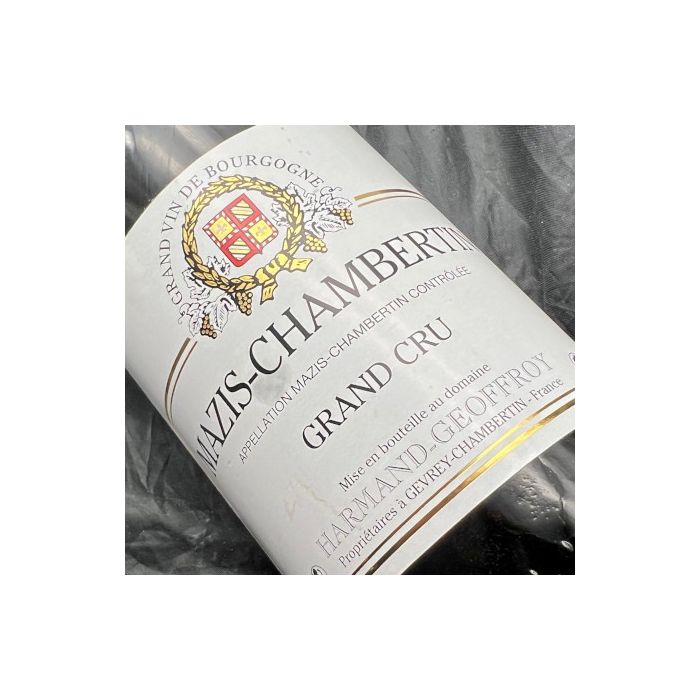
Domain Harmand Geoffroy Mazy Chambertin 2014 Bottle (75cl)
The 2014 Domaine Harmand Geoffroy Mazis-Chambertin is a red Burgundy wine from the Mazis-Chambertin Grand Cru in the commune of Gevrey-Chambertin. Crafted exclusively from Pinot Noir, it comes from the 80 ares owned by the estate in this climat, planted with old vines around 40 to 70 years of age. Mazis-Chambertin is a Côte de Nuits appellation dedicated exclusively to red Pinot Noir wines.
La bouteille proposée
- Size
- Bottle (75cl)
- Packaging
- Loose
- Label Condition
- Perfect
- Fill Level
- Perfect
- Capsule Condition
- Perfect
Identité du vin
- Couleur
- Red
- Pays
- France
- Région
- Bourgogne
- Appellation
- Gevrey Chambertin
- Producteur / Domaine
- Domaine Harmand Geoffroy
- Parcelle / Cru
- Mazis-Chambertin
- Millésime
- 2014
Cépage et assemblage
- Grape Variety
- 100% Pinot Noir
Domaine Harmand Geoffroy
The Harmand-Geoffroy estate is a family-run business situated in Gevrey-Chambertin, in the Côte de Nuits. It cultivates 9 hectares of Pinot Noir exclusively within the commune of Gevrey-Chambertin, ranging from Bourgogne to Mazis-Chambertin Grand Cru. Philippe Harmand, the fifth generation of the family, now oversees the vineyard work and winemaking.
- Owner
- Famille Harmand-Geoffroy, représentée par Philippe Harmand
- Maître de chais
- Philippe Harmand
- Surface (ha)
- 9.00 ha
- Production (average bottles per vintage)
- environ 45 000 bouteilles/an
Histoire du domaine
The Harmand-Geoffroy estate is a family-run business established in Gevrey-Chambertin since the late 19th century. It originated from the family-run Lucien Geoffroy et Fils estate, which was taken over in 1989 by Gérard Harmand and his wife. Under their management, the estate has expanded to cover 9 hectares. The vineyard is planted entirely with Pinot Noir and is situated exclusively within the commune of Gevrey-Chambertin. It comprises regional and commune appellations, several Premier Crus, as well as a plot of Mazis-Chambertin Grand Cru. Philippe Harmand gradually took over the running of the estate from the mid-2000s. He represents the fifth generation of the family and oversees both vineyard management and winemaking. The viticultural practices outlined by the estate and local organisations are based, in particular, on soil cultivation without the use of chemical weedkillers, and on integrated pest management.
Mazis-Chambertin
Mazis-Chambertin is a Grand Cru appellation corresponding to a physically demarcated terroir in Gevrey-Chambertin, comprising the lieux-dits Les Mazis-Hauts and Les Mazis-Bas. Located on the foothills on a slight plateau facing east, it extends Clos de Bèze to the north and features a slightly concave topography. Its superficial, carbonate, clayey soils rich in iron oxides overlie a Jurassic marl-limestone substrate ensuring efficient drainage and regulated water supply.
- Vineyard commune
- Gevrey-Chambertin
- Origin of the vineyard name
- The place name "Mazis" evokes dwellings that disappeared in the Middle Ages, a presence corroborated by ashlar stones and fragments of tiles.
- Exposure
- East (levant)
- Slope
- gentle plateau; lower section with a slight slope
- Soil
- Scarcely developed, carbonated, thin, well-draining, clayey soils rich in iron oxides.
- Subsoil and geology
- Hard limestones and Bajocian marly level; Bathonian frost-susceptible limestone in the upper section, beneath scree deposits, clays, and red silts.
Le domaine dans cette parcelle
- Estate holding in the vineyard (ha)
- 0.800000 ha
- Indicative vine age
- Six parcels spread between Mazis-Haut and Mazis-Bas, showing an average age of about 45 years according to a professional source.
Histoire de la parcelle
The reputation of the climat is attested in the 18th century: Abbot Courtépée cited the "Mazy" among the renowned climats in 1774. In 1855, Doctor Lavalle distinguished the upper part as "1ère cuvée" and the lower part as "2ème cuvée". A judgment by the Dijon tribunal in 1931 recognized the Mazis-Chambertin appellation of origin and established its boundaries; the AOC was subsequently recognized by decree on July 31, 1937.


