




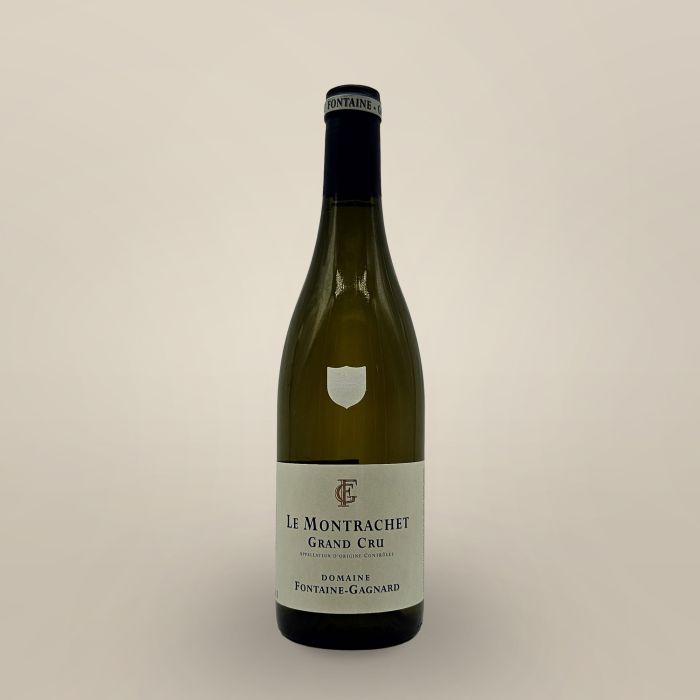
Domaine Fontaine-Gagnard Montrachet 2017 Bouteille (75cl)
The 2017 Domaine Fontaine-Gagnard Montrachet is a white Burgundy from the Montrachet appellation, classified as a Grand Cru. Made exclusively from Chardonnay, it comes from the estate's parcel in Montrachet. The Wine Advocate awards it 96/100, recommending a drinking window between 2020 and 2035, while James Suckling rates it 95/100. Critics describe a rich, satin-smooth wine with notes of white flowers, citrus, pear, brioche, and butterscotch, framed by a long, precise finish.
La bouteille proposée
- Size
- Bottle (75cl)
- Packaging
- Loose
- Label Condition
- Perfect
- Fill Level
- Perfect
- Capsule Condition
- Perfect
Identité du vin
- Couleur
- White
- Pays
- France
- Région
- Bourgogne
- Appellation
- Puligny Montrachet
- Producteur / Domaine
- Domaine Fontaine-Gagnard
- Parcelle / Cru
- Montrachet
- Millésime
- 2017
Cépage et assemblage
- Grape Variety
- 100% Chardonnay
Domaine Fontaine-Gagnard
The Fontaine-Gagnard estate is a 12-hectare family-run vineyard based in Chassagne-Montrachet, in the Côte de Beaune. Founded in 1985 by Laurence Gagnard and Richard Fontaine, it comprises mainly vineyards in Chassagne-Montrachet, supplemented by a few plots in Volnay and Pommard. The estate produces, in particular, wines from the Chassagne-Montrachet Premier Crus and the Montrachet, Bâtard-Montrachet and Criots-Bâtard-Montrachet Grands Crus.
- Owner
- Famille Fontaine-Gagnard
- Maître de chais
- Céline Fontaine
- Surface (ha)
- 12.00 ha
- Production (average bottles per vintage)
- 60 000 bouteilles/an
Histoire du domaine
The Fontaine-Gagnard estate was founded in 1985 in Chassagne-Montrachet by Laurence Gagnard and her husband Richard Fontaine. Laurence is the daughter of Jacques and Marie-Josèphe Gagnard, who come from a family with a long history in local winegrowing. The estate was established using the family’s vineyards. Its vineyard now covers 12 hectares, mainly in Chassagne-Montrachet, with plots also in Volnay and Pommard. Céline Fontaine joined the business in 2007. Frédéric Robert joined her in 2018 and learnt about vineyard work and winemaking at the estate. Céline Fontaine now runs the estate and oversees the winemaking process. The operating company is currently managed by Laurence Gagnard and Céline Fontaine.
Montrachet
Montrachet is a physically delimited climat and Grand Cru appellation shared between Puligny-Montrachet and Chassagne-Montrachet. Its vines occupy a narrow, elongated strip, perpendicular to the slope, in a slight concavity in the lower part of the east- and southeast-facing hillside. The terroir combines red, clayey, calcareous, and very stony soils with Jurassic substrates differentiated by a fault. Its rapid drainage and nocturnal air drainage limit humidity and frost risks.
- Vineyard commune
- Puligny-Montrachet et Chassagne-Montrachet
- Origin of the vineyard name
- The name comes from "Mont Rachet," understood as "bald mountain" or "barren mountain," probably referring to the sparsely vegetated promontory overlooking the site; "râche" is a regional term designating ringworm or scurf.
- Exposure
- East to southeast
- Altitude
- 250–270 m
- Slope
- Lower part of the hillside; strip perpendicular to the slope
- Soil
- Red, clayey, calcareous, very stony, and well-structured soils; locally lean and very stoney soils.
- Subsoil and geology
- Fault separating two sectors; Oxfordian marls rich in iron oxides over Bajocian/Callovian flaggy limestones, with locally highly fragmented Bathonian limestones.
Le domaine dans cette parcelle
- Estate holding in the vineyard (ha)
- 0.070000 ha
- Vineyard holding status
- owner
Histoire de la parcelle
The cru is attested as early as the 13th century in the form "Mont Rachaz." It truly took off in the 18th century under the impetus of the Clermont-Montoison family, lords of Chagny, and Thomas Jefferson placed it on par with Chambertin in 1787. Puligny and Chassagne appended the name Montrachet to their village names in 1878. A Beaune court ruling defined the appellation of origin in 1921, and the Montrachet AOC was subsequently recognized on July 31, 1937.


