




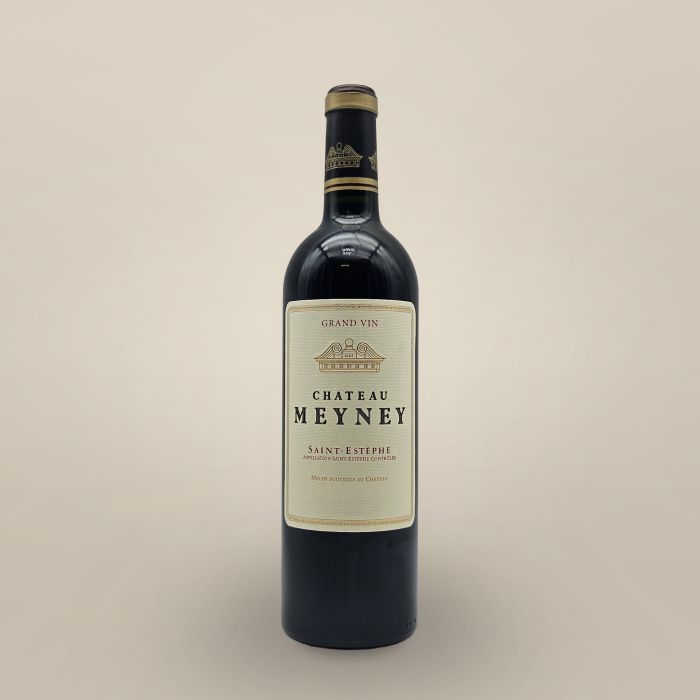
Château Meyney 2010 Bouteille (75cl)
The 2010 Château Meyney is a red wine from Saint-Estèphe in Bordeaux, produced by Château Meyney. It blends Cabernet Sauvignon, Merlot, and Petit Verdot. James Suckling awards it 92/100, Wine Advocate 83/100, and Jancis Robinson 17+/20. Jancis Robinson highlights a wine combining power and finesse, with supple tannins and a refined, concentrated palate; James Suckling notes a balance between fruit and tannins. Drinking windows are indicated as 2020 to 2025 by Wine Advocate, and 2020 to 2040 by Jancis Robinson.
La bouteille proposée
- Size
- Bottle (75cl)
- Packaging
- Original Wooden Case of 12
- Label Condition
- Perfect
- Fill Level
- Perfect
- Capsule Condition
- Perfect
Identité du vin
- Couleur
- Red
- Pays
- France
- Région
- Bordeaux
- Appellation
- Saint Estèphe
- Producteur / Domaine
- Château Meyney
- Millésime
- 2010
Cépage et assemblage
- Grape Variety
- Cabernet Sauvignon, Merlot, Petit Verdot
Château Meyney
Château Meyney is a wine estate in Saint-Estèphe, in the Médoc, situated on hilltops overlooking the Gironde estuary. Its 51-hectare vineyard, comprising a single block, rests on siliceous gravel and features a vein of blue clay. Owned by CA Grands Crus, a subsidiary of the Crédit Agricole group, the estate’s history has been linked to the Feuillants monks since 1625.
- Owner
- CA Grands Crus (groupe Crédit Agricole)
- Maître de chais
- Thomas Hernandez
- Surface (ha)
- 51.00 ha
- Production (average bottles per vintage)
- 300 000 bouteilles/an
Histoire du domaine
Vine-growing at Meyney is documented as far back as before 1625. In that year, Pierre Forthon bequeathed part of the estate to the Feuillants, who subsequently purchased the remainder of the property and developed both the vineyard and the operational infrastructure. The monks began building the ‘Maison du Meyney’ in 1625; its construction was completed in 1662. After the Revolution, Jean-Jacques Luetkens acquired the estate in 1791. His widow, Louise, succeeded him, and the family retained Meyney for several generations, first under the Fumel family and then the Du Sault family. In 1919, Désiré Cordier, a wine merchant and also owner of the Châteaux Talbot and Gruaud-Larose, purchased the property. In the 1920s, he introduced Petit Verdot to the vineyard through mass selection. The estate came under the control of CA Grands Crus, a subsidiary of the Crédit Agricole group, in December 2004. Anne Le Naour is in charge of general management and winemaking; Thomas Hernandez is the cellar master.


