




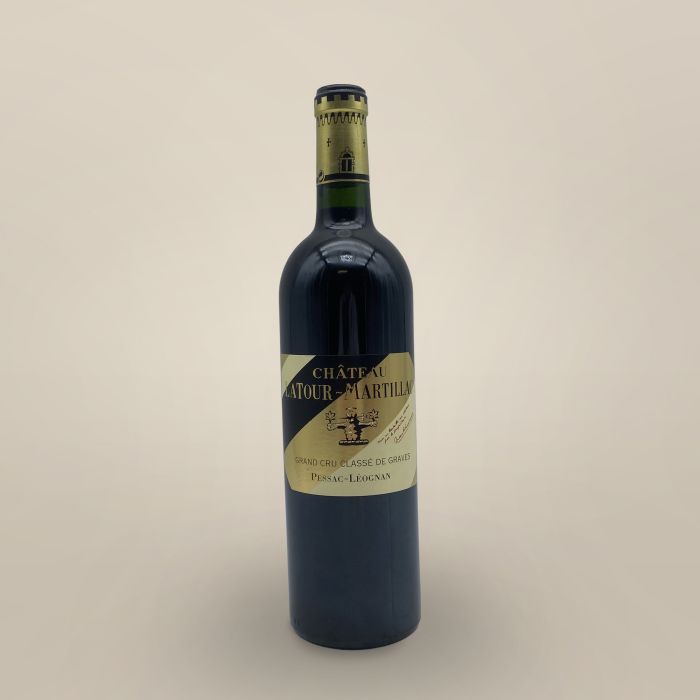
Château Latour Martillac 2001
The 2001 Château Latour Martillac is a red wine from the Pessac-Léognan appellation in Bordeaux, produced by Château Latour Martillac. Its blend comprises 55% Cabernet Sauvignon, 40% Merlot, and 5% Petit Verdot. It receives 87/100 from The Wine Advocate and 16/20 from Jancis Robinson. Critics describe a dense, medium-bodied wine, marked by toasted oak and tannins, with a slightly fading finish. Indicated drinking windows: 2005–2013 according to The Wine Advocate and 2008–2015 according to Jancis Robinson.
La bouteille proposée
- Size
- Bottle (75cl)
- Packaging
- Original Wooden Case of 12
- Label Condition
- Perfect
- Fill Level
- Perfect
- Capsule Condition
- Perfect
Identité du vin
- Couleur
- Red
- Pays
- France
- Région
- Bordeaux
- Appellation
- Pessac Léognan
- Producteur / Domaine
- Château Latour Martillac
- Millésime
- 2001
Cépage et assemblage
- Grape Variety
- 55% Cabernet Sauvignon, 40% Merlot, 5% Petit Verdot
Château Latour Martillac
Château Latour-Martillac is a wine estate in Martillac, within the Pessac-Léognan appellation, classified for both red and white wines in the Graves classification. Its 54-hectare vineyard is run by the Kressmann family, who have owned it since 1930. The estate notably includes the historic Grapecap plot, which was grafted in 1884.
- Owner
- Famille Jean Kressmann
- Maître de chais
- Valérie Vialard
- Surface (ha)
- 54.00 ha
- Production (average bottles per vintage)
- Rouge : 240 000 bouteilles ; blanc : 50 000 bouteilles
Histoire du domaine
The estate takes its name from a tower built in the 12th century, a remnant of a small fort attributed to Montesquieu’s ancestors. Viticulture is documented as the main activity there in the first half of the 19th century, notably through plans dated 1847 and 1860. In 1871, the Bordeaux wine merchant Edouard Kressmann took an interest in the estate, then known as Latour, and began marketing its wines. In 1884, he advised planting a plot of white grape varieties, which survives today under the name Grapecap. His eldest son, Alfred Kressmann, acquired the estate in 1930 and renamed it Château Latour-Martillac to avoid any confusion with Château Latour in Pauillac. He then undertook a restructuring of the vineyard and expanded the Cabernet Sauvignon plantings. Jean Kressmann inherited the estate in 1954, continued its expansion and brought the vineyard to nearly 30 hectares by the early 1970s. The château was classified amongst the Graves crus classés in 1953 for its red and white wines, and subsequently came under the Pessac-Léognan appellation, created in 1987, to the establishment of which Jean Kressmann contributed. Loïc Kressmann joined the estate in 1975 and Tristan Kressmann in 1986; they subsequently took charge of its management and development. Since 2019, Edouard Kressmann, Loïc’s son, has been technical director, overseeing the vineyard and the winemaking process. Valérie Vialard is the cellar master, assisted by Léa Viguier, the assistant cellar master.


