


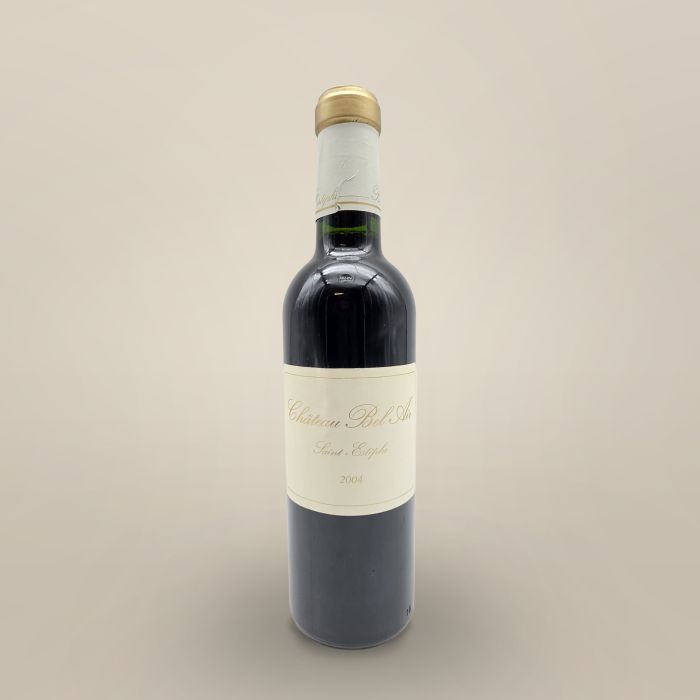
Château Bel Air Saint Estèphe 2004 Demi Bouteille (37,5cl)
Château Bel Air 2004 is a red wine from the Saint-Estèphe appellation in Bordeaux, produced by Château Bel Air. Its blend brings together Cabernet Franc, Cabernet Sauvignon, Merlot, and Petit Verdot. Hailing from a small vineyard of approximately 5 hectares, this vintage was barrel-aged and its production was limited to 26 000 bottles. This cuvée thus pairs the classic identity of a Saint-Estèphe with production on the scale of a small-sized estate.
The bottle offered
- Size
- Half Bottle (37,5cl)
- Packaging
- Original Wooden Case of 24
- Label Condition
- Perfect
- Fill Level
- Perfect
- Capsule Condition
- Perfect
Wine details
- Couleur
- Red
- Pays
- France
- Région
- Bordeaux
- Appellation
- Saint Estèphe
- Producteur / Domaine
- Château Bel Air
- Millésime
- 2004
Cépage et assemblage
- Grape Variety
- Cabernet Franc, Cabernet Sauvignon, Merlot, Petit Verdot
Château Bel Air
Château Bel Air was a small five-hectare estate located in the Saint-Estèphe appellation, long managed by Jean-François Braquessac. Its vineyard, predominantly planted with Cabernet-Sauvignon, produced structured Médoc reds sourced exclusively from the estate's grapes. The property was acquired in 2012 by Belgian entrepreneur Chris Cardon, who also owns Château La Haye.
- Owner
- Chris Cardon
- Surface (ha)
- 5.00 ha
Histoire du domaine
Château Bel Air was operated as a small family property by Jean-François Braquessac, a wine broker in the Médoc. Professional sources document a vineyard of about five hectares — 4.92 hectares for the 2009 vintage — with a high proportion of Cabernet-Sauvignon, complemented by Merlot, Cabernet Franc, and Petit Verdot. In 2012, alongside his acquisition of Château La Haye in Saint-Estèphe, Chris Cardon bought Château Bel Air and its five hectares from Jean-François Braquessac. The Château Bel Air brand was subsequently registered by the company Château La Haye – Terroirs Nobles. Consulted sources do not confirm whether an independent production is still commercialized under this name, nor do they identify a cellar master specifically assigned to Château Bel Air.