




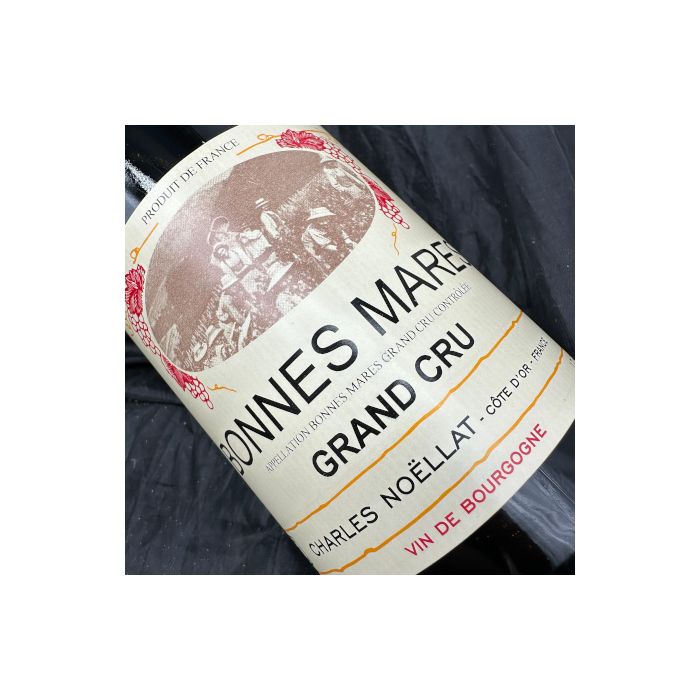
Domaine Charles Noellat Bonnes Mares Grand Cru 2014 Bouteille (75cl)
The 2014 Domaine Charles Noellat Bonnes-Mares Grand Cru is a red Burgundy wine from the Bonnes-Mares Grand Cru in the Côte de Nuits, between Chambolle-Musigny and Morey-Saint-Denis. Crafted by Domaine Charles Noellat, owned by the Noellat family, it is composed of 100% Pinot Noir. The Bonnes-Mares parcel, classified as a Burgundy Grand Cru, exclusively produces Pinot Noir red wines. The appellation is renowned for structured, fleshy, and deeply tannic wines, harmonizing power and elegance.
La bouteille proposée
- Size
- Bottle (75cl)
- Label Condition
- Perfect
- Fill Level
- Perfect
- Capsule Condition
- Perfect
Identité du vin
- Couleur
- Red
- Pays
- France
- Région
- Bourgogne
- Appellation
- Chambolle Musigny
- Producteur / Domaine
- Domaine Charles Noellat
- Parcelle / Cru
- Bonnes-Mares
- Millésime
- 2014
Domaine Charles Noellat
Domaine Charles Noëllat was a vineyard in Vosne-Romanée, established in the early 20th century by Charles Noëllat and his wife Anne-Marie, known as Laure. Its vineyard, which included plots in Romanée-Saint-Vivant, Richebourg and Grands-Échezeaux, was broken up after 1987; the majority of the remaining land was sold to Lalou Bize-Leroy in 1988. Since 2013, a separate Maison Charles Noëllat has been reviving the family name through the selection, ageing and marketing of Burgundy wines, without this constituting a takeover of the historic wine estate.
- Owner
- Famille Noellat
Histoire du domaine
The Noëllat family has been involved in Burgundian wine-growing since the 17th century and was originally based in Meuilley, near Nuits-Saint-Georges. In the 19th century, Félix Noëllat established the family estate in Vosne-Romanée. His son Charles Noëllat, born in 1868, founded the estate bearing his name in the early 20th century with his wife Anne-Marie, known as Laure. Having been called up during the First World War, Charles left Laure to continue managing and developing the estate. By the 1930s, the estate covered around 25 hectares and included plots in several appellations of the Côte de Nuits, including Romanée-Saint-Vivant. Charles died in 1939; following the death of their son André in 1941, Laure and their daughter Geneviève ensured the estate’s continuity throughout the war. In 1947, Christian Moreau, Geneviève’s husband, joined the business. Their daughter Anne-Marie took over its management in 1976. Following Geneviève’s death in 1987, disputes over the estate led to the vineyard being broken up; the largest remaining portion, reported to be 12 hectares at the time of sale, was acquired by Lalou Bize-Leroy in 1988 and incorporated into Domaine Leroy. The current Maison Charles Noëllat was relaunched in 2013 by Stéphane, a descendant of Charles Noëllat, and Antoine Laurent; it selects Burgundy wines and ages and bottles its ‘Hommage à Bligny-lès-Beaune’ range.
Bonnes-Mares
Bonnes-Mares is a physically delineated Grand Cru of the Côte de Nuits, split between Chambolle-Musigny and Morey-Saint-Denis, with the largest portion located in Chambolle-Musigny. The vineyard forms approximately a rectangle south of Clos de Tart, on a gently sloping hillside with an easterly exposure. The light, gravelly, brown to reddish soils containing clay with flint rest on Jurassic limestone and white marl.
- Vineyard commune
- Chambolle-Musigny (principalement) et Morey-Saint-Denis
- Origin of the vineyard name
- Name attested since the late Middle Ages, of uncertain etymology. The BIVB favors the hypothesis of the old verb "marer", meaning to cultivate with care, rather than a reference to mother goddesses.
- Exposure
- east
- Altitude
- 250–280 m
- Slope
- gentle slope
- Soil
- Light and gravelly soil, brown or reddish, predominantly clayey with flint, approximately 40 cm deep.
- Subsoil and geology
- Limestone slab and white marl of Jurassic origin, dating back approximately 150 million years.
Histoire de la parcelle
The vineyard has been known as Bonnes-Mares since the late Middle Ages. The appellation of origin was recognized by the decree of December 8, 1936. Its production parcel area was subsequently approved by the INAO during the sessions of July 24, 1965 and June 1-2, 1988.


