




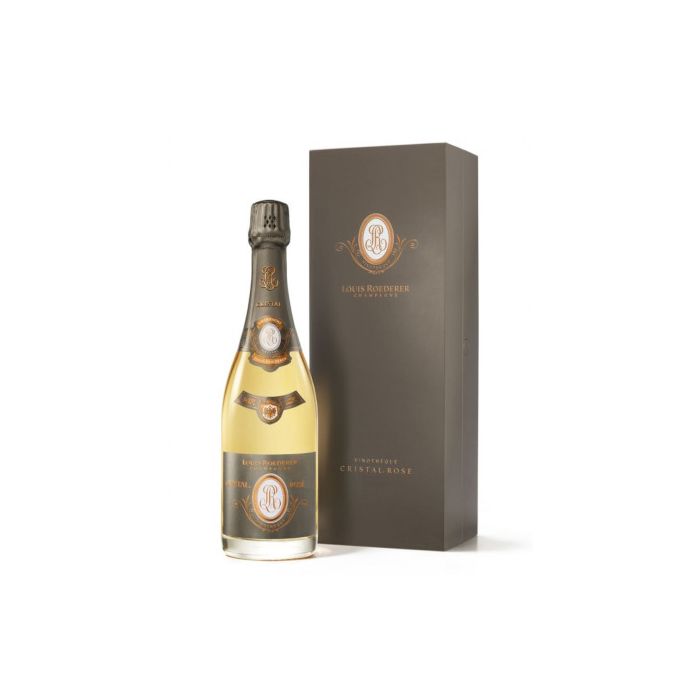
Champagne Cristal Rose Vinothèque 1999 Magnum (150cl)
The 1999 Champagne Cristal Rosé Vinothèque by Roederer is a rosé Grand Cru Champagne crafted from 55% Pinot Noir and 45% Chardonnay. This cuvée spent seven years on lattes (lees) followed by seven years on pointes prior to disgorgement. The Wine Advocate awards it 95/100 and recommends it from 2019 to 2035; Jancis Robinson rates it 19/20 and James Suckling gives it 97/100. Critics describe a mature, dense, and silky wine with notes of dried fruit, pastry, spiced cherry, praline, and a touch of sea spray, underpinned by a chalky framework and a long finish.
La bouteille proposée
- Size
- Magnum (150cl)
- Packaging
- Gift Box
- Label Condition
- Perfect
- Fill Level
- Perfect
- Capsule Condition
- Perfect
Identité du vin
Cépage et assemblage
- Grape Variety
- 55% Pinot Noir, 45% Chardonnay
Roederer
Louis Roederer is a Champagne house based in Reims, founded in 1776 under the name Dubois et Fils. Remaining under family control and run by the Rouzaud family, it manages a vast vineyard spread across the Montagne de Reims, the Marne Valley and the Côte des Blancs. Jean-Baptiste Lécaillon is the cellar master and head of winemaking.
- Owner
- Famille Rouzaud
- Maître de chais
- Jean-Baptiste Lécaillon
- Surface (ha)
- 250.00 ha
- Production (average bottles per vintage)
- 3 800 000 bouteilles/an
Histoire du domaine
The company was founded in Reims in 1776 by Pierre-Joseph Dubois and his son under the name Dubois et Fils. In 1833, Louis Roederer inherited the business from his uncle, gave it his own name and began to expand its export operations. From the 1830s onwards, Hugues Krafft’s commercial efforts played a key role in establishing the house on the Russian market. In the mid-19th century, Louis Roederer also developed his own vineyard to ensure greater control over his supply of grapes. In 1852, the house moved to Boulevard Lundy in Reims, where buildings and cellars carved into the chalk were constructed. In 1876, Louis Roederer created Cristal for Tsar Alexander II of Russia. Following the untimely death of Louis Roederer II in 1880, his sister Léonie Olry-Roederer became the owner of the brand and the estates. Her son Louis-Victor, followed by her brother Léon Olry-Roederer, subsequently ran the house; on Léon’s death in 1932, his wife Camille Olry-Roederer took over the reins. Jean-Claude Rouzaud, Camille Olry-Roederer’s grandson, inherited the business in 1979 and expanded the family group. His son, Frédéric Rouzaud, has been at the helm of the house and the group since 2006. Since 2000, Louis Roederer has been applying practices to its vineyards inspired in particular by organic, biodynamic and regenerative agriculture; Jean-Baptiste Lécaillon is now the cellar master.
Cristal Rosé Vinothèque
Cristal Rosé Vinothèque is a very long-aged edition of the Cristal Rosé prestige cuvée, produced in very limited quantities. The bottles continue their maturation in the Louis Roederer cellars, notably on laths, sur pointes and then after disgorging depending on the editions, in order to seek a balance between evolution, freshness and complexity.
- Origin of the cuvée name
- "Cristal" refers to the transparent bottle created in 1876 for Tsar Alexander II; "Vinothèque" designates this expression kept for a very long time in the cellars of the Maison.
- Cuvée creation year
- 2017
- Style of the cuvée
- A long-matured rosé Champagne seeking intensity and complexity without losing the purity, energy and chalky freshness characteristic of Cristal Rosé. Its overall style combines finesse, silky texture, controlled concentration and evolved expression of bottle aging.
- Position within the range
- Vinothèque expression, extremely rare and long-aged, positioned at the pinnacle of the Cristal Rosé range.
Histoire de la cuvée
The Vinothèque concept was launched in 2017 with older editions of Cristal and Cristal Rosé, with the first documented release based on the 1995 vintage. It extends Cristal Rosé, created in 1974, through an aging of about twenty years in the cellars of the Maison before its commercialization.


