



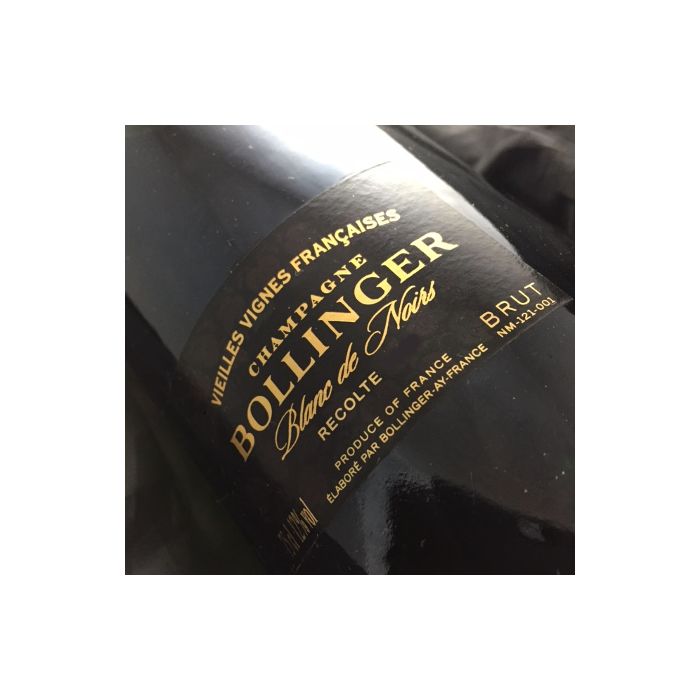
Champagne Bollinger Vieilles Vignes Francaises 2000
The 2000 Champagne Bollinger Vieilles Vignes Françaises is a vintage white Champagne classified as Grand Cru, produced by Bollinger. This cuvée is crafted exclusively from Pinot Noir from old vines. It comes from the Clos Saint-Jacques and Clos des Chaudes-Terres in Aÿ, two ungrafted ungrafted-root plots that survived phylloxera. The vines are cultivated using the provignage method, and the wine is vinified in old oak barrels before extended cellaring. A singular Blanc de Noirs deeply rooted in Champagne's viticultural heritage.
The bottle offered
- Size
- Bottle (75cl)
- Packaging
- Gift Box
- Label Condition
- Perfect
- Fill Level
- Perfect
- Capsule Condition
- Perfect
Wine details
- Couleur
- Sparkling White
- Pays
- France
- Région
- Champagne
- Producteur / Domaine
- Bollinger
- Cuvée
- Vieilles Vignes Françaises
- Millésime
- 2000
Cépage et assemblage
- Grape Variety
- 100% Pinot Noir
Bollinger
Founded in Aÿ in 1829, Bollinger is a Champagne house that has remained under family control. Its vineyards cover 179 hectares, spread across seven vineyard blocks, 85 per cent of which are classified as grands crus or premiers crus. Pinot Noir predominates here, and the house continues to vinify some of its wines in small oak barrels.
- Owner
- Société Jacques Bollinger (famille Bollinger)
- Surface (ha)
- 179.00 ha
- Production (average bottles per vintage)
- environ 2 500 000 à 3 000 000 bouteilles/an
Histoire du domaine
The company Renaudin-Bollinger & Cie was founded in Aÿ on 6 February 1829 by Athanase de Villermont, Joseph (known as Jacques) Bollinger and Paul Renaudin. Athanase de Villermont contributed the land inherited from his family, whilst Joseph Bollinger took charge of marketing and Paul Renaudin of the cellar. Georges Bollinger, Jacques’s son, subsequently ran the company during the phylloxera crisis and the First World War. On Georges’s death in 1918, his son Jacques took over the management of the business, expanded the facilities and, notably, acquired vineyards in Tauxières. Following Jacques’s death in 1941, his wife Elisabeth Law de Lauriston-Boubers, known as Lily Bollinger, ran the house until 1971, through the war and the subsequent post-war recovery. Under her leadership, Bollinger expanded its international presence and, in 1967, launched the R.D. champagne, standing for ‘Récemment Dégorgé’ (recently disgorged). Claude d’Hautefeuille then took charge of the house from 1971, before Christian Bizot succeeded him in 1978; the latter formalising a charter of ethics and quality in 1992. Ghislain de Montgolfier took over as head of the house in 1994, followed by Jérôme Philipon, who became chairman in 2008 – the first non-family member to hold the position. Charles-Armand de Belenet was appointed managing director of Champagne Bollinger in 2017. The house remains part of the Bollinger Group, a family-owned group which also comprises other houses and estates.
Vieilles Vignes Françaises
Vieilles Vignes Françaises is a vintage 100% Pinot Noir Champagne coming exclusively from two Grand Cru plots in Aÿ: Clos Saint-Jacques and Clos des Chaudes-Terres. Their ungrafted vines, preserved from phylloxera, are planted densely (en foule) and cultivated using the ancient method of provignage (layering). The cuvée is vinified in old oak barrels, then riddled and disgorged by hand.
- Origin of the cuvée name
- The name refers to rare ungrafted French vines, known as "francs de pied", preserved in the Clos Saint-Jacques and Clos des Chaudes-Terres in Aÿ.
- Cuvée creation year
- 1969
- Style of the cuvée
- A complex, powerful vintage Blanc de Noirs capable of long aging, sought after for its authentic expression of Pinot Noir and pre-phylloxera Champagne.
- Position within the range
- An emblematic, heritage, and extremely rare cuvée, positioned at the pinnacle of Bollinger's Blancs de Noirs.
Histoire de la cuvée
Following the phylloxera crisis, Bollinger preserved two rare parcels of ungrafted Pinot Noir in Aÿ. In 1969, Madame Bollinger decided to craft the first vintage of Vieilles Vignes Françaises from them, in order to preserve and pass on this testimony of pre-phylloxera Champagne.