




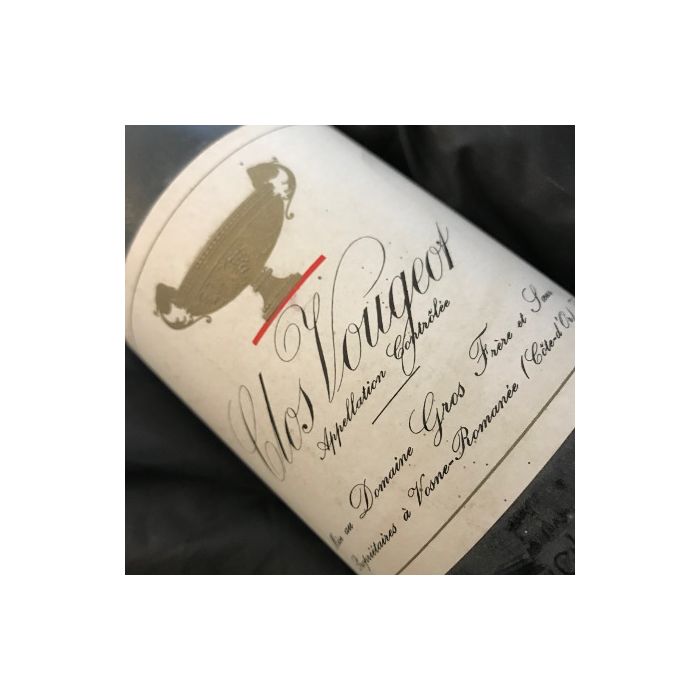
Domain Gros Frere et Sœur Clos Vougeot 2016 Bottle (75cl)
The 2016 Domaine Gros Frère et Sœur Clos Vougeot is a red Burgundy Grand Cru wine originating from the Clos de Vougeot parcel. Produced exclusively from Pinot Noir, it comes from a vine acquired by Jules Gros in 1920, located in the upper part of the clos, against its wall and to the northwest of the château. Replanted between 1986 and 1989, this parcel sits at an altitude of 260 meters and benefits from eastern and southeastern exposures.
La bouteille proposée
- Size
- Bottle (75cl)
- Packaging
- Loose
- Label Condition
- Perfect
- Fill Level
- Perfect
- Capsule Condition
- Perfect
Identité du vin
- Couleur
- Red
- Pays
- France
- Région
- Bourgogne
- Appellation
- Vosne Romanée
- Producteur / Domaine
- Domaine Gros Frère et Soeur
- Parcelle / Cru
- Clos de Vougeot
- Millésime
- 2016
Cépage et assemblage
- Grape Variety
- 100% Pinot Noir
Domaine Gros Frère et Soeur
Domaine Gros Frère et Sœur is a family-run estate in Vosne-Romanée, in the Côte de Nuits. Formed in 1963 through the merger of the estates inherited by Gustave and Colette Gros, it cultivates 23 hectares of vineyards, comprising plots in regional, commune-level, Premier Cru and Grand Cru appellations. The seventh generation, Élodie and Vincent Gros, now run the estate.
- Owner
- Famille Gros, via la SAS Gros Frère et Sœur
- Maître de chais
- Vincent Gros
- Surface (ha)
- 23.00 ha
- Production (average bottles per vintage)
- environ 120 000 bouteilles/an
Histoire du domaine
The history of the Gros family in Vosne-Romanée dates back to 1830, when Alphonse Gros, together with his wife Julie, founded the family estate there. His son Louis-Gustave was one of the winegrowers in the Côte de Nuits who pioneered bottling and direct sales to private customers. Over the generations, the family expanded their vineyard. In 1963, following the death of Louis Gros, two of his four children, Gustave and Colette, pooled their shares and established Domaine Gros Frère et Sœur in the family home on Rue des Grands Crus in Vosne-Romanée. As they had no children of their own, they took in their nephew Bernard Gros in 1980 to pass on the trade to him. Following Gustave’s death in 1984, Bernard Gros went into partnership with Colette. Over the course of more than thirty years, he restructured and replanted part of the vineyard. His children, Élodie and Vincent, subsequently joined the business. Bernard Gros handed over the running of the estate to them in 2010, whilst the company remains managed by members of the Gros family. Vincent Gros is recognised as being directly involved in winemaking decisions.
Clos de Vougeot
The Clos de Vougeot is a vast, single-piece vineyard enclosure, surrounded by walls and located at the foot of the Côte de Nuits slope, in the commune of Vougeot. Its terroir varies markedly from top to bottom: thin, gravelly soils on Bajocian limestone in the upper part, more clayey brown soils on limestone debris in the middle, and deeper, clayey and silty soils on a marly layer in the lower part. The site simultaneously constitutes a physically demarcated Burgundian climat and the emblematic parcel area of the AOC Grand Cru Clos de Vougeot or Clos Vougeot.
- Vineyard commune
- Vougeot
- Origin of the vineyard name
- "Clos" designates the vineyard historically enclosed by walls; "Vougeot" takes up the name of the place, linked to the Vouge which marks a historical boundary of the estate.
- Altitude
- 240–265 m
- Slope
- gentle, average of about 3.8%
- Soil
- At the top, shallow, granular soils rich in gravel; in the middle, shallow, more clayey brown soils on limestone debris; at the bottom, deeper brown soils rich in clay and fine silt.
- Subsoil and geology
- Jurassic complex; Bajocian limestone slab in the upper part, limestone debris in the middle, and marly layer in the lower part, with the influence of superficial formations linked to the outlet of the combe d'Orveau.
Histoire de la parcelle
The wine estate was gradually established by the Cistercian abbey of Cîteaux starting from the early 12th century; a medieval agreement set boundaries that have remained almost unchanged, and the wall was built before the end of that century. The farm buildings were developed from the 12th to the 15th century, then complemented in 1551 by the Renaissance residence that became the château du Clos de Vougeot. The abbey kept the estate until the Revolution; the buildings and vineyards were confiscated and then sold as national property in 1791, subsequently leading to the fragmentation of the property. The appellation d'origine contrôlée Clos de Vougeot or Clos Vougeot was recognized by decree on July 31, 1937.


